
Repository
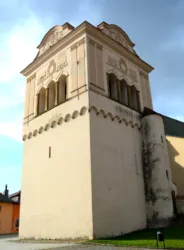
Spišská Sombat Bell Tower
Building, structure
The houses and most important public buildings of the richest citizens of the rich Saxon (zipszer) town of Spišské Székesfehérvár are located on the main square, which still retains its unified medieval-early modern appearance. One of these is the bell tower belonging to the 13th...
Read More


Birthplace and statue of József Petzvál
Building, structure
József Miksa Petzvál was an engineer, mathematician, and university professor. He achieved significant research results in the field of theoretical and practical photonics, and his inventions gave a huge boost to photography in the middle of the 19th century. In addition, he enri...
Read More

The main building of Lipótvár railway station, designed by Ferenc Pfaff
Building, structure
The 19th century, especially the second half, was a triumph of railway construction throughout Europe. At that time, the partly state-owned and partly private railway network, which was the lifeblood of the dualist Monarchy, was also built. The railway stations and other railway ...
Read More

Grave of World War I hero Viktor Gretzmacher
Cemeteries, tombstones, grave sites
Gretzmacher Viktor, the son of a merchant from Szepesbéla, Árpád Gretzmacher, was the first president of the football section of the Szepesbéla Sports Association, founded in 1911. ; In World War I, he fought as a reserve lieutenant of the Imperial and Royal 66th Infantry Regimen...
Read More
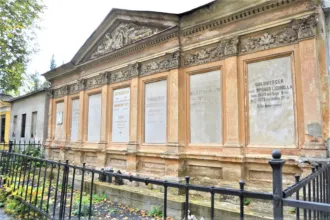
Bethlenfalvy Ernő's resting place
Cemeteries, tombstones, grave sites
Ernő Bethlenfalvy (* Késmárk, February 12, 1880 – † Hunfalva, June 18, 1955); Economist, nature diver, specialist writer Although he was born in Késmárk, he spent a significant part of his life in Hunfalva, where he had estates (they were “nationalized” in 1945 due to his Hungari...
Read More
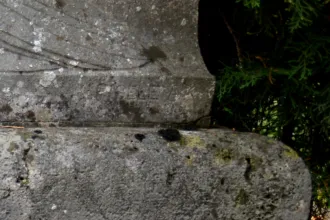
Grave of Frigyes Scholcz, lyceum principal and teacher
Cemeteries, tombstones, grave sites
Frigyes Scholcz, abbot of the Roman Catholic Church, lyceum teacher, son of János Scholcz and Katalin Schmidt, born on July 16, 1831 in Ruszkinócz (Szepesm), he completed the gymnasium in Késmárk and the philosophy and theology course in Prešov. After passing the exam for a minis...
Read More
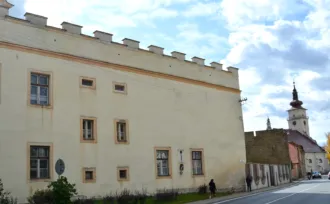
Gyula Krúdy's memorial plaque in Podolini
Statue, monument, memorial plaque
Between 1888 and 1891, Gyula Krúdy (Nyíregyháza, 21 October 1878 – Budapest, 12 May 1933), a writer and one of the greatest figures of 20th-century Hungarian fiction and literature, was a junior student at the Piarist grammar school in Podolin. He lived at 92 Fő tér in Podolin. F...
Read More
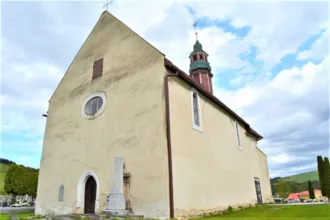
St. Anne's Cemetery Chapel in Podolini
Building, structure
The chapel was built in the 13th century in Romanesque style, making it the oldest surviving building in the city today. Later, in the 16th century, it was rebuilt in Renaissance style. Its furnishings and altars date from the Baroque era and the 18th century. On its main altar, ...
Read More
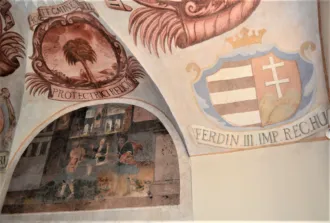
Piarist Church and Monastery, Podolin
Building, structure
The Hungarian Piarist province considered Podolin, located in the Poprad Valley, its cradle, although in 1642, when the first Piarist appeared there, the town, together with the towns of Spiš that had been mortgaged during the reign of Sigismund, belonged to Poland. The founder, ...
Read More
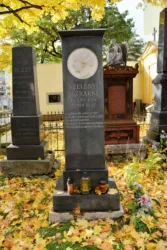
The grave of Éva Blasy, Oszkárné Szelényi
Cemeteries, tombstones, grave sites
Éva Erzsébet Blasy Szelényi Oszkárné was born in Késmárk on March 9, 1882. She learned the basics of painting from Nándor Katona, who was a student of László Mednyánszky. She continued her studies in Budapest and at the Berlin Academy of Arts, where she mainly devoted her time to...
Read More