
Repository

St. Wendel Church, Keszegfalva
Building, structure
The history of the village from an ecclesiastical point of view dates back to 1763. The oldest Latin record, written by the then pastor György Laczkovics, dates back to this year. The records also show that the first church in Keszegfalva was built in 1756, and the first pastor l...
Read More


World War I Memorial, Keszegfalva
Statue, monument, memorial plaque
The sculpture of the Keszegfalva World War I memorial is the work of Gyula Berecz. Gyula Berecz from Komárom created several heroic monuments for the settlements around Komárom in the period between the two world wars. His works are in Udvard, Keszegfalva, Megyercs, Nemesócsa, an...
Read More
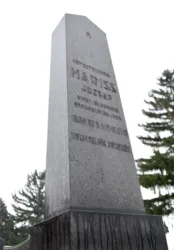
The grave of parish priest József Hariss
Cemeteries, tombstones, graves
József Hariss (1868–1943) parish priest of Kemence, Gúta, Szőgyén, Bese, deputy parish priest of the Verebély Parish District. ; The chapel of Pozba Szentkút was built during József Hariss's work in Barsbes. According to the memorial plaque there: "... It was built in honor of th...
Read More
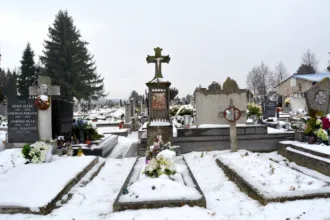
The grave of priest Miklós Pallay
Cemeteries, tombstones, graves
Pallay Miklós Hybben was born in Liptó County on November 26, 1868. He earned a degree in theology. He was ordained a priest by István Pribék, auxiliary bishop of Veszprém, on September 10, 1894. He continued his studies at the Augustineum in Vienna on April 22, 1893, and then at...
Read More
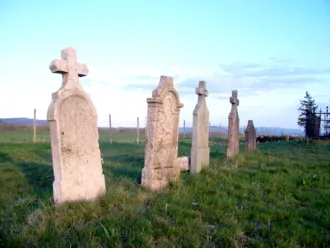
St. Maurice Roman Catholic Church in Kistata
Building, structure
The first written mention of Tata (in the form of Tadej) dates back to 1228. Today it is mentioned as Kistata puszta, located on the border of Kőhidgyarmat, southwest of the village. ; The data from 1230 regarding the settlement and its already existing church are noteworthy, acc...
Read More

Cemetery Crucifix (Everyone's Cross)
Sacral small monument
The entire small monument is made of pink Süttő marble, which is currently placed next to the St. Rosalia Chapel, on the left side. It was moved to its current location when the cemetery was transformed into a park. ; Its base consists of two parts, in the middle of the upper, co...
Read More

Assumption Parish Church, Gúta
Building, structure
The Church of the Assumption of the Virgin Mary (or Our Lady of the Assumption) is located in the central square of the town. It is surrounded by a spacious, well-kept park. The church was built in the Baroque style in 1724-25, on the site of an older Gothic church destroyed by f...
Read More
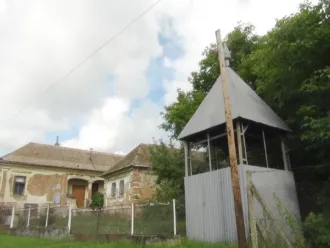
Bell tower in Dúlháza (Balogvölgy)
Sacral small monument
The village along the Balog river is named after Dúl of the Goroni family, who was mentioned in 1378. It was owned by the Kisfaludy family. It was a co-church of Zsíp. It does not have a church. The bell tower is square, with slate cladding attached to an iron structure, with a s...
Read More

Millennium Memorial Column, Gúta
Statue, monument, memorial plaque
The Millennium Memorial Column is the work of Norbert Gerendás, a woodcarver from Szentpéter, and György Reicher, a blacksmith. The Holy Crown can be seen on the top of the monument, which was inaugurated in 2000. The celebrations on August 20 are held at the memorial column.
Read More

Memorial plaques for displaced and deported Ghouta citizens
Statue, monument, memorial plaque
The memorial plaques of the displaced and deported citizens of Ghouta (1994, 2007) are located under the main entrance of the former cemetery. They commemorate the families of Ghouta who were forcibly forced to leave their homes during the years of displacement and deportation (1...
Read More