
Repository

Tomb of the Chief Surgeon of the Hungarian Army, József Szaiff
Cemeteries, tombstones, graves
Dr. József Szaiff was a Budapest physician who fought in the defense of Lipótvár during the Hungarian Revolution and War of Independence of 1848/49. After its surrender, he was captured by the imperialists and imprisoned (Königgrätz), from where he was released after the suppress...
Read More


Grave of the military commander Zsigmond Szeghy
Cemeteries, tombstones, graves
Zsigmond Szeghy, a Hungarian soldier from Nagymegyer, was born in 1826 and participated in the Hungarian Revolution and War of Independence of 1848/49. He lived to be fifty years old and died in 1876. His tombstone was neglected for many decades. In 1995, the Nagymegyer Organizat...
Read More

Tomb of the national guard József Nagy Rátz
Cemeteries, tombstones, graves
He was born in Nagymegyer in 1808. From 1836 he gradually held various positions in the city. At first he was a member of the noble council, then later a lieutenant of the nobility. During the revolutionary period of 1848/49 he became the city clerk, the commander of the 180-memb...
Read More

The Reformed Cemetery of Nagymegyer
Cemeteries, tombstones, graves
In the cemetery street, opposite the Catholic cemetery, there is the Reformed cemetery, the exact formation of which is unknown. In 2013, there were 810 graves in the cemetery. The cemetery was built on an artificial hill, thus protecting the graves from the frequent floods and i...
Read More

The Catholic Cemetery of Nagymegyer
Cemeteries, tombstones, graves
The cemetery at the end of Szent István Street is the largest cemetery in the city. In 2013, there were 1,848 graves in it, so the city government is looking into the possibility of opening a new cemetery. We do not know the exact date of its establishment. However, we do know th...
Read More

The Nagymegyer Prisoner of War Cemetery
Cemeteries, tombstones, graves
The cemetery was established in the autumn of 1914 by the corps guarding the Nagymegyer POW camp and the Hungarian authorities of the time, after the city did not allow the burial of a large number of prisoners of war who had died of infectious diseases prevalent in the camp. The...
Read More

The Jewish Cemetery of Nagymegyer
Cemeteries, tombstones, graves
The most significant monument of the former Jewish community in Nagymegyer today is the Nagymegyer Jewish Cemetery. The cemetery is located north of the city, next to the Nagymegyer Evangelical and former prisoner of war cemeteries, the so-called “Serbian cemetery”. A dirt road l...
Read More
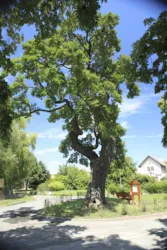
The Matthias tree in Nagymegyer
Other - other
At the end of Vadász Street in Nagymegyer stands an old oak tree. According to a historical legend still alive in the city, King Matthias tied his horse to this tree and had his tent pitched when he visited Nagymegyer to investigate the complaint of the Nagymegyer people. The Nag...
Read More

The Reformed Church of Dunaszerdahely
Building, structure
The church is one of the youngest public buildings in Dunaszerdahely, built in 1998, in a postmodern style, with the help of sister churches. ; In the early 1990s, the goal was to build not only a church, but also a building complex, which included the pastor's residence and room...
Read More
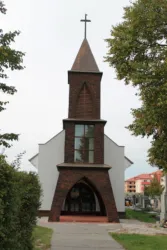
The All Saints Church in Sikabony
Building, structure
In the Sikabony district of Dunaszerdahely, in its cemetery, a church was built on the site of the former cemetery chapel, consecrated on November 25, 2012, in honor of All Saints Day. ; The plan to renovate and enlarge the then chapel was already born in 2009, but during the lat...
Read More