
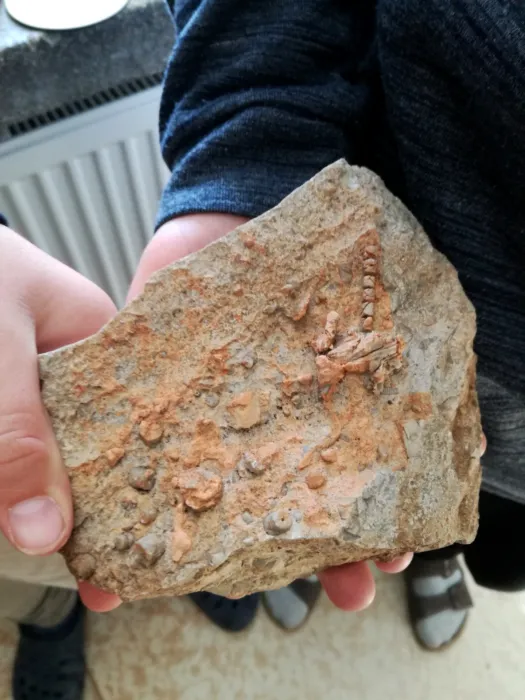
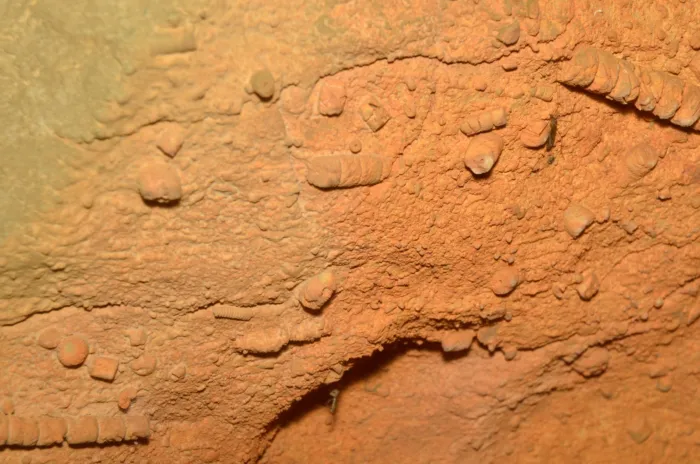
Sea lily, fossils in Kecső spring number 3
Other - other
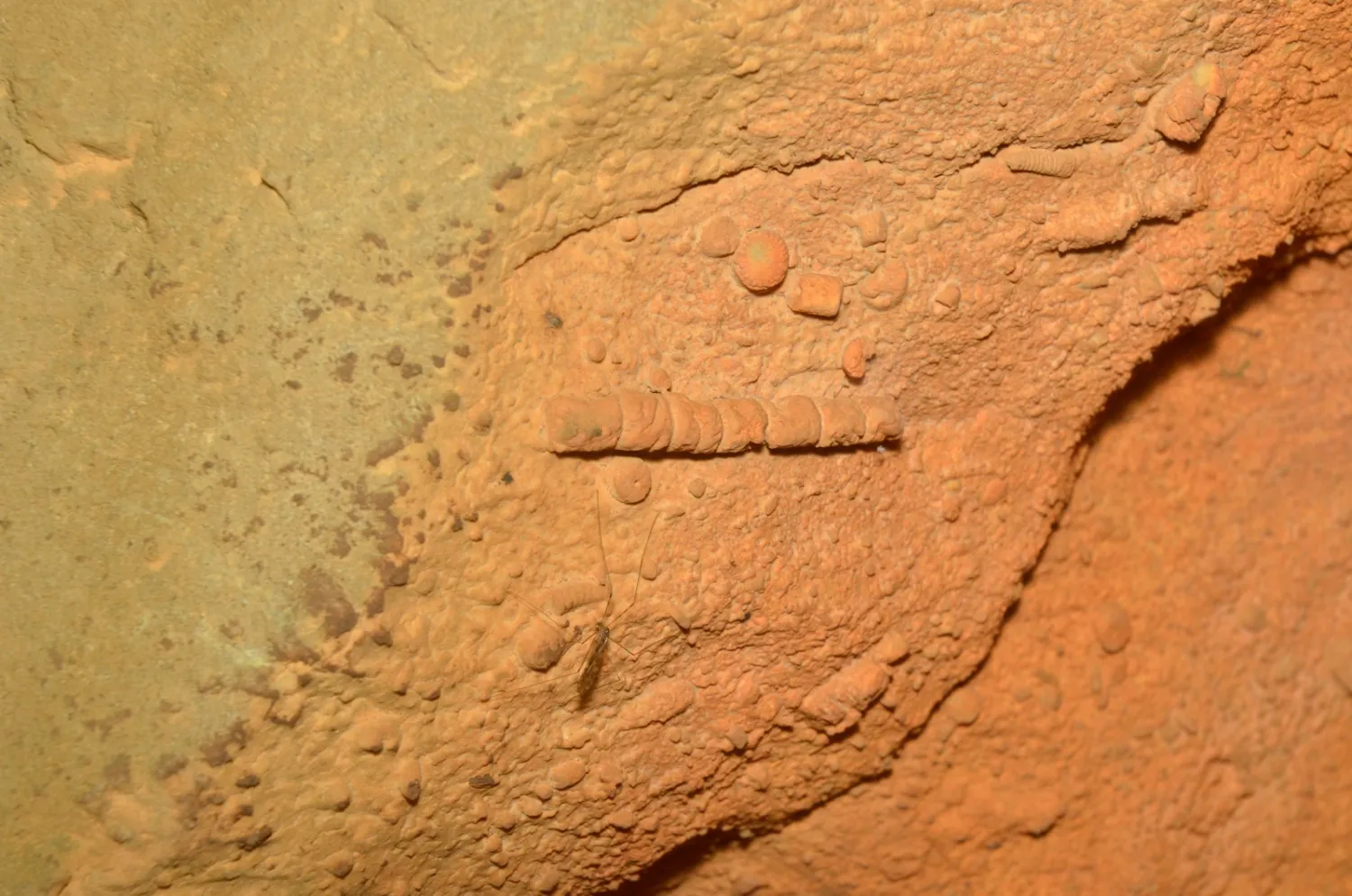
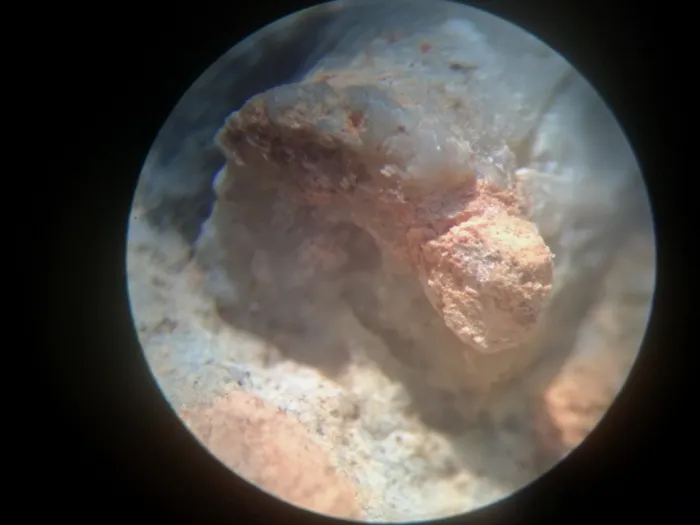
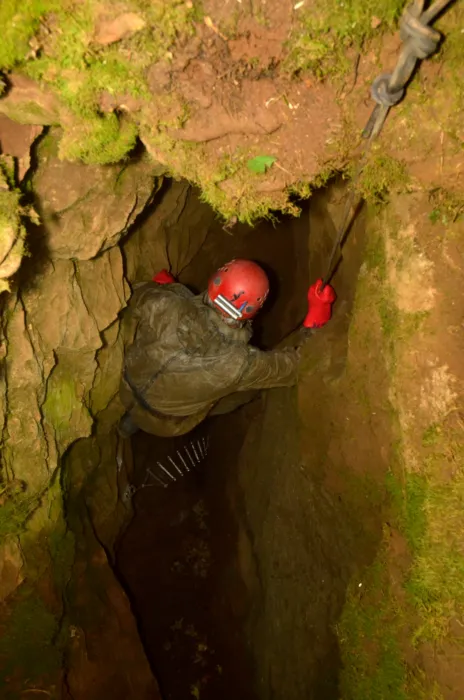
Two students of the Dénes György Elementary School in Pelsőc, Krisztián Garaj and János Kálmán, began an interesting study. Led by Csaba Igaz, a chemistry-biology teacher, in the fall of 2018. They examined the remains of sea lily fossils in the Kecső spring number three. ; Kecső is located in southeastern Slovakia, in the Slovak Karst National Park, and the Kecső spring number three in question is located east of the village, just a few meters from the Slovak-Hungarian border. ; Kecső is known for the Domicai dripstone cave, which forms a unit with the Baradla cave in Hungary. Domicai was discovered by Ján Majko, whose name is also closely linked to the spring number three we are researching. ; The Kecső spring number three is a 9-meter-deep intermittent karst spring 1 km east of the village of Kecső. ; The spring was first mentioned by Ján Majko in the journal Krásy Slovenska in 1959. The spring was originally a 30-80 cm wide, 2 m deep fissure, the excavation of which began in 1947. The horizontal parts were reached that year, but the excavation work was stopped due to lack of space. It is interesting to note that 4 obsidian, 1 worked flint and a Neolithic millstone were found here, but no fossils are mentioned. ; The spring is now a 2.5-3 m long, 1.5 m wide fissure. Traces left by drilling and explosives can be observed on its northern wall, and fossils can be observed on its southern wall at the eastern corner. There is a pile of stones between the spring and the Kecsői stream, which was probably excavated by Ján Majko's team. Fossils can also be found here. ; The fossils were first noticed by Michaela Stražanová in July 2018. She is a member of the Ján Majko Speleological Society. ; Since then, we have known that the fossils are the remains of sea lilies. These are invertebrate marine animals with a calcareous skeleton, a class of echinoderms. Their mouths face upwards, and their bodies are held in place by a stalk. The stalk consists of calcareous plates or segments lying one above the other, which can be round or pentagonal in shape. ; There are 430 known species of sea lilies today, but the number of extinct species is much higher, about 1,500 species. ; Circular segments are noticeable in the wall of the spring, but chains of segments can also be observed. We used a measuring tape and a cent coin to illustrate the dimensions. The largest fossils we found were 5-5.5 cm. ; ; The boys describe the process of the observations and their results: ; As a first step, we had to master the single-rope technique, which allowed us to descend into the cave. ; In the next step, we cleaned the northern side of the spring so that we could descend to the fossils there. At first, we used the southern side, but since the remains are also located here, they could have been damaged. Therefore, we did not use the southern side for further descent. ; As a third step, we determined the average density of the fossils. We counted the fossils in 10 x 10 cm squares systematically, but maintaining randomness. The calculations were performed along an imaginary grid. ; We counted at 8 points. Only clearly identifiable fossils were included. Their size ranged from 1 mm to a few cm. The chains of sections count as 1 fossil. ; The average density was calculated by dividing the sum of the 8 data by 8. The average density of fossil occurrence is 26.75 fossils per 100 cm2, which translates to 2675 fossils per 1 m2. ; During our research, we learned more about fossils. ; We noticed that the fossils were broken and crystalline in several places. Dr. Lubomír Sliva explained this to us. The limestone skeleton of sea lilies is originally made of aragonite, which, after the animals died, recrystallized over time and under the right conditions, i.e. transformed into calcite. Calcite is characterized by cleavage surfaces, while aragonite is not. ; We found a stone between the spring and the Kecsői stream that had fossils on it. We were able to examine these with a microscope, and we also sent the stone to the Comenius University in Bratislava for further study. ; University colleague Dr. Alexander Lačný determined from the fossils that the species name is Encrinus lilliformis. We were also able to observe the central channels in which the animal itself lived under a microscope. ; Dr. Lajos Gaál drew our attention to the fact that the fossils may be 236 million years old, because the spring originated in the so-called Steinalm type limestone, which was deposited in the upper part of the lower (so-called Anisian) layer of the Middle Triassic. Similar finds are known in some places from Aggtelek and the nearby Szilice area. ; In summary, we can say that the fossils come from sea lilies, the species Encrinus lilliformis. The remains of the stem have survived, which consist of circular sections with a central channel. The original aragonite skeleton has recrystallized and turned into calcite. The largest fossils are 5 cm long chains of sections and the average density of the fossils is 2675 fossils/m2, and their age is 236 million years (Triassic period of geological history). ; The significance of the finds lies in the fact that after the Permian extinction, the higher organisms that formed the sea reefs disappeared for a long time. The Aggtelek lilies, similar to the Kecső lilies, are among the first such organisms to reappear. The Kecső findings can therefore expand our knowledge about the appearance of higher organisms after the Permian extinction.