
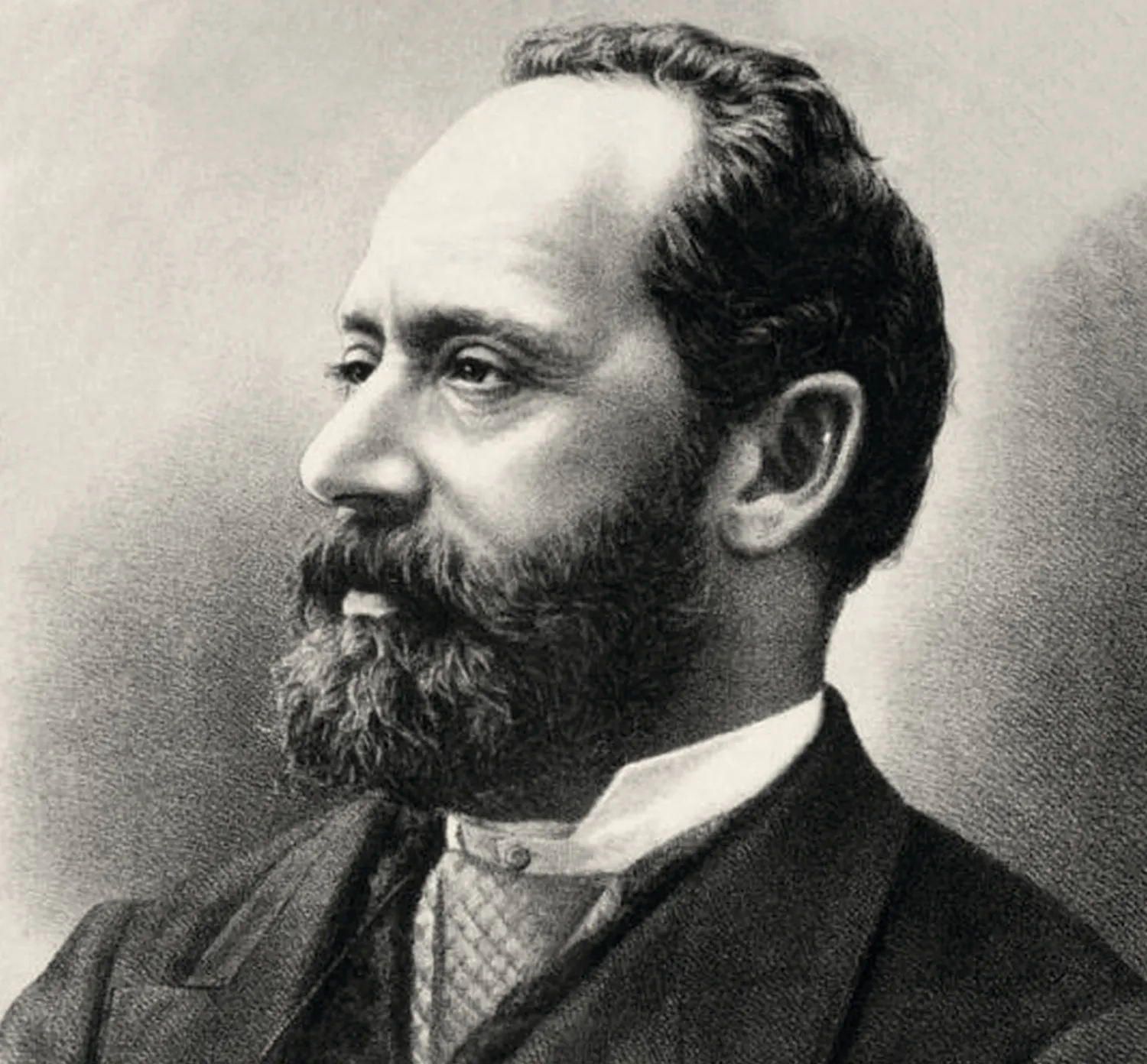
Armin Vambery
Other - other
* Szentgyörgy, March 19, 1832 – † Budapest, September 15, 1913 / orientalist, linguist, university professor, member of the Hungarian Academy of Sciences ; ; Originally, his name was Herman Wamberger. Although he was born in Szentgyörgy near Bratislava, he considered Dunaszerdahely to be his birthplace, where he lived with his mother and stepfather from the age of 3. He studied at the local elementary school until the age of 12, then worked as a tailor and tutor for a short time. From 1845, he studied at the Piarist gymnasium in Szentgyörgy, then in Sopron, at the Lutheran lyceum and in Bratislava, but did not reach the final exam. His extraordinary language skills were evident at a very young age and over the years he mastered about a dozen languages. Initially, he tried to make a living as a tutor, then, with the help of his interest in Turkish literature and culture and several patrons, including Baron József Eötvös, he went to Istanbul, where he perfected his language skills and got to know the Eastern world better. He regularly reported on his first stay in Turkey for several Hungarian newspapers and compiled the first Turkish-German and German-Turkish dictionary, which was published in Constantinople in 1858. In 1860, he was elected a corresponding member of the Hungarian Academy of Sciences, and he himself returned to Pest in 1861 to gain support for his great plan: to search for the Hungarian homeland. ; In the next three years, he reached Tehran, from there he traveled with a group of pilgrims returning from Mecca through the desert areas of Central Asia and visited many places (Khorasan, Bokhara, Samarkand, etc.), and then returned safely home in 1864 from his journey fraught with many dangers. His achievement deserves recognition not only because he managed to convince his companions that he was a devout Muslim, but also because he had limped since childhood and walking was quite tiring for him. He compiled his experiences and scientific observations in several volumes. He intended some of them for the general public, and these were a great success among readers. His scientific works were received with certain reservations and his ideas about the Turkish-Turkish relationship of the Hungarian language were criticized in particular. This resulted in the professional debate known as the Ugric-Turkic War, which ended with the victory of the “Finno-Ugricists”. The disappointed Vámbéry enjoyed much greater recognition abroad, he moved in the highest circles in London, and was even warmly received at the royal court. The scientist did not hide his sympathy for the English and seized every opportunity to draw attention to the danger of Russian expansion in Central Asia. From the 1870s onwards, he taught oriental sciences as a university professor at the University of Budapest. He was one of the founders and president of the Hungarian Geographical Society in 1889–1890. The Hungarian Academy of Sciences elected him a corresponding member in 1860, a full member in 1876, and an honorary member in 1893. After the change of regime in 1990, the Vámbéry Civic Association was founded in Dunaszerdahely, which tries to cherish the scientist's memory with various events. The Vámbéry oeuvre series is published by Lilium Aurum Publishing House, and the International Vámbéry Conference is held annually, which is a scientific forum for specialists in Oriental studies and Turkology, the programs of which are compiled by the Vámbéry Scientific College. The bust of Ármin Vámbéry was placed in the square named after Vámbéry in Dunaszerdahely. ; ; His main works: ; In a dervish robe across Central Asia, 1864, ; My wanderings and experiences in Persia, 1867, ; On the Eastern Turkic languages, 1869, ; The synonyms of words in the Hungarian and Turko-Tatar languages, 1869, ; Indian fairy tales, 1870, ; Russia's position of power in Asia, 1871, ; The history of Bokhara, 1872, ; Islam in the 19th century. century, 1875, ; Oriental life pictures, 1876, ; The nationality of the Huns and Avars, 1881, ; The origin of the Hungarians, 1882, ; The origin and growth of the Hungarians, 1895, ; Studies in the Old Turkic language, 1901, ; My struggles, 1905, ; Western culture in the East, 1906, ; At the cradle of the Hungarians, 1914.