
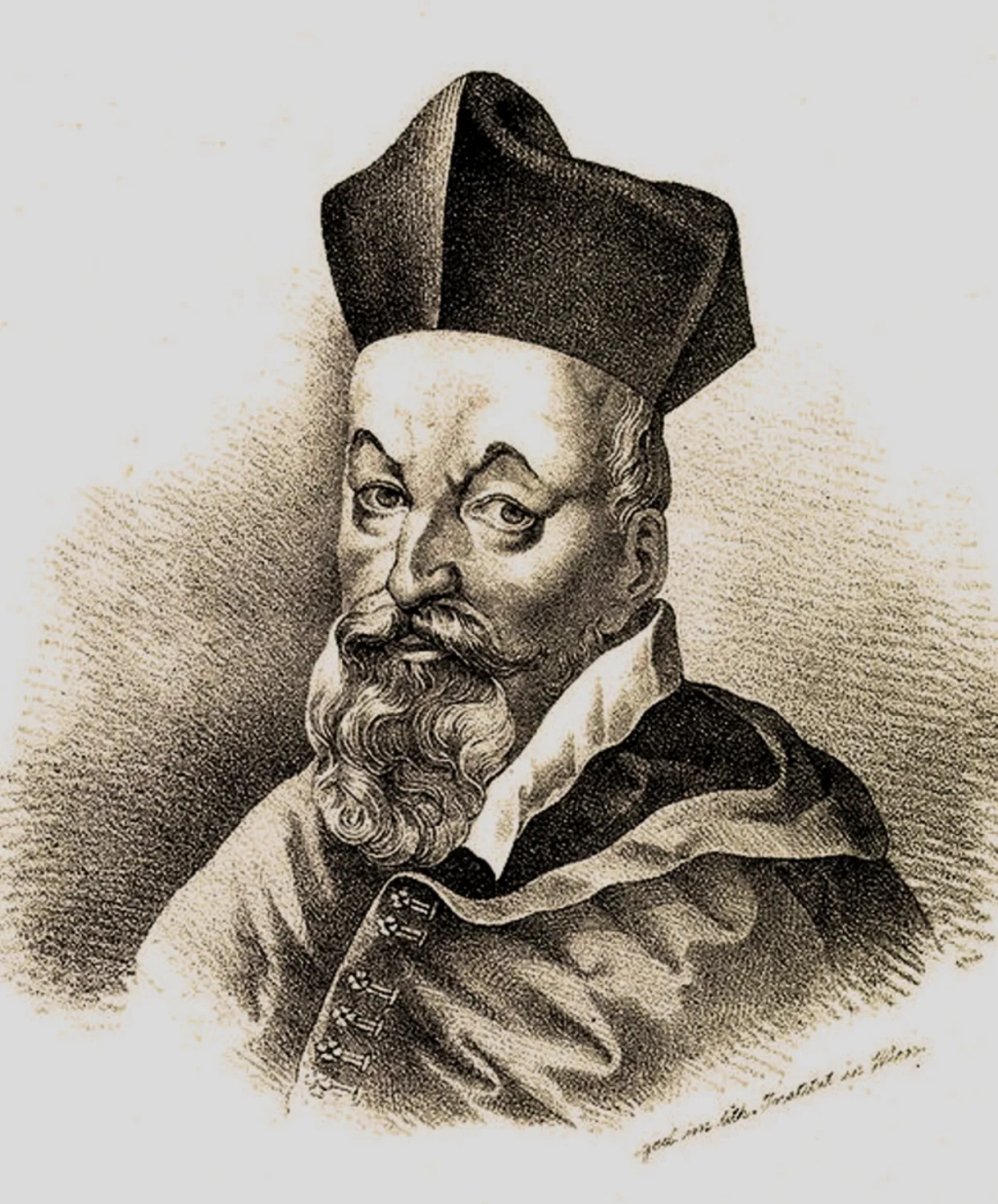
Cardinal Péter Pázmány, Archbishop of Esztergom
Other - other
* 1570. October 4. Nagyvárad - † 1637. March 19. Bratislava / cardinal, archbishop of Esztergom, translator, philosopher, university professor ; ; Son of a Reformed noble family. His father was Miklós Pázmány, a vice-governor of Bihar, and his mother was Margit Massai. ; He began his schooling in Nagyvárad in 1580. In 1582, his father, who had been widowed, married the Catholic Borbála Toldy. Under the influence of his stepmother and István Szántó, the first Hungarian Jesuit, he converted to Catholicism in 1583, and was a student of the Jesuit high school in Kolozsvár in 1583-87. In 1587-88, he completed the first year of philosophy and entered the Jesuit order. In 1588-90, he was a novice in Krakow, and for half a year in Jarosław. ; Between the autumn of 1590 and the spring of 1593, he studied philosophy in Vienna. Due to his excellent abilities, his superiors sent him to Rome. In 1593-97, he was a theological student at the Collegio Romano, serving his third probationary year in the last year. In 1597, after about ten years of regular study, he received the degree of Doctor of Theology and was ordained a priest. ; In 1597-1600, he taught philosophy in Graz, compiling five dissertation theses in Latin. In 1598, he was appointed head of the university's humanities department. He taught the system of Saint Thomas Aquinas based on Aristotle (dialectic, physics, metaphysics). ; On October 15, 1600, he was sent to Vágselly, and in February 1601 to Košice as a Hungarian confessor. ; In the summer of 1602, he opened a series of religious debates with his Reply to István Magyari's book On the Causes of Many Depravities in the Countries (Nagyszombat, 1603). ; Between 1603 and 1607, he taught again in Graz, this time in theology. At that time, he wrote his Book of Prayer (Graz, 1606). His popularity is shown by the fact that three further editions were published during the author's lifetime (1610, 1625, 1631). ; On November 4, 1606, he became a doctor of theology. ; In November 1607, he returned to Hungary for good, and became the leader of the emerging Catholic renewal alongside Archbishop Ferenc Forgách of Esztergom. In 1608, he protested at the Diet of Bratislava against the resolution declaring the exile of the Jesuits. He converted several noble families to Catholicism. ; In 1609, he attacked Péter Alvinci in an ironic-sounding polemic (Five Beautiful Letters, ibid., 1609). In response to Alvinci's quick response, he replied in the same year (A Sieving of Alvinczi's Answer, Bratislava, 1609). ; His other polemic (The One God of the Great Calvinus, Nagyszombat, 1609) so outraged the Protestant orders that they demanded his prosecution. ; Drawing on the lessons of his polemics, Pázmány finally compiled his main work, a vast synthesis of Catholic defense, the Guide to Divine Truth (Bratislava, 1613). His subsequent polemical writings defend the principles of the Guide (Az kálvinista prédikátorok [...] tekélletességénég tükőre, Vienna, 1614, Csepregi mesterség, ibid., 1614, Miklós Szyl under the pseudonym, Csepregi szégyenvallás Prague, 1616). ; Between December 15, 1614 and January 24, 1615, Pázmány cleared himself in Rome of the accusations of his alleged free lifestyle and Protestant connections. The general of the order, Aquaviva, dissuaded him from joining the Carthusian order. ; After the death of Archbishop Forgách (October 16, 1615), both the Viennese court and the Hungarian Catholic Church saw him as the only possible successor. The Pope released him from his Jesuit vows and appointed him provost of Turóc, and in 1616, archbishop of Esztergom. This also made him the country's chief chancellor, and he gained a significant role in the royal council. He argued for the election of Ferdinand II as Hungarian king, and he crowned him on July 1, 1618. ; During Bethlen's campaigns, he mostly stayed in Vienna, and was a participant in the peace negotiations. ; In 1623, he founded a Hungarian seminary for the training of priests (Pázmáneum) in Vienna. He translated Thomas a Kempis's work Imitatio Christi (Four Books of Thomas a Kempis on the Imitation of Christ, Vienna, 1624). In the introduction to this work, he formulated one of the characteristic principles of translation of the time: "the inviting explanation of the meaning" and "the gracious flowing manner of speech" were equally important requirements, i.e., accuracy of content and a beautiful Hungarian style. ; Against the theological professor of Wittenberg, Fridericus Baldwinus, who responded to the Kalauz in Latin (1626), he wrote his treatise The Leader of the Lutherans Hiding After the Dark Dawn (Bratislava, 1627) in Hungarian, emphasizing that he consciously chose the Hungarian language instead of Latin: “And although I can speak Deacon, but since I wrote the Kalauz for the Hungarians, in Hungarian, I also want its protection in Hungarian, for the spiritual healing of my nation. I know that no one will object to this. For if others are allowed to respond to the Hungarian book in Deacon, they cannot forbid me from writing in Hungarian about the Deacon book.” ; On November 19, 1629, Pope Orbán VIII appointed him a cardinal. ; In the spring of 1632, he was the envoy of Ferdinand II in Rome. He could not fulfill his task, he failed to win the Pope to embrace the interests of the Habsburg dynasty. ; In 1635 he founded a university in Nagyszombat, for the time being only with a theological faculty, and entrusted its management to Jesuits. ; In 1636 he successfully mediated between György I. Rákóczi and István Bethlen in the struggle for the Transylvanian princely throne. He had previously stressed the need for a strong, independent Transylvania independent of the Habsburgs: "Protestant Transylvania is the guarantee of Hungarian freedom, and Catholic Hungary is the guarantee that the heart of Hungary remains Catholic." ; Published in Bratislava, his collection of about a hundred sermons, the result of forty years of his activity as a preacher. ; He preached for the last time on Christmas 1636. ; He died in Bratislava on March 19, 1637. According to his last will, he was buried in this city, in the crypt of St. Martin's Cathedral. ; ; His literary work was primarily guided by practical goals: "We do not need fancy words, but strong realities." He created important works in almost every genre of Catholic church literature. The guiding principle of Graz's philosophical lectures was Aristotle, and he supplemented his teaching with commentaries by Spanish Jesuits. He taught scholastic theology based on Thomas Aquinas, but not the entire dogma, but selected chapters of the Theologia scholastica. His works in Latin remained in manuscript, and were only published in the edition of all his works. His Dialectic is the only domestically edited Catholic logical summary of the century. Pázmány intended it as a textbook, and had the manuscript clarified for printing. His death prevented its publication. The work discusses its material in the spirit of the Aristotelianism of Catholic scholasticism. ; From 1599 he worked on his polemical treatise Diatriba theologica, which defends the views of Roberto Bellarmino against the Anglican theologian William Whitaker of Cambridge. Pázmány was in contact with Bellarmino in Rome, and he also participated in the debate that developed around him. The central theme of the debate, the criteria for the “true church”, also returns in his later Hungarian-language polemical writings. His polemical treatises are characterized by strong logic, conciseness, making complex phenomena understandable, making abstract concepts visual, and the use of various tones, from pathos to irony, from crudeness to lyricism. He exploited the contradictions between Protestant denominations and clashed their views. Kosztolányi aptly describes his style: “hot ink flows from his pen, and there is fire in his inkwell, a heavenly spark, but also the sulphurous flame of hell”. ; In his response, he puts forward church-historical and theological arguments, but when necessary, he uses the tools of logic, e.g. in response to the accusation of Catholics of idolatry, he shows the difference between the “worship” and veneration of images (Christian Reply on the Worship of the Glorious Saints, Graz, 1607). In The One Faith, he illustrates with quotations taken out of context from the great John Calvin that Calvin’s doctrines contradict fundamental Christian truths in every way. ; His most successful stylistic masterpiece is the Five Beautiful Letters, in which he does not expound abstract dogmas, but rather draws a vivid picture of a Protestant preacher pretending to be ignorant, thus becoming a twisty parody of style. ; His Guide attempts to answer all the controversial questions of denominational polemics: first he takes the generally accepted Christian dogmas in order, then discusses denominational differences. His refuting and argumentative details, his sensitive images, his repeatedly subordinate and subordinate, rhythmic circular sentences, metaphors, intensifications and accumulations are all characteristic features of early Baroque prose. Since no substantive response was received from the Protestant side to the Guide, only some of its details were attacked, Pázmány responded only in short writings. ; His religious writings, the Prayer Book and the Kempis translation served to boost the Catholic life of piety. Their style is more relaxed, softer, more lyrical, but the clarity of reason shines through the emotions in them too. ; From a literary point of view, his collection of sermons is the most significant. He wrote the speeches “for all Sundays and some holidays” not with the intention of delight, but of moral utility. In them, he does not expound on articles of faith, nor does he debate, but rather teaches morality. The central category of his ethics is intention: it qualifies actions regardless of their results. He attributes great importance to will and intelligence. He addresses all strata of society, and with a sober sense of reality he provides practical guidance and a system of moral norms that can be followed. “In these works of Pázmány, it is not the baroque element that is conspicuous, and in fact, in his sermons he confronts not one of the characteristics of the baroque style.” (Tibor Klaniczay) ; Both his speeches, as well as his church organizing and church political activities, helped the re-Catholicization, the Hungarian Catholic renewal. ; His works represent the final triumph of the Hungarian language; he was the first to express many abstract concepts in church prose in Hungarian. The tight structure of his language, his scholastically educated clarity, and his nuanced, multifaceted style created a tradition to be followed for centuries, thus his writing became a rich heritage for the whole of Hungarian literature. “He knew all the secrets of the Hungarian language. His prose is gentle and powerful, flexible and hard, his complex circular sentences are solid linguistic-logical structures: his building blocks are spoken language.” (Márton Tarnóc) ; ; His significance was most fully expressed by Kosztolányi: “He is the father and legislator of Hungarian prose… When I think of him, I do not feel the need for language renewal, I do not see the deficiency that those who wanted to force our language to new tasks with all their might discovered a century later, at the beginning of the 18th century. I do not want to diminish the merit of this movement. I know that without him many of us would still have to stutter today, our style would be incomplete and defective. But it is certain that before him our prose was more rooted and more substantial…”