
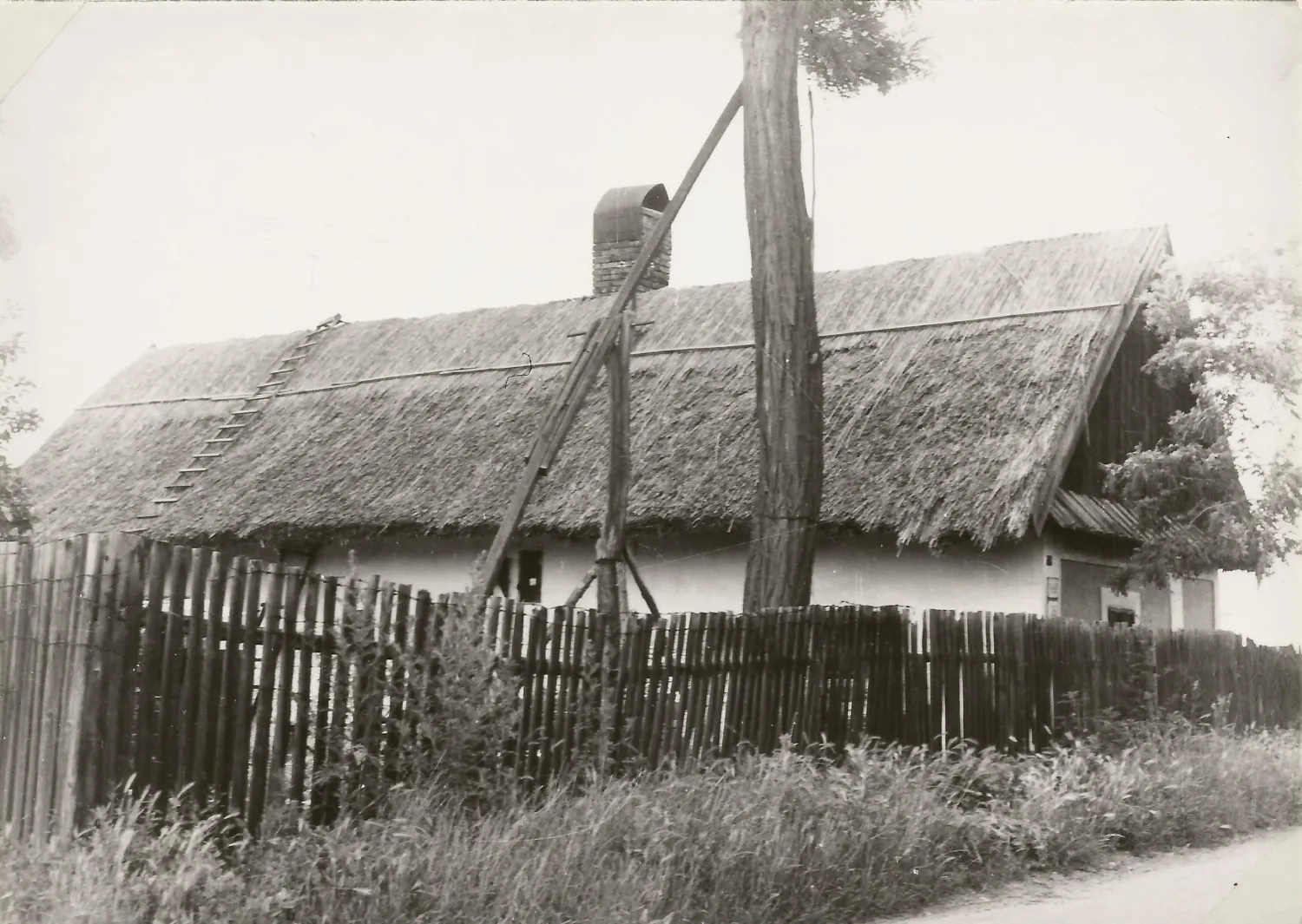
Farmhouse
Other - other
"As was customary at the time and in accordance with the construction possibilities, they were built on the ground itself, almost without a foundation. There were the so-called stacked walls, which were made by mixing clay mud and straw (crushed) and kneading them together barefoot on the ground (later, the more affluent ones kneaded them with horses or oxen). The wall builders then stacked this mass on top of each other in the designated places with an iron pitchfork. Since the material was quite plastic, they could only stack one or two rows a day, as the thicker layer collapsed - flowed apart. Naturally, the wall thickness was at least 60-70 cm. Over the openings (doors and windows), bridging was made of beams carved from acacia wood or just round wood peeled from its bark. When the walls were stacked to the required height, after drying, they were leveled with spades and shovels. carved – inside and out. Then came the wooden structure of the roof, which was mostly also carved from acacia wood. The rafters were mostly made of round wood, on which round wood slats were also placed at a distance of 80-100 cm. The reeds or jute straw were then laid on this structure. Particular care was taken with the saddle edge, because this is where the damage began the earliest. Over time, this described method changed in that the walls were filled with semi-moist earth, but now on a brick or concrete base. In fact, they were also built from adobe (raw brick). The bricks were laid by adobe-laying gypsies or members of poor families, who certainly also kneaded the hard, chaff-like mud with their feet, which they then laid out with water-soaked plank forms. A lot of earth and water were needed for adobe laying, so they were usually spread out in a suitable place and there the They were also laid out on site. This method could only be done in warm and dry weather. Depending on the weather, they dried for 2-3 or even more days, then they were stacked in stacks of 100 so that the stacks ended in a peaked arch to offset any rain. After drying, the customer took over the building on site and had it transported to the construction site. The binding material for the masonry was also mud. In both cases, the walls were smoothed with a clay mass, which was then whitewashed several times with milk of lime, thus forming a fairly hard plaster. The ceilings were made of carved beams and fairly thick boards stacked on top of each other. The beams of the first room, i.e. the clean room, or possibly the kitchen, were carved with various carvings according to the financial circumstances of the builder. The year of construction, the owner's name and some small note were always carved on the master beam. We should also mention the oven, which was heated from the open kitchen, where the huge open chimney was actually located. The oven itself was in the room so it also heated it. 2-3 diagonal hardwood slats were built into the chimney, on which the meat intended for smoking was placed after the pigs were killed. Sausages, hams, ribs, etc. The interesting thing about these chimneys was that clay plaster was placed on a lattice-like basket woven from willow twigs. Later they were built from adobe, and later from burnt bricks. Of course, bread, leavened cakes and even meat were baked in the oven. The fuel was mostly corn cobs, grape branches, and, if necessary, straw." (Chalupeczky J.)