
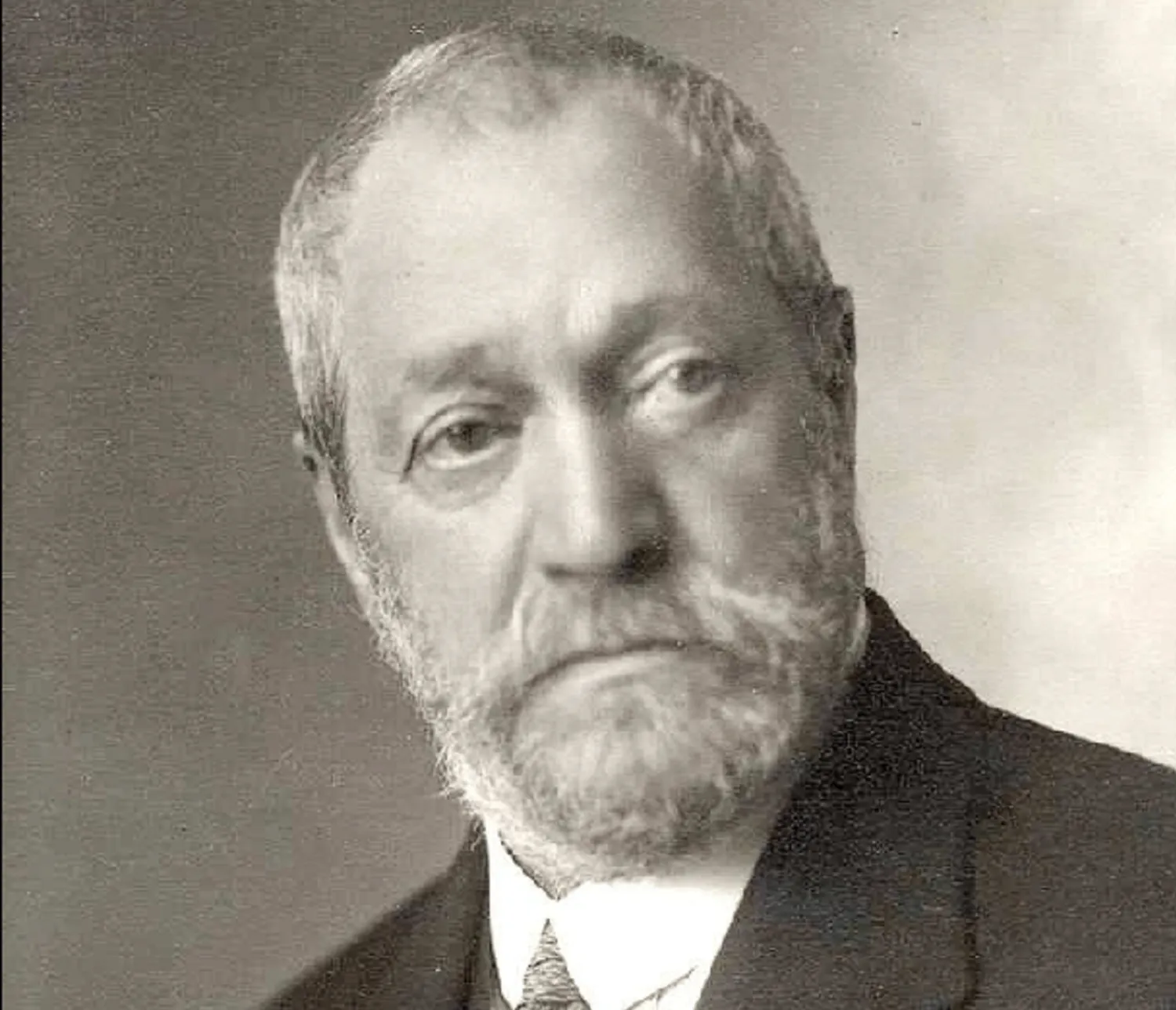
Rado Kövesligethy
Other - other
* Verona, September 1, 1862 – † Budapest, October 11, 1934 / astronomer, geophysicist, university professor, member of the Hungarian Academy of Sciences (1909) ; ; When he was four years old, his military officer father left his family and he was raised by relatives in Augsburg. Later he moved to Bratislava, where he completed high school between 1873 and 1881. During his high school years, he worked with Miklós Konkoly Thege in Ógyallan during the summer holidays and developed a new method for detecting the parallax of fixed stars. In 1881–1884, he was a student at the University of Vienna, where he graduated. He listened to lectures by Josef Stefan (1835–1893), Theodor von Oppolzer and Edmund Weiss, among others. From 1882, he was an assistant at the Vienna Observatory. From 1883 to 1887 he was an observer at the Ógyalla Observatory. Here he also constructed a spectrophotometer and was the first to use the measurement of the radial velocity of stars to determine the spatial motion of the Sun. Between 1883 and 1893 he was an assistant to Loránd Eötvös at the University of Pest, in 1889 he became a private professor of cosmography and geophysics at the university, from 1897 an extraordinary professor and from 1904 a public full professor. In 1904 he was elected a permanent member of the International Association of Seismologists. In 1906 he founded the Hungarian Earthquake Calculation Institute and the university Earthquake Observatory in Budapest, of which he was the director until his death. From the beginning he participated in the tests of the Eötvös pendulum, and in its first field application in the measurements carried out on Mount Ság in Vas County. During the Soviet Republic, he was the director of the Teacher Training Institute. For this reason, he was reprimanded by the University Council in 1921, and was only able to continue his work as a university professor in 1924–1925. He retired in 1933. He was one of the pioneers of theoretical research in both astrophysics and seismology, and raised Hungarian astronomical education to an international level. He was a regular member of several foreign societies. In 1924, the Geographical Society awarded him the Lóczy Memorial Medal. His scientific works and papers were published in domestic and foreign journals. The Hungarian Academy of Sciences elected him a corresponding member in 1895 and a regular member in 1909. ; ; His main works: ; Prinzipien einer theoretischen Astrophysik auf Grund mathematische Spektralanalyse, 1884, ; Handbook of Mathematical and Astronomical Geography, 1899: ; Seismonomia (Modena, in Latin), 1906, ; The Universe, 1906.