
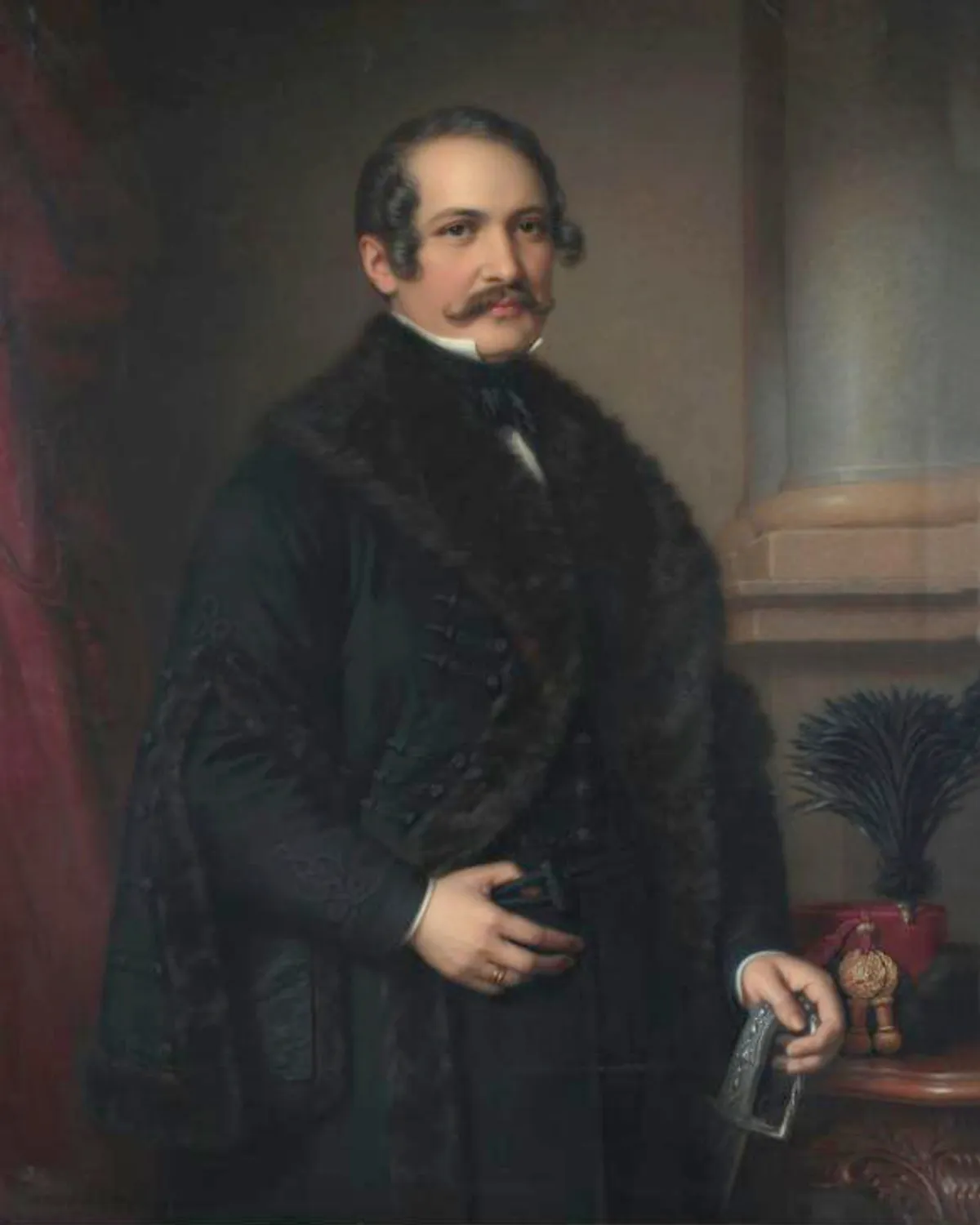
Baron of Királyfiai János Jeszenák
Other - other
* 22 January 1800, Bratislava - † 10 October 1849, Pest, Budapest / politician, government commissioner, chieftain, martyr of the 1848–49 revolution and war of independence, Lutheran church district inspector, great-grandfather of János Esterházy ; ; Baron János Jeszenák (IV.) was born in Bratislava. His family took their first name from the village of Királyfia near Somorja in Bratislava County, where they still had estates in the 1800s. His father János (III.), a Lutheran church inspector, donated his books and "field tapestry" collection to the National Museum in 1808. He had a sister named Lujza. (born 1803), who married Count Sámuel Teleki. ; János Jeszenák's wife was Count Alojzia Forgách. They had five children: János became a lieutenant of the imperial and royal hussars, Sándor died at the age of 21, and Béla died at just a few years old, so the family became extinct in the male branch. His daughters were Lujza (Gyuláné Draskóczi) and Gizella. Gizella married Count István Esterházy (1822–1899), who served as a captain of the Hungarian army during the War of Independence, then became a member of parliament and finally the chief of Bratislava County (1875–1889). Through this family branch, János Jeszenák's great-grandson is the Hungarian martyr politician János Esterházy. ; He finished his schooling in Bratislava, then went on a two-year trip abroad: to Italy, France and England. During his stay in London, on July 19, 1821, he attended the coronation of King George IV, accompanied by Prince Pál Antal Esterházy, ambassador and later Hungarian Minister of Foreign Affairs. ; He was not attracted to official work, so in 1822 he took over his father's estate in Szenitsa in Nyitra, where he farmed, where he lived in a familiar environment with his serfs. He participated in the Nyitra county assemblies, where he joined the opposition. His views were basically close to the ideas of István Széchenyi, and he even corresponded with the count. ; He was the chief inspector of the Lutheran parish in Nyitra, and from 1841 he was the inspector of the Lutheran and schools district on the Danube in place of Count Károly Zay. He held this position until his death. He participated in the important national assemblies of the Reformation era as an opposition member of the main board, where he supported, among other things, Széchenyi's idea of a bridge to be built between Buda and Pest, or the orders' proposal for a new building for the National Museum, and then he also embraced the cause of the Védegylet. In 1839/1840 he became closer acquainted with Count Lajos Batthyány, and his relationship with Széchenyi probably deteriorated from that point on. ; In 1848, as a reliable opponent of reform, he was appointed as the chief governor of Nitra County, then as a plenipotentiary government commissioner and as a government commissioner of the troops fighting against the insurgents in the Highlands, on the proposal of the Minister of the Interior Bertalan Szemere. As a government commissioner, it can be considered his merit that he managed to prevent the Slovak uprising of September 1848: on September 26 at Szenice, and then on September 28 between Ótura and Mijava, the mobilized national guards and two companies of the 34th (Prince of Prussia) Infantry Regiment inflicted a severe defeat on the insurgents. ; It was also thanks to Jeszenák's activities that Lipótvár remained in Hungarian hands: he took a tough stance against the hesitant Colonel Karl Bibra and the four Romanian border guard companies stationed here, which led to the raising of the Hungarian flag on October 16, 1848. The castle held out until February 1849. ; After that, he tried to deploy significant forces against the troops of Field Marshal Balthasar Simunichal who were invading from Moravia, but on December 16, the Hungarian armies suffered a decisive defeat in the Battle of Nagyszombat and the cs. kir. Lieutenant General began the siege of Lipótvár on December 20. Jeszenák first retreated to Érsekújvár, then in January 1849 moved his headquarters to the Komárom fortress. In July 1849, he joined the Felduna army led by Artúr Görgey and marched with it to Arad. Finally, during the surrender of August 13, he was captured by the Russians and handed over to the Austrians along with other Hungarian politicians. ; For his outstanding work, after the failure of the revolution and the war of independence, he was sentenced to death by the blood court, and was executed in Pest on October 10, 1849, together with the government commissioner László Csány. ; ; ; ; 