
Mural series of the legend of Saint Ladislaus in Kakaslomnik
Sacral small monument
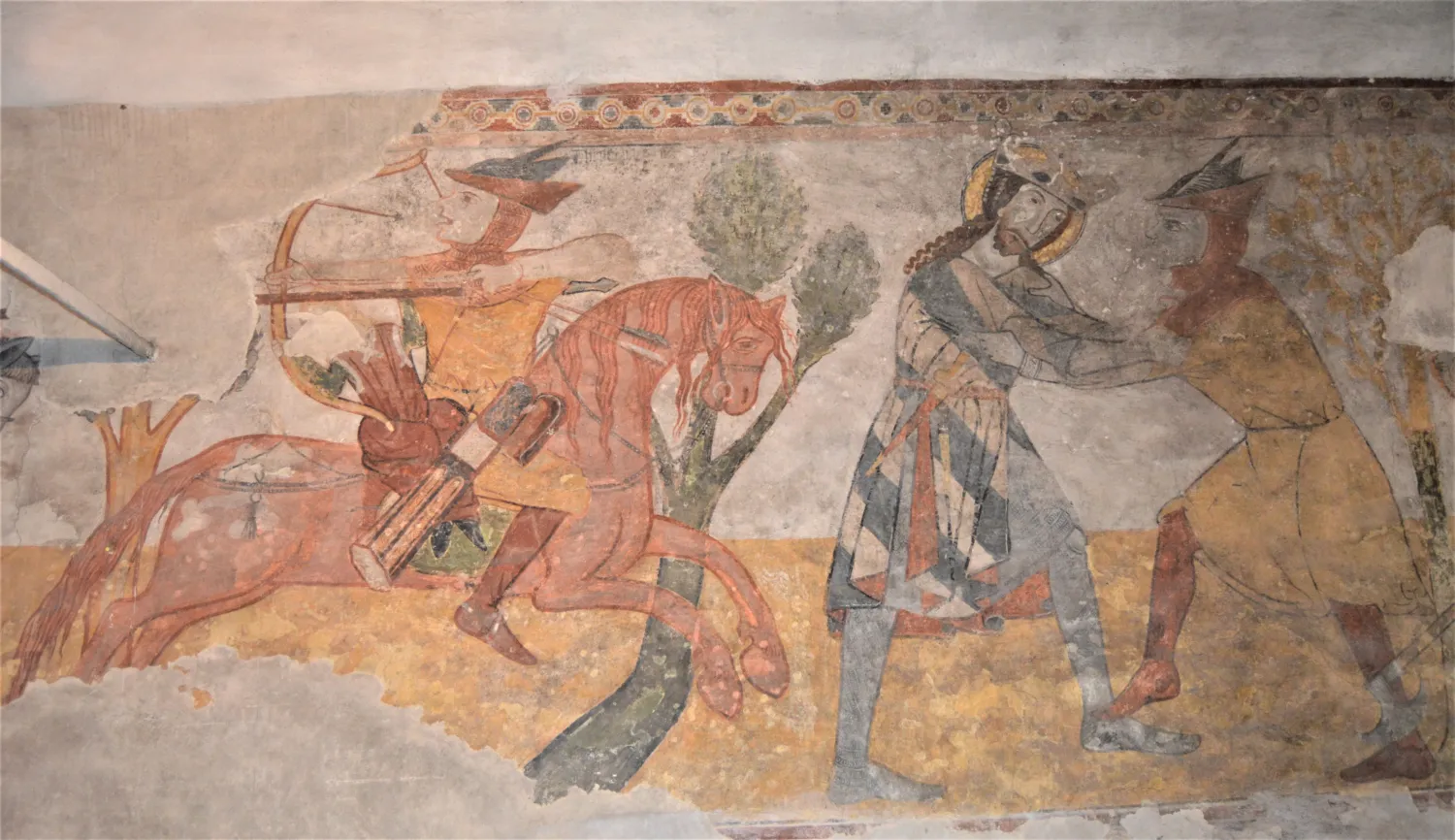
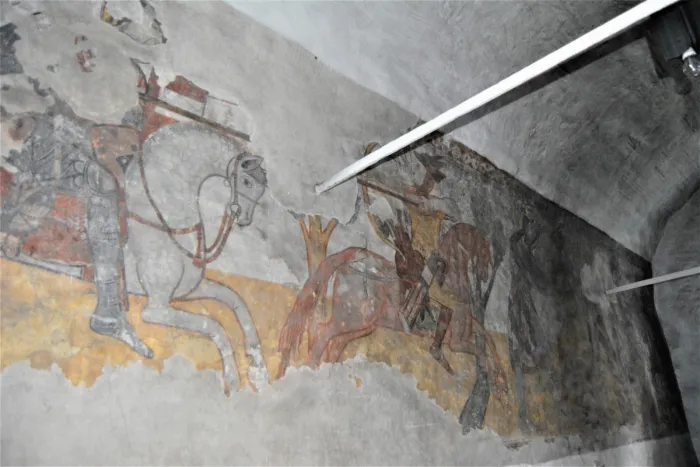
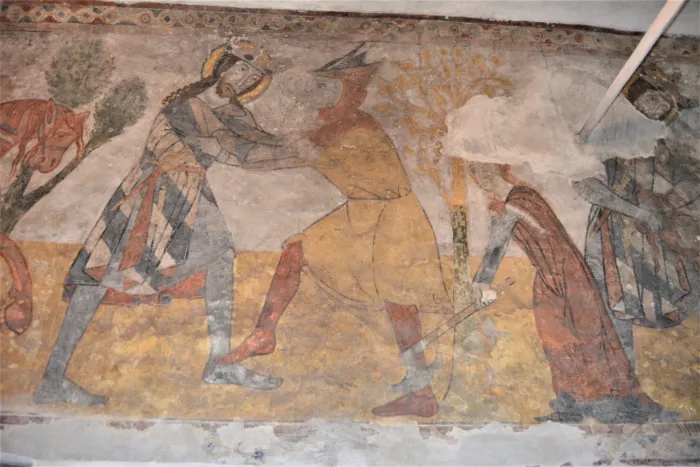
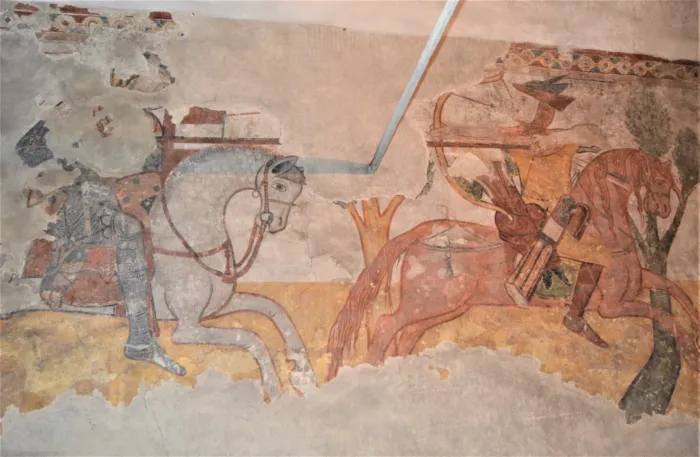
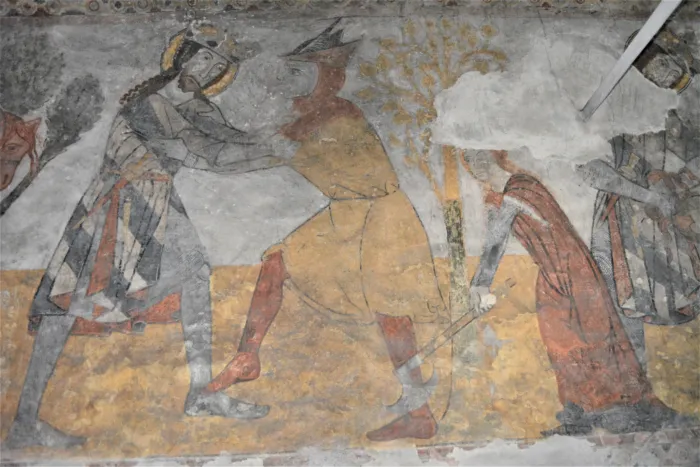
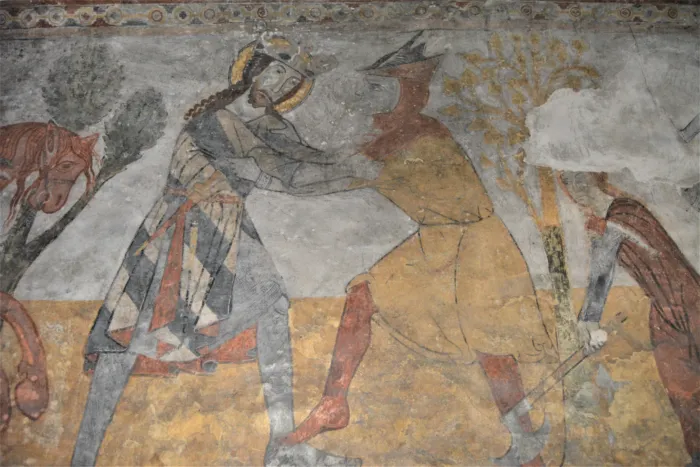
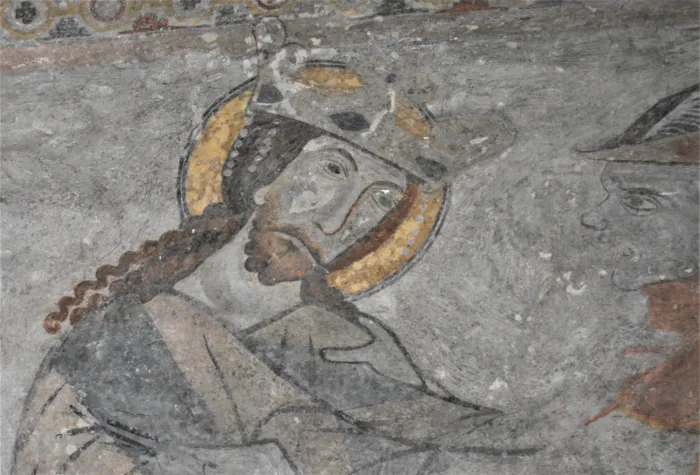
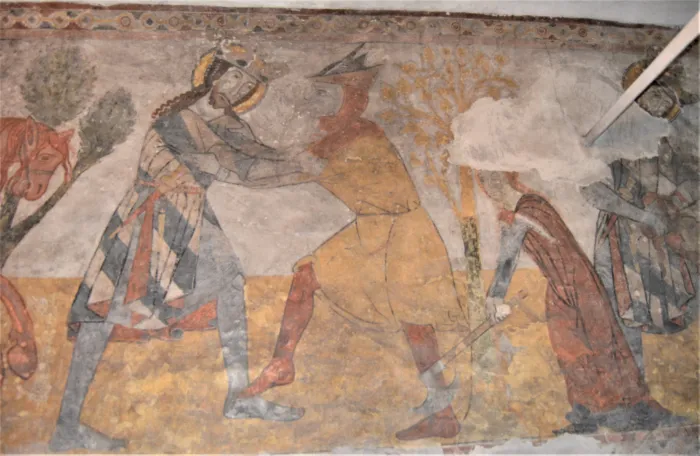
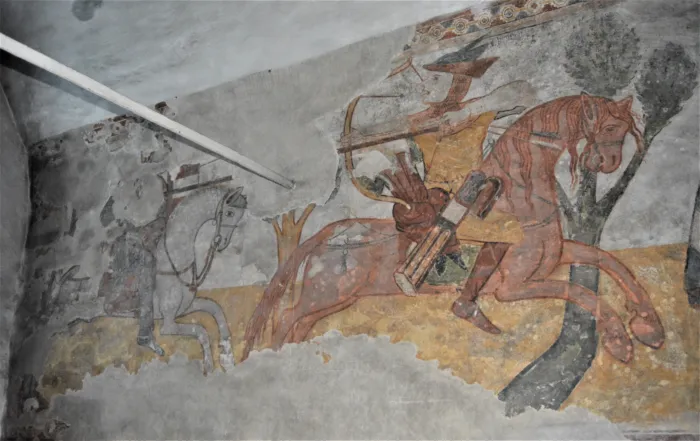
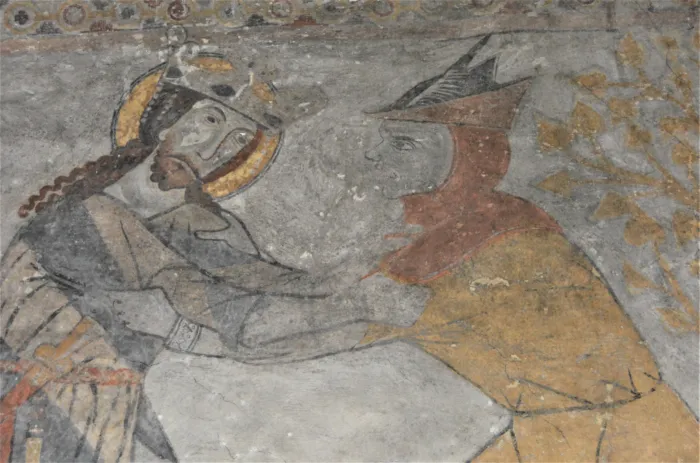
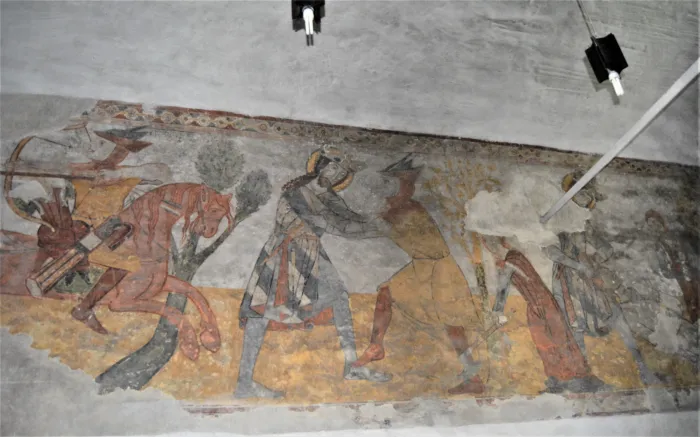
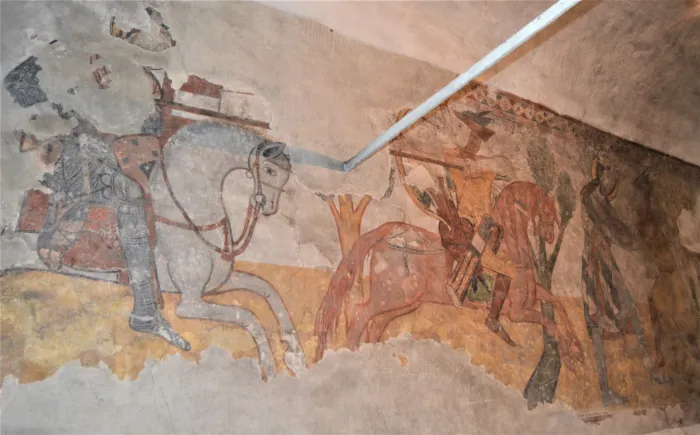
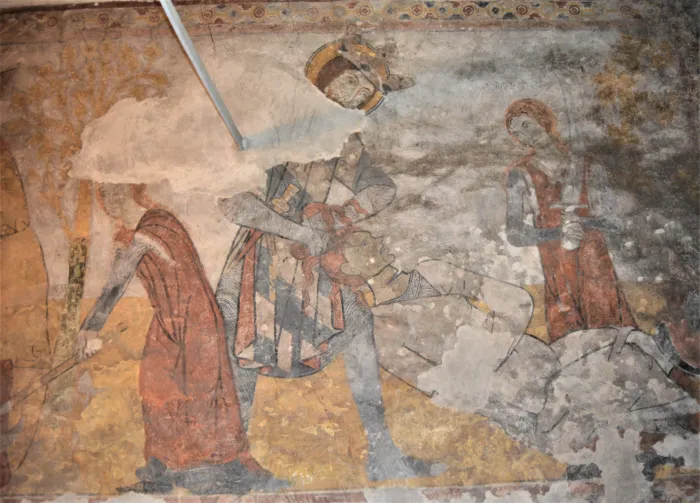
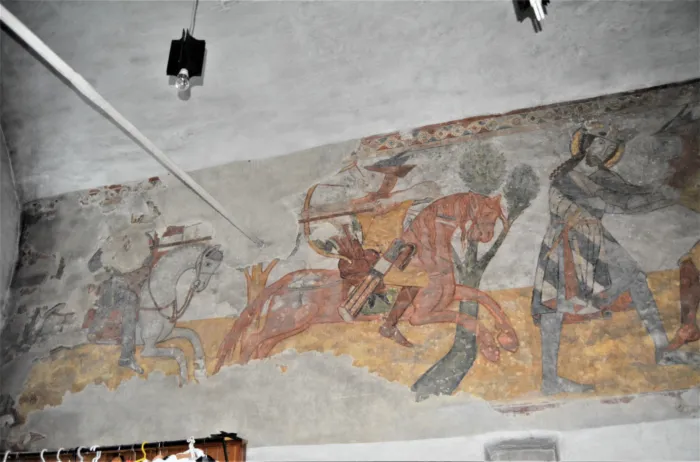
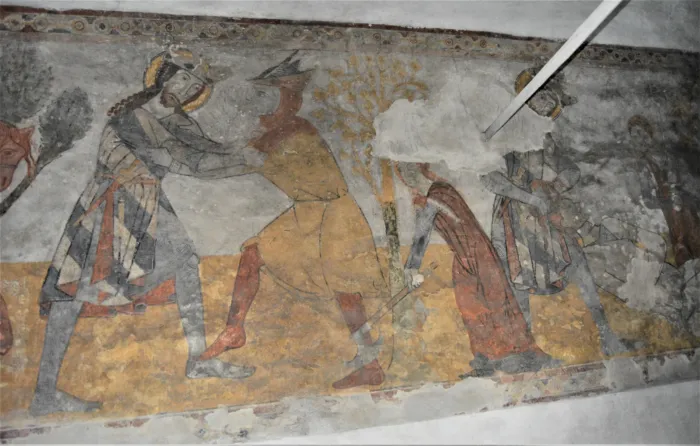
The Legend of Saint Ladislaus of Kakaslomnik is one of the best-known fresco cycles, thanks to the fact that after its discovery (1957) and restoration, the vivid colors, high artistic presentation, richness of detail and the sweeping momentum of the series of images, despite their fragmentary nature, made them of outstanding importance. It is also one of the earliest depictions (around 1317): it precedes the Carrasco paintings by at least 50 years, but similarly, the traces of the master of the Kakaslomnik paintings lead to the royal court based on his experience and practice. ; The fresco can be seen in the current sacristy of the Roman Catholic church dedicated to Saint Catherine of Alexandria, relatively low, at eye level. ; The first part of the Kakaslomnik fresco cycle is in a damaged state, as is the last scene: part of the wall was demolished to make the former chapel smaller. However, the three middle scenes are vivid and captivating: the horseman figure of the Cuman warrior abducting the girl, the unarmed wrestling of the two men, and finally the beheading of the Cuman warrior. ; In the scene of the abduction of the girl, a very small female figure, clinging to the warrior and his bow, crouches behind the Cuman in the saddle. The Cuman warrior shoots an arrow backwards, with his left hand, while Saint Ladislaus's spear pierces his chest, and an arrow also flies towards his face. Fire or smoke comes out of the Cuman warrior's mouth, and although the spearhead has pierced him and is clearly coming out of his back, he still holds his bow firmly and aims it at Saint Ladislaus. While the king's horse is light, the Cuman warrior's is dark, with a reddish tint, but both horses have human eyes. ; In the wrestling scene, Saint Ladislaus appears with a face reminiscent of Christ, crowned and with a halo, while the Cuman's face is dark grey, and the dark smoke billowing from his mouth is also grey. He is about to step on the Holy King's foot with his foot, when the girl strikes him from behind with the axe and cuts the fishhook. The two faces clearly express very different fighting styles: the Cuman, straining all his strength and fighting furiously, with his eyebrows drawn together and his head held forward in an aggressive manner, fights dynamically, while Saint Ladislaus, who is a little taller, bends his head down, his face is more sad and gentle than angry, his eyebrows are raised high. ; In the last scene depicted, Saint Ladislaus holds the already dead Cuman's head by its red, long hair, whose neck the girl - now depicted in a larger figure - has cut off with a sword: the blood is now flowing faintly from the large wound. Here too, a dark plume of smoke can be clearly seen billowing from the Cuman's open mouth, the girl stands before him with a raised sword held in front of her, and her name can be read above it: "Ladiva est ita." ; It may be noticed that the two warriors standing opposite each other, the white-riding Saint Ladislaus with the halo and Thepe, the only one named by name on this fresco, the Cuman leader with his dark horse, his distorted face spewing smoke and fire, and his strange strength that survives spear thrusts, are symbols of two universally opposing principles. ; Gyula László was the first to suggest – also based on the results of some previous researchers – that the version of the Christian Saint Ladislaus legend painted on the walls of churches is a baptized version of a mythical heroic tale with very early roots, originating from the nomadic world of the steppes. The two invulnerable heroes fighting with each other as táltos, together with their horses, represent darkness, the other represents light, and this can be interpreted on multiple levels. Gyula László discovers numerous parallels from the material and spiritual memories of steppe cultures, and Lajos Vargyas also traced the ballad tradition of Anna Molnár, which can be linked to this. ; Marcell Jankovics explored these multi-level interpretation possibilities – including the examination of constellations – who examines the parallels of Hungarian folk tales and fairy tales, as well as the táltos-shaman traditions and representations of other peoples, and sees the legend of Saint László as a mythical earthly image of the cyclical, cosmic celestial story. ; The Dominican monk Béla Hankovszky followed the same line, emphasizing the supernatural mission, when he linked Saint Ladislaus as an “apocryphal saint” with the taltos tradition of the Árpád house. ; In European and Christian culture, stories are universally known where two men fight each other, the stake of the fight is a woman/several women, and one of the two men is somehow a representative of darkness, the underworld, sin, the passionate/instinctive/animal level. Among the many similar ones, the fight between Theseus and the half-human, half-animal/bull-shaped Minotaur from Greek mythology, for the rescue of the young virgins of Athens, or the fight between Perseus and Andromeda, and the fight between Bellerophon and the Chimera, can be mentioned. The story, which also goes back to very early roots, is related to this: the fight between Saint George and the dragon in defense of the princess. ; This latter story is also important for our topic because although it is not one of the many tales in which the prince/poor young man saves one or more girls from the captivity of the dragon/monster, in a tough duel (in Hungarian folk tales, by fighting with bare hands), in the case of Saint George, the hero who confronts the monster is also a glorious, canonized holy figure of Christianity. In the Western Church, he is one of the 14 Helping Saints, and in the Eastern Church, he is one of the Great Martyrs. ; The killing of the dragon is the victory of Light over Darkness, and also of the true faith over paganism. The glorious holy warrior, with divine help, representing the Supreme Being himself, defeats the representative of the underworld, Evil. His victory means hope and encouragement to the believers, countless icons and holy pictures depict him stabbing and killing the ugly, frightening, diabolically terrifying monster, i.e. the Antichrist himself. In contrast to him, Saint George appears as the Savior, the Alter Christus. ; This sequence of images echoes in the struggle between Saint Ladislaus and the deformed-faced Cuman warrior, especially if we consider the signs that refer to the Christian devil: such as the horns, traces of which we suspect in the Cuman's two-pointed helmet. In other depictions, this is even more emphatically expressed: Saint Ladislaus holds the Cuman's head almost by its horns in the frescoes of Gelence or Székelyderzs in Háromszék, but we can also see an example of this in Szentmihályfa in the Felvidék. ; The experience of existence, which the Judeo-Christian faith explains with the operation of Evil, is universally known in all human cultures: the bipolarity of the moral world, which we discover not only in the external world, in society. The ambivalence of certain elements of our own lives, the dark passions of our hearts and the alarming/frightening negativism of our thoughts and feelings that sometimes arise unexpectedly, the destructive aggression that arises within, indicate that everyone is subject to a lawfulness that does not originally depend on them. Those anti-human events, the news of which almost entangles us through globalization: the attacks on the human world, humanity, when viewed at their roots, are not far from the soul of any of us: the burden is common. And calling it a burden also seems necessary because this view also brings with it a heavy, guiding sense of responsibility: we are at once vulnerable and at once responsible, shapers of our own destiny and – in connection with others – the destiny of others. ; The Christian churches explain the experience that we encounter the forces, motives, and tension of GOOD and EVIL at the same time with the teaching of original sin, and that the battle is not over, despite our redemption. Or it is over, but we do not yet see it clearly: only through a mirror, dimly, with the blind eye of faith, groping. ; When we contemplate the legend of Saint Ladislaus with this mature experience, the exclusive, unambiguous formula that stands before us in the story is captivating. It is almost instructive and purifying to see the Holy King on the Kakaslomnik fresco, with his gentle, Jesus-like face, as he fights hard at the same time, and opposite him the powerful, athletic Cuman warrior, with a distorted face, horns, spewing fire and smoke, as he throws all his strength into the fight. And if we also cite the sentence from the chronicle that “Saint Ladislaus, although seriously wounded…”, set out to protect the girl, then an evangelical teaching unfolds in connection with the image: the weak hero, capable of being wounded/ready to suffer, who wins despite this, or precisely because of it. The man who accepts his fate, accepts his mission, and goes through the dark tunnel of his own weakness: he defeats Evil. ; Because the essential element of this teaching is that Evil can be defeated. And that there is nothing to be done: even wounded, even weak, something calls to the side opposing Evil. ; It is thought-provoking how small signs there are of which warrior is on which side. Their horses are equally beautiful, human-looking, and well-bred. They themselves are equally strong, attractive, well-dressed, distinguished, and masculine. The guiding signs are not intrusive, but rather suggestive: like the smoke that billows from the mouth of the Cuman warrior, or the ominous message of the darker colors. It requires attention, devotion, the inner work of distinction to be able to choose between them. ; And the girl chooses: whomever she strikes, that one perishes. The girl, who in medieval iconography often symbolized the human soul itself, knows who to side with: she chooses the white rider, the Holy King. She decides.