
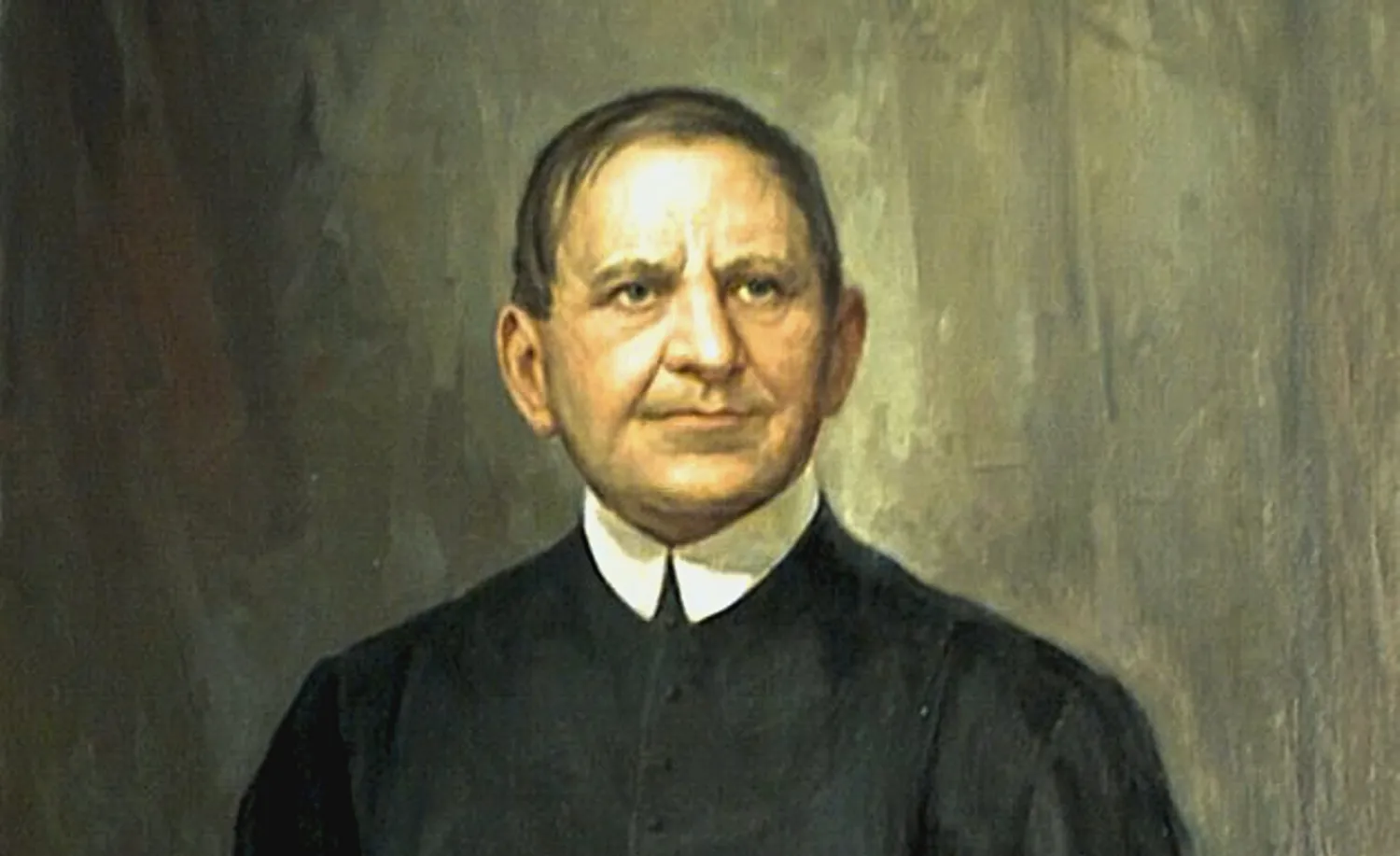
István Jedlik Ányos
Other - other
* Szímő, 11 January 1800 – † Győr, 13 December 1895 / physicist, inventor, Benedictine monk, university professor, member of the Hungarian Academy of Sciences (1858) ; ; Originally István Jedlik, his monastic name was Ányos. He started his secondary schooling in Nagyszombat, then continued in Bratislava and finished it in Győr. He was ordained a priest in Pannonhalma in 1817. He completed his liberal arts studies at the order's Győr Lyceum in 1818–1820, and then received his doctorate at the University of Pest in 1822. He began his teaching career at the Győr Gymnasium in 1825, and continued at the Physics Department of the Győr Lyceum the following year. From 1831 to the end of 1839 he was a professor at the Royal Academy in Bratislava, and from 1840 to 1878 at the University of Pest. Due to his patriotic attitude, he was only confirmed with difficulty after the failure of the War of Independence. He was the rector of the university in 1863–1864. He retired in 1878 after 53 years of teaching. His chair was taken over by the young Loránd Eötvös. In the first phase of his work, he dealt with chemistry, electrochemistry and electricity, and later, in addition to electricity, he mainly dealt with optical experiments. In 1826, he constructed a soda water production machine, on the basis of which the first domestic soda water plant was established. In 1827–1828, to illustrate the electromagnetic effect of electricity, he developed his commutator-driven "electrical vortex" that performed a continuous unidirectional rotating motion, which was the first electric motor operating purely on the basis of electromagnetic effects. With his invention, he preceded the first practical electric motor (M. H. Jacobi, 1834) by six years. By perfecting his device, he proved that the electric motor could also be made suitable for driving vehicles, and in 1855 he constructed a model of an electric motor car. At the same time, he achieved significant results in the field of improving electric cells and accumulators (1840–1850s), and a factory was established in Pest for their production. His batteries were well-known and sought after, and they were shipped to Paris and even Constantinople. In the 1850s, he constructed an optical grating dividing machine of unparalleled precision for his time for his photonic experiments. To power this, in the second half of the 1850s he developed his "unipolar lightning starter", the first unipolar machine, during the experiments he conducted in connection with which he discovered the dynamo-electric principle. In the instructions for the machine, inventoried in 1861, he formulated the dynamo-electric principle six years before Werner Siemens (1816–1892) and Ch. Wheatstone (1802–1875). (His machine is also of pioneering importance as a unipolar machine, because the problem of a unipolar generator used in practice was only solved in 1905 by Jakob Noegerrath.) ; His third most significant electrical engineering invention is a high-capacity electrical condenser: the "tubular lightning tensioner", the forerunner of the impulse generators used in the first phase of nuclear technology research. His invention was awarded the “Medal for Progress” at the 1873 Vienna World Exhibition, on the recommendation of Werner Siemens. His light interference experiments related to his university lectures (1860s) were also of pioneering significance. He participated in the editing of the first German-Hungarian scientific dictionary containing about 20,000 invented words… (Pest, 1858). A considerable part of our physical, chemical and mathematical vocabulary originates from him or was spread through him. His work The Nature of Heavy Bodies (Pest, 1850), the first Hungarian-language university textbook published during the dictatorship, was awarded the Grand Prize by the Hungarian Academy of Sciences. The significance of his work was recognized and praised by Loránd Eötvös according to its merits, and his priority as an inventor later became known and accepted not only in Hungarian but also in international scientific history literature, mainly because of him. In comparison to his extensive experimental activity, he wrote very little, only 40 of his publications appeared in the Proceedings of the Hungarian Doctors and Naturalists' Traveling Congresses, and to a lesser extent in the publications of the Hungarian Academy of Sciences and the Royal Hungarian Natural Sciences Society, and in the form of notes written for his students. In the foreign trade press, he described only one of his more significant inventions, the "tubular lightning arrester". The Hungarian Academy of Sciences elected him a full member in 1858 and an honorary member in 1873. A vocational secondary school in Érsekújvár, a mechanical engineering college in Győr and Csepel in Hungary, and a gymnasium bear his name, and streets and squares in many cities are named after him. Some of his books have survived only in manuscript (e.g. The Science of the Weightless. First Section: Physics). ; ; His main works: ; Compendium Hydrostaticae et Hydrodynamicae, 1847 ; (in Hungarian: Supplements to the Science of Water, 1850), ; Elements of Physics (I. Physics of Heavy Bodies), 1850, ; Thermodynamics (university notes), 1851, ; Physics (university notes), 1851, ; Über Ketten aus Röhren bestehender Elektrizitätsrecipienten (Repertorium für Experimentalphysik…), 1882.