
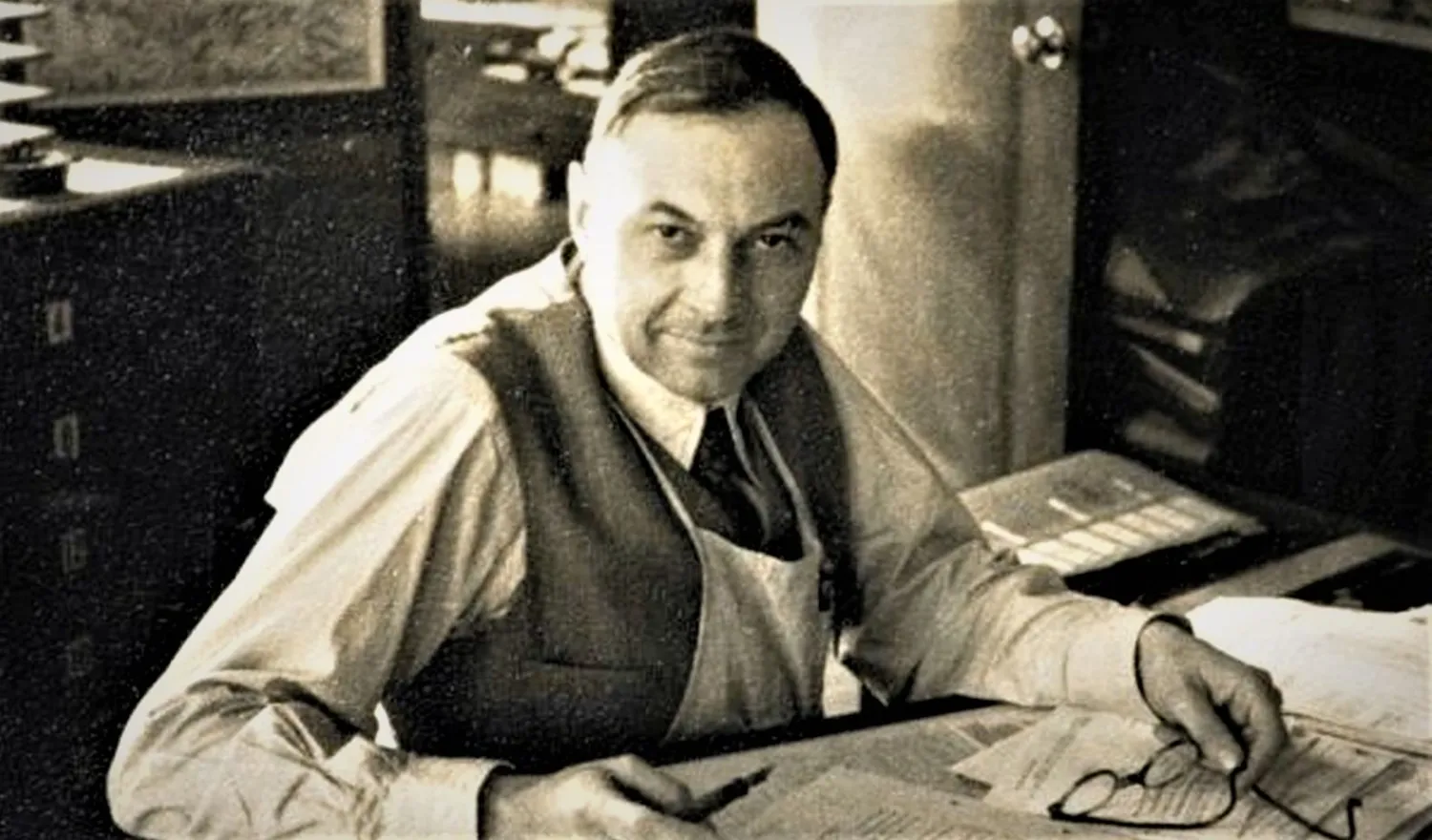
Laszlo Hugyecz
Other - other
* Banská Bystrica, January 8, 1893 – † Berkeley, USA, October 26, 1958 / architect ; ; His father was Slovak (architect Juraj Hudec), his mother Hungarian (teacher Paula Skultéty). He studied architecture at the Budapest University of Technology and became a member of the Hungarian Chamber of Architecture in 1914. He suffered a leg injury while fighting in World War I and was taken prisoner by the Russians. Thanks to his knowledge of the Slovak language, he was soon employed as an architect in Siberia. On one occasion, he jumped off a moving train near the Russian-Chinese border and escaped to China, where he ended up in Shanghai with the help of the Danish mission. As an employee of an American architectural firm, he received major commissions and designed about 40 buildings that still stand in the Chinese metropolis between 1925 and 1941 (Shanghai Grand Theatre, Green House, Joint Saving Loan Bank, etc.). The 22-story Parkhotel was the tallest building in Shanghai until 1980. In 1922, he married a Swiss woman, in 1928 he received Hungarian citizenship and invited his two younger brothers to live with him. In 1942, he became the honorary consul of Shanghai, but after World War II he returned to Europe and settled in Switzerland. From there he went to Rome, where he became a member of the international group searching for the tomb of St. Peter. From then on, he no longer worked in architecture. In the late 1940s, he moved with his family to the USA, to San Francisco, and acquired American citizenship. After his death, the remains of László Hugyecz were brought to Bánya Beszterce and buried there.