
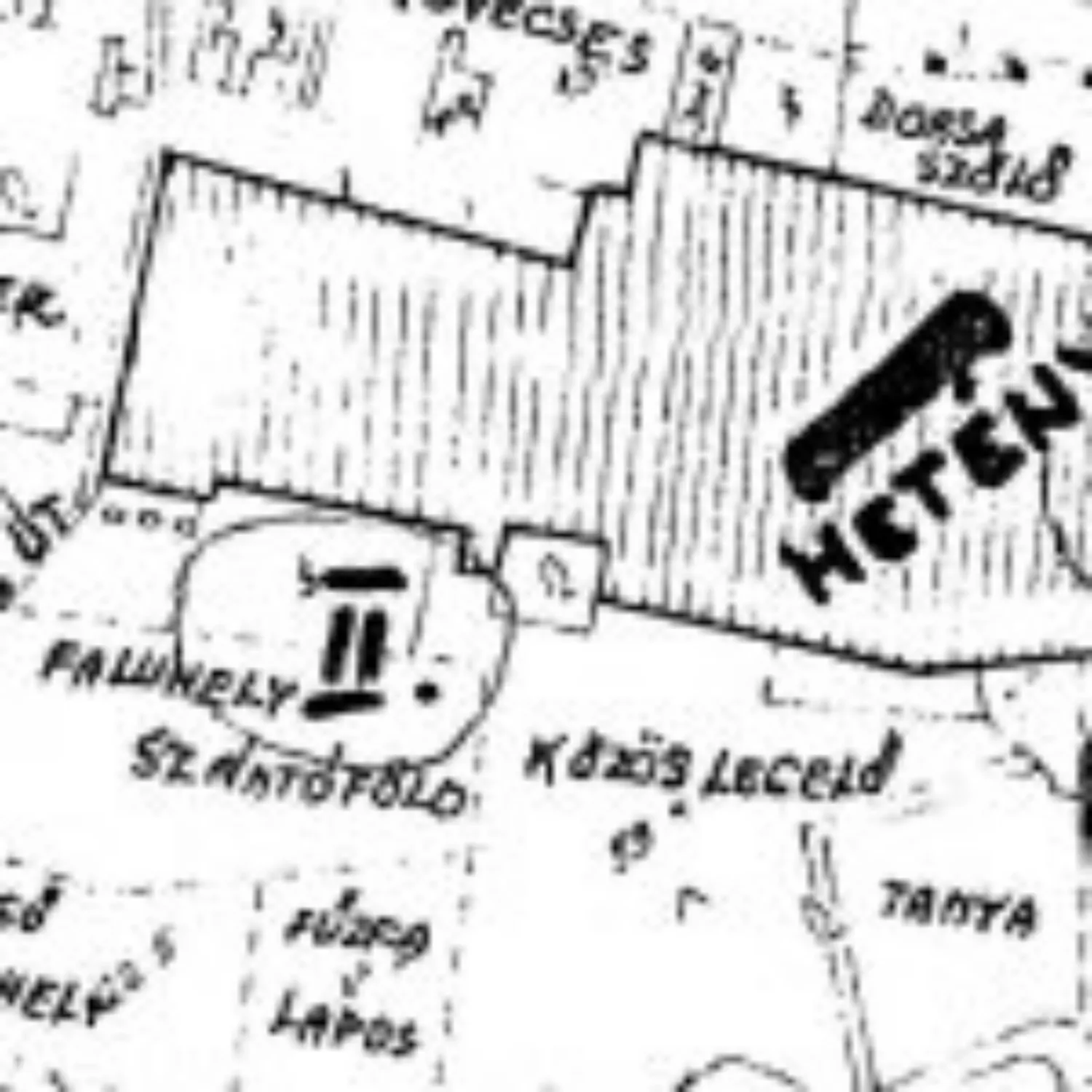
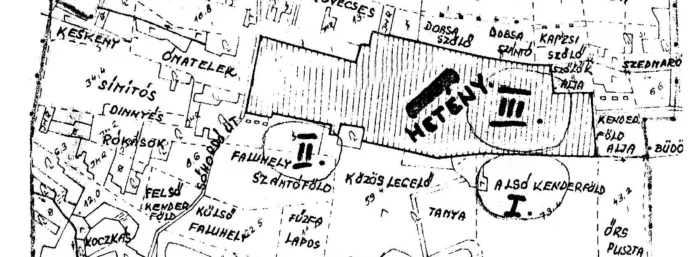
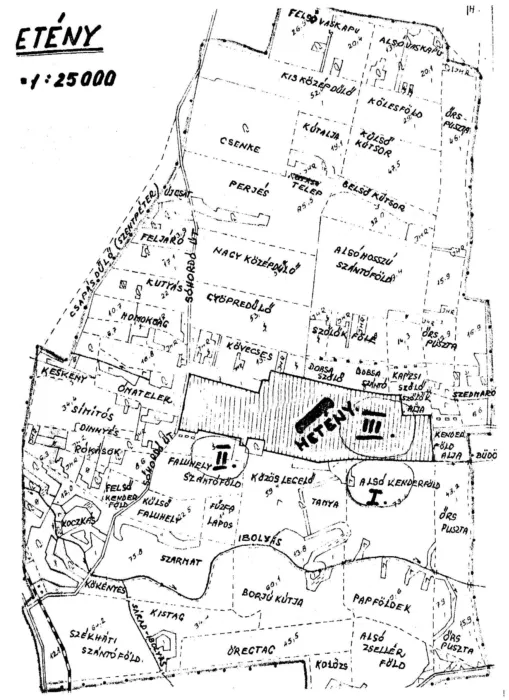
Names of Hetény lands
Other - other
 , ; ; Szöllökföle, Szőlőkföle – This land has always been a vineyard. Most of the new plantings were planted here, especially in the hilly, sunnier parts. Only one vineyard separated it from Szőlőkaljá (Dobsa, Kapzsi-szőlő). ; ; Öregtag – One of the extreme vineyards on the border of the village. It has quite wet, but good soil. Mainly hoe plants were planted here. The wet, grassy part was mowed. After the canalization was built, the grassy area of the drained parts was broken up and utilized. ; ; Ásóhoszú – Grapes were planted in the hillier part of the vineyards extending towards Vaskapu. It was very popular among farmers due to its good soil. ; ; Faluhé, Faluhely – This vineyard is located in the upper part of the village, under the old market square. Its name and the excavations carried out here prove that the village was once here. Finds from the Hungarian Conquest period have been found. It is said that pottery fragments and bones were also found after ploughing. ; ; Zsitvapart – It is located along the Zsitva River. It is a well-tillageable area. Suitable for growing water-intensive crops. Together with Öregtag, it closes the village border towards the neighboring Őrspuszta (Kolozsmajor), which administratively still belongs to Hetény. The Kolozs estate was a religious trust property of the Roman Catholic Church. ; ; Homoktag – Its name includes the material of its soil. The hillier part is a good place for growing grapes. The lower part has more compact soil, suitable for growing other crops. It was gradually planted with grapes because phylloxera completely destroyed the vines in the Vaskapu vineyard. ; ; Kertekajja – Szöllőláb, Szőlőláb belong here. This is a sloping area. In the upper part there are the hailoks – wine houses. Grapes were planted here. In the lower, well-productive part, kitchen garden and hoe plants were planted. Some people sowed it with testes. ; ; Vaskapu – It is divided into two parts: Felső-Vaskapu, Alsó-Vaskapura. Its name means the edge, the border of the village. In the past, grapes were grown here. However, phylloxera spread quickly in the compacted soil, destroying the grapes. The unevenness of its soil is caused by the collapsed wine cellars. ; ; Csenke – In the second half of the 1800s, there were vineyards here, and hailoks were built here. The grapes were destroyed by phylloxera, the entire plantation was ruined. After that, they started to settle the Sand Bank with grapes. People left not only the area, but also the old hailoks. Csenke gradually became a forested area, which came under the supervision of the Farmers' Community, which ordered the thinning and felling. Everyone received a share of the harvested wood in proportion to the area they brought in. The wood from the area planted with acacia was used to make kutagas, kutgems, whips, and fence posts. ; ; Common – pasture – This area was also supervised by the Farmers' Community. The number of animals that could be driven out to pasture depended on the size of the area they brought in. One four-legged animal was one resident. If the farmer drove out more animals to pasture than his resident allowed, he paid for it in grain or money. The shepherds were paid from the money, and the remaining amount was used for farming. Pigs, geese, calves, and foals were grazed in a separate area. ; ; Keskenyek – A narrow area of land towards Szentpéter. ; ; Középdűlő – The geometrically central part of the border area belonging to the municipality, located north of the village. The soil is good and rich in fertility. However, in drier weather, it yields little. ; ; Rójedek – The farmers’ plots are located perpendicular to the longer part of the dűlő. Therefore, the length of the plots is shorter than usual. Cereals and cereals were grown here. ; ; Kockas – The part towards the railway station. Its soil is waterlogged, black clay, therefore it gives a good harvest even in drier weather. ; ; Zsellértag – The soil is well-fertile. The hillier parts always gave a good harvest, so the wealthier farmers bought the land from the zellers. The lower-lying area was wet, so it was used as a hayfield. ; ; Kölesfőd – This is also the name given to a part of Perjések and Középdűlő. Its soil is well-cultivable, flat. It was primarily used for growing corn. ; ; Gyöpredűlő – one part was a bit gravelly, but the other part was well-grown. ; ; Kúcsor - Kútsor, continuing on the road leading to the slopes, the animals were herded to the pasture, where there were two hemeskuts next to each other. Hence the name, it was used as a pasture