
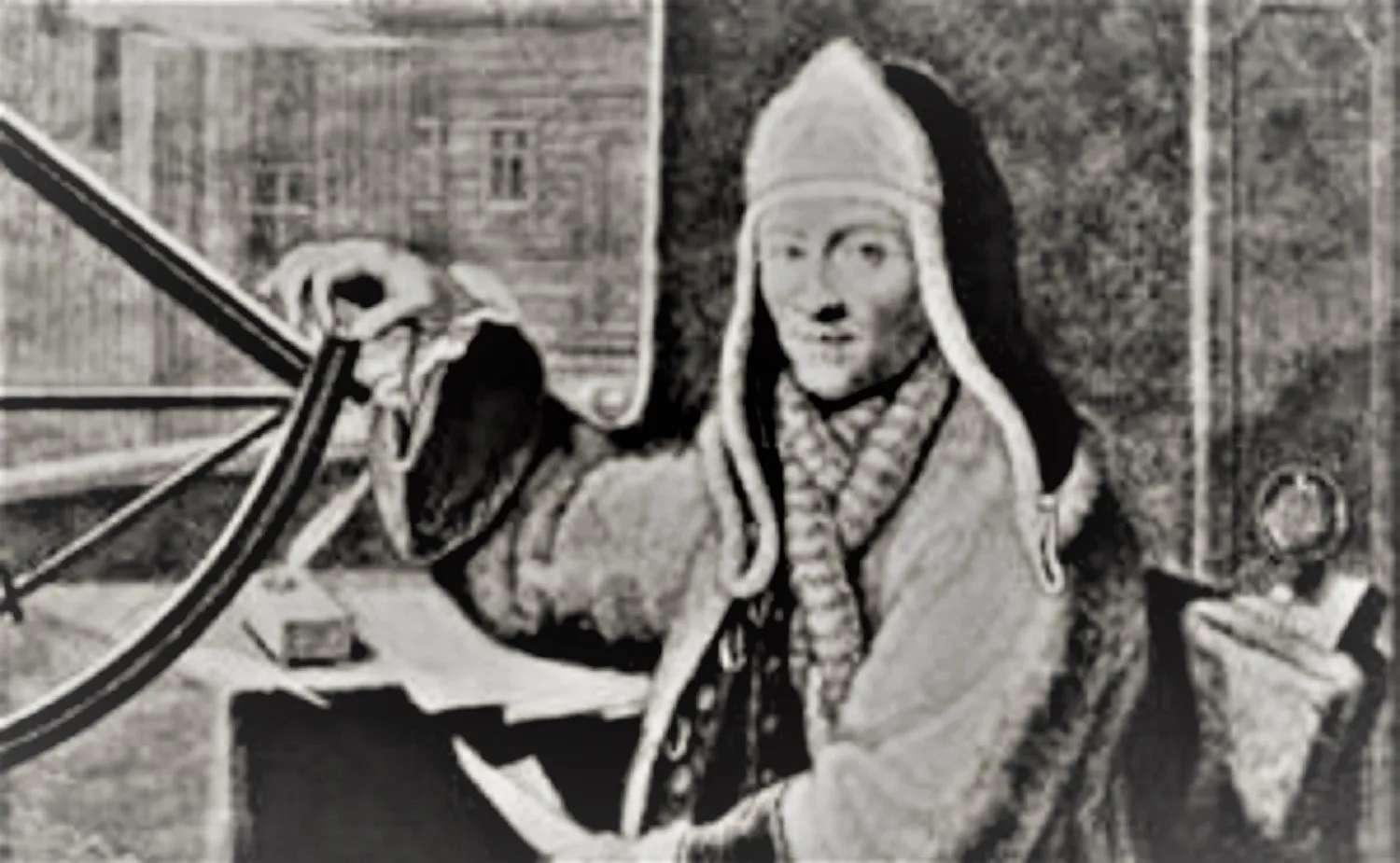
Hello Miksa Rudolf
Other - other
* Hegybánya, 15 May 1720 – † Vienna, 14 April 1792 / astronomer ; ; He is the first in the Höll family whose name was used exclusively in the form Hell. Most encyclopedias and biographies list Selmecbánya as his birthplace, but he was most likely born in nearby Hegybánya. Hell was the youngest child of Máté Kornél. After completing his secondary school studies in Selmecbánya, he entered the Jesuit order in Bánya Biszterce and from 1738 spent his two novice years in the convent in Trenčín. Between 1741 and 1743, he studied philosophy at the University of Vienna, these studies also included natural sciences and mathematics. From 1745 he taught Latin and Greek at the order's gymnasium in Levoča, later he was also entrusted with the rhetoric and poetry classes, and in addition he was also entrusted with the management of the boarding school. In 1748–1751 he studied again in Vienna, primarily studying theology, but at this time he also delved into astronomy with Joseph Franz, who was the head of the Jesuit astronomical observatory at the time. In addition to his studies, he taught mining knowledge to young noblemen and translated German mining laws into Latin. He even started writing a history and geography textbook, but the manuscript of this was lost. He was ordained a priest in 1751 and spent his third probationary year in the monastery in Banat, then the order sent him to Cluj in 1752 to teach mathematics and astronomy in the Jesuit college that was being built at that time. At this time, he began to deal with the issues of electricity and magnetism, suspecting that there was a closer connection between the two phenomena. He also studied the healing effects of magnetism. At this time, he also wrote a book on mathematics, which was the first in a planned series, but the continuation was never realized. In 1755, after the death of the previous head of the Vienna court observatory, court astronomer Jakob Marinoni (1676–1755), Maria Theresa appointed him head of the institution. His tasks were initially set in points, including the observation of planetary orbits and extraordinary astronomical events, and the editing and publication of the astronomical yearbook Ephemerides Astronomicae, which had already been started by Marioni. In it, he published important astronomical data for the given year, partly based on his own observations and partly on his calculations. Thanks to this, his work was increasingly noticed in Europe. He also excelled as a teacher, boosting astronomical and geodesic education in Vienna and educating numerous talented students. One of these was János Sajnovics (1733–1785), who was with Miksa Hell in 1758–1759, and with whom he later participated in the observation of the Venus transit on the distant island of Vardő. Since he was primarily interested in solving practical questions due to his family upbringing, this practicality was also characteristic of his astronomical work. In 1764, he proved through ingenious experiments that the moon of the planet Venus, which many people thought they saw, was actually an optical phenomenon, a reflection of light. He also introduced some new methods in geographical location. He was actually the first to apply the geographical latitude measurement, now known as the Horrebow–Talcott method. The essence of this is that the zenith distance of two stars passing at the same height on the meridian must be measured and, assuming that their refraction is the same, the geographical latitude can be calculated. Hell rose to the forefront of European astronomers in a few years, so it is not surprising that King Christian VII of Denmark asked him to organize and lead the expedition that was to observe the transit of the planet Venus across the Sun on June 3, 1769, on the island of Vardø, which lies beyond the Arctic Circle. János Sajnovics (Nagyszombat) also participated in this expedition, who, in addition to astronomical observations, also examined the relationship between the native Lapp language and the Hungarian language. It is generally believed that Miksa Hell initiated all this. He himself carried out regular meteorological and magnetic measurements during the expedition, but he was also interested in the problem of the aurora borealis, and also conducted botanical and zoological research. The successful observation of the Venus transit was greeted with great acclaim in the Danish capital, Copenhagen, but the measurement data only came to light after the results of other observers, and suspicions of subsequent correction arose, which were only dispelled in the 19th century by the American astronomer Simon Newcomb (1835–1909). Hell was also interested in questions of Hungarian history. He also corresponded with György Pray about the origin of the Hungarians. Due to the dissolution of the Jesuit order, the conditions of his scientific work became more difficult, as he was forced to do without his former colleagues. Even so, he had great merit in the development of Hungarian astronomy, as the establishment of several observatories (Kolozsvár – 1755, Eger – 1776, Buda – 1780, Gyulafehérvár – 1792) is directly or indirectly related to his person. He planned several works, e.g. a three-volume Nordic encyclopedia, but these have mostly survived in fragmentary and manuscript form. ; ; His main works: ; Elementa Algebrae Joannis Crivelli magis illustrata et novis demonstrationibus et problematibus aucta, 1745, ; Elementa mathematica naturali philosophiae ancillantia. Tomus I:Elementa Arithmeticae numericae, et literalis seu Algebrae, 1755, ; Anleitung zum nutzlichen Gebrauch der künstlichen Stal-Magneten, 1762, ; Observatio transitus Veneris ante discum Solis, die 3 Junii Anno 1769, 1770.