
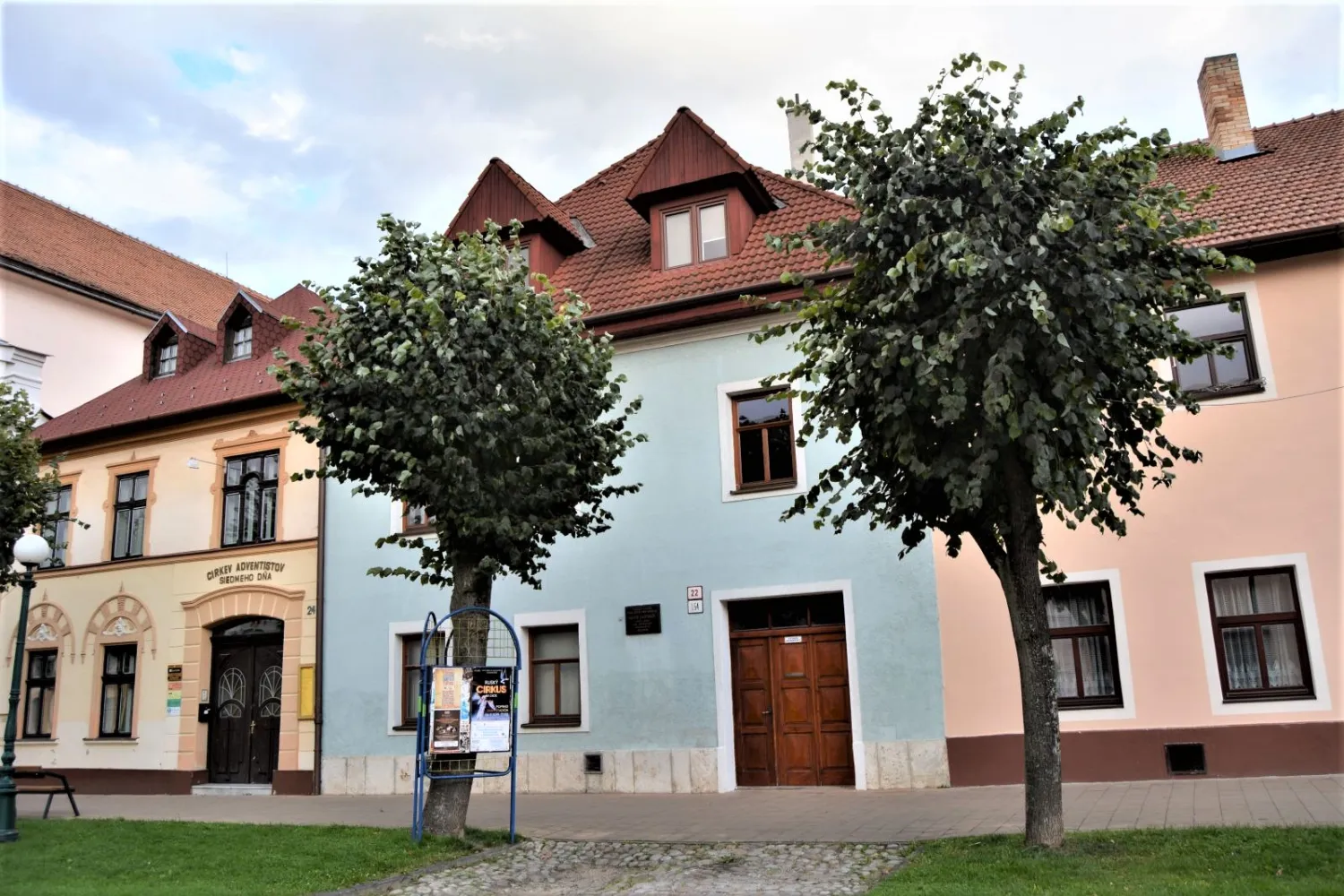
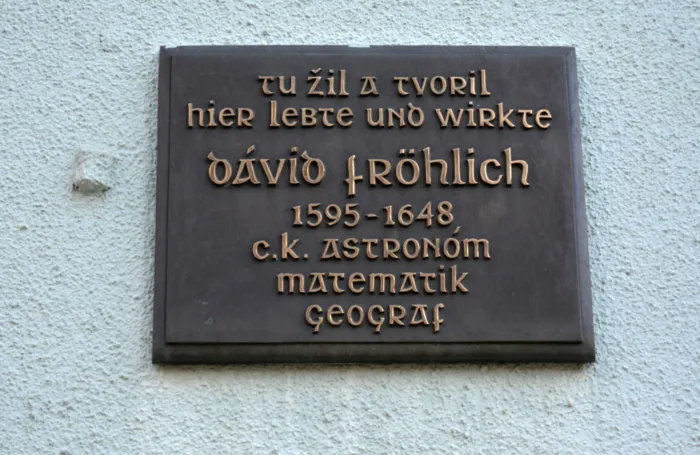
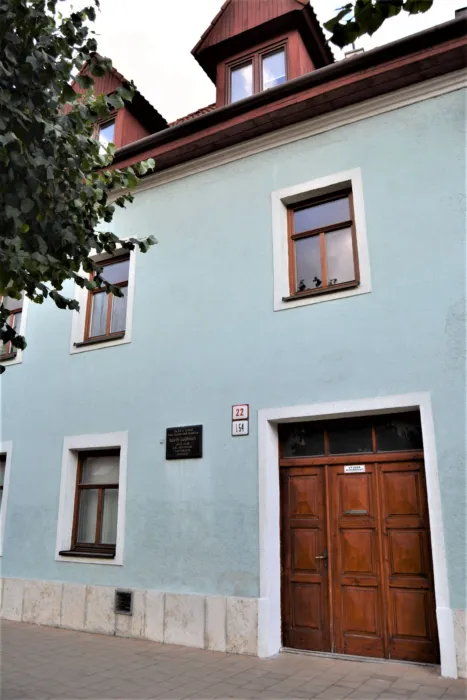
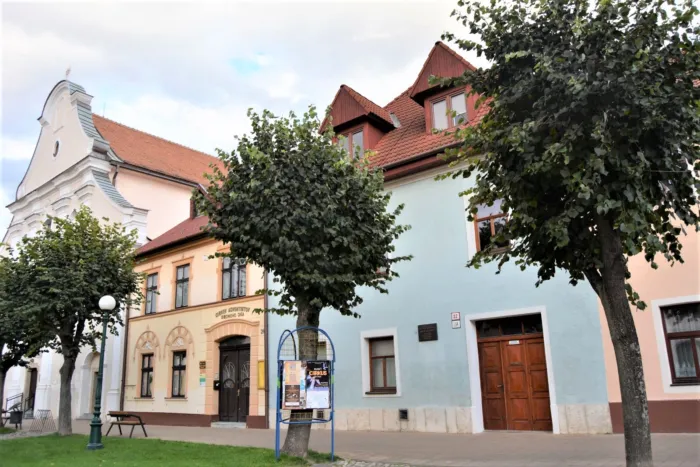
Dávid Frölich's house and memorial plaque
Statue, monument, memorial plaque
Dávid Frölich (Késmárk, 1595 - Levoca, 24 April 1648) was a geographer, calendar maker, astronomer and mathematician who also had significant physical knowledge. He is a solitary figure of this century, ahead of his time in many respects. He had no students or followers, and posterity treated him much more scornfully than János Honterus, the learned printer and teacher, whose works were at least studied by diligent philologists and church historians. ; He completed his studies in Frankfurt on the Oder, and spent a total of twelve years traveling abroad. He gained such fame, especially with his calendars in Hungarian, German and Latin, that Ferdinand III awarded him the title of "imperial and royal mathematician" and granted him a pension. After returning from abroad, he lived in Keszthely, and in addition to his literary work, he taught mathematics and history as a private tutor. However, he did not owe his fame to his science, but to the fact that he was the first to climb the peaks of the High Tatras, namely in 1615. ; He himself describes this event in two of his works, Medulla Geographiae.., published in 1639, and Cynosura Viatorum, published in 1644. This is not primarily interesting because we get to know him as an early alpinist, but because the descriptions of his observations obtained on this occasion present him as a true natural scientist in an era when it was much more customary to revive the wild speculations of old literature than to report on his own experiences. ; F. D., in fact, noticed the change in air pressure with geographical height much earlier than it was recorded by Torricelli, Pascal or others in universal physics history writing. In his work, we find, alongside the most modern ideas of his time, the superstitions of the previous century or even earlier times. But let us not forget: even in the 18th century we encounter contradictions similar to his. ; His works can be divided into three groups. One group includes his geographical works, the Medulla as a purely geographical description, and the Cynosurae peregrinantium, which is mixed in genre: in addition to geography, it can also be called a moral, historical, or even entertaining work. The other - quantitatively largest - part of his work is made up of calendars. However, these cannot simply be classified as works belonging to a single genre. Their languages are Hungarian, German, and Latin, and they were published annually. The third group of his works includes the chapters of the calendars that do not quite fit in with tradition, as well as the Anatome Revolutionis Mundanae (Sketch of the Revolution of the World), which he wrote as early as 1632, showing that he did not quite agree with his own calendars either. ; F. D. is therefore the most prolific calendar author of the first half of the 17th century, who published these works annually from 1623 onwards under the title Fasti or Ephemeris in Latin, in Hungarian as "Fröelich Dávid Késmárki Astronomus Kalendáriumá", and perhaps in the largest number (at least the largest number that has survived) his German-language "Schreibkalenders": his "Almanachs" or "Tagebuch". ; Calendars can be said to be the first form of popular dissemination of knowledge, and F. D. truly shows himself to be a master of this genre. His running through e.g. on meteorology - along with many similar ones, it is placed between the individual chapters of the Prognosticon, as answers to some "useful and funny questions". It is obvious that he not only wanted to make the calendar more interesting and colorful with this, but he placed the questions between two Prognosticons precisely because the readers would certainly have read what kind of harvest there would be or what epidemics were expected, and thus this clever editorial principle was the best way to arouse interest in scientific questions. ; ; Dávid Fröhlich's former residence and the memorial plaque hanging on it can be found at Fő utca 54/22 in Késmárk.