
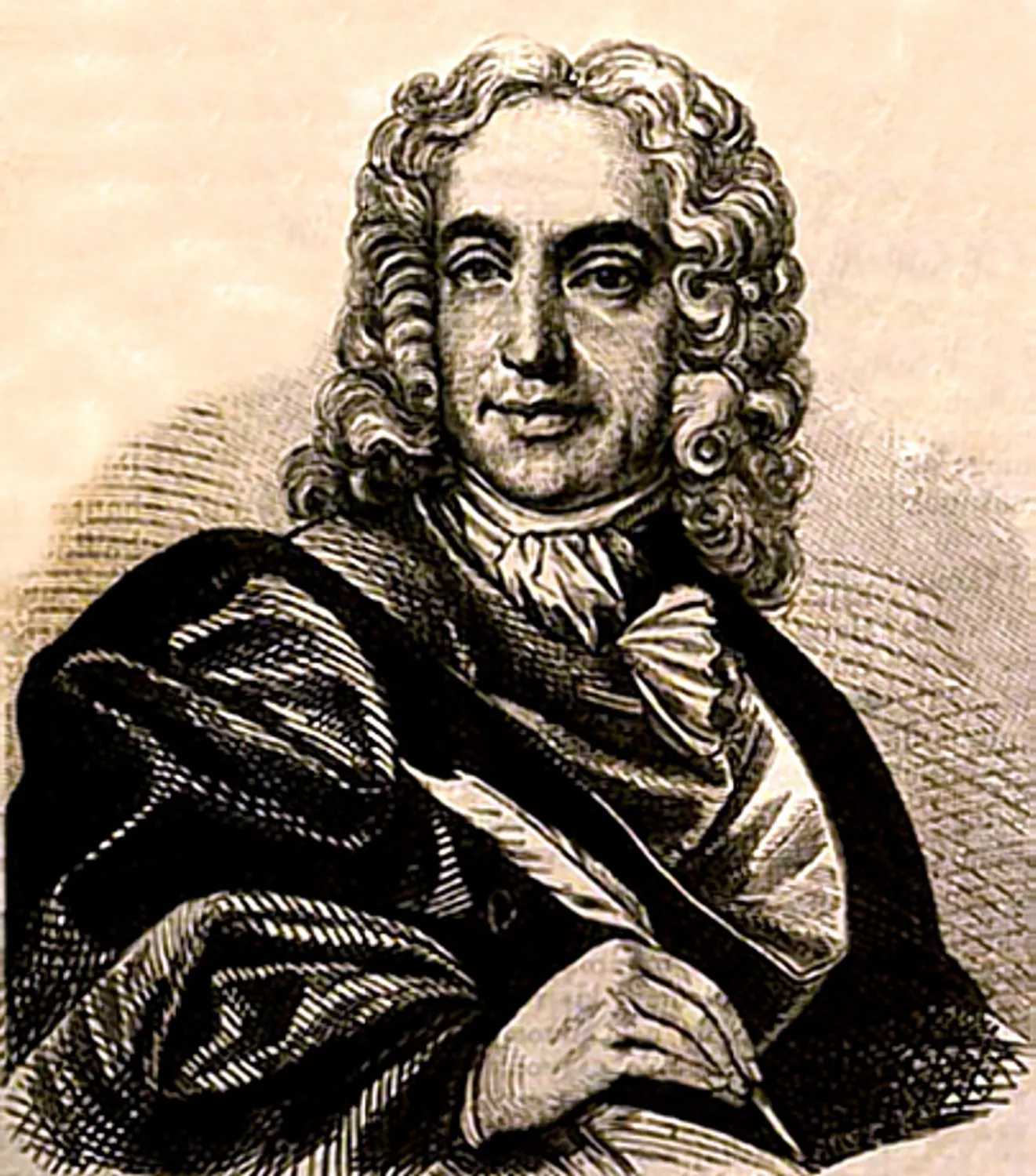
Matthias Bel
Other - other
* Ocsova, March 24, 1684 – † Bratislava, August 29, 1749 / Lutheran pastor, polymath, teacher, historian and geographer ; ; There has been much debate about his origins between Slovak and Hungarian historians, and this has not been resolved to this day. For this reason, his name is also written in different forms: Matej Bel, Matthias Belius. It seems likely that his father was a Slovak butcher, his mother was Hungarian (Erzsébet Cseszneky). He began his elementary and secondary school education in Losonc, Alsósztregová and Bánya Beszterce and finished it at the Lutheran Lyceum in Bratislava. In 1702–1703, he studied in Veszprém and Pápa at the ref. He also studied at the college, then with the financial support of the Lutherans of Rožňany and Banská Bystrica, he studied theology, medicine and political science at the University of Halle in Germany between 1704 and 1707. After graduating from university, he taught in Germany for a short time, then returned to Hungary in 1708. Between 1709 and 1713, he was a teacher and then rector of the Banská Bystrica gymnasium. Based on the examples in Germany, he tried to reform the Banská Bystrica gymnasium, the news of which spread quickly and perhaps because of this, he was invited to Bratislava to become the director of the Evangelical Lyceum. Here he continued to implement the reforms, and placed great emphasis on the teaching of geography, history and language. Meanwhile, he realized how little was known about the history and geographical conditions of Hungary, but also about the Hungarian language, so he began working on a large-scale project, which aimed to eliminate these shortcomings and to write works that would familiarize the foreign scientific public with the country and its people, and the languages used there. ; He compiled a German grammar for the Hungarians, and at the same time wrote a Hungarian grammar for the Germans (Der Ungarische Sprachmeister, oder kurze Anweisung zu der edlen ungarischen Sprache, 1725). Even before this, he had published a book on Hungarian runic writing: De vetere litteratura Hunno-scythica (On Ancient Hunnic Literature, Leipzig, 1718). Although he was aware of the Finnish-Hungarian language-related efforts, he relied more on medieval Hungarian chronicles, since he had already advocated the search for old sources and their publication in printed form. In his work on runic writing, he first raised the need to establish a scientific society in Hungary. He was one of the most outstanding practitioners of the Latin language at the time; his Latin grammar was first published in Levski in 1717, and was later published in Nuremberg in 1719. All the essential elements of the work of his predecessors and contemporaries can be found in his life's work. He took part in the cultivation of pious and theological literature: he republished István Huszti's Arndt translation (Nuremberg, 1724) and edited, among others, Thomas a Kempis's De imitatione Christi (On the Imitation of Christ, Leipzig, 1725). He published a new edition of the Hungarian New Testament with Kölesér's corrections (Leipzig, 1717), and together with Dániel Krman he revised the Czech-language Králic Bible, also used by Slovaks (Halle, 1722). He was the main representative of textbooks, primarily grammar literature, which served the mutual understanding of the mixed-language population and the cultivation of their native languages. He has pioneering merits in the fields of scientific and literary history, as well as historical source research. However, he considered his main goal to be the cultivation of state knowledge literature that explores the past and present of Hungary, its geography and ethnography, and its political and economic relations in the greatest possible detail. In the 1720s, he compiled a manuscript of more than 550 pages entitled Tractatus de re rustica Hungarorum (Treatise on the Cultivation of the Hungarians), which, however, has not yet been published in its entirety and only three copies are known. The authorship of the manuscript is also disputed, and if Bél himself wrote most of it, others certainly contributed to its writing (e.g. János Kristóf Deccard, rector of the Sopron Evangelical Lyceum). However, as early as 1723, he published a “show book” entitled Hungariae antiquae et novae prodromus (Show from the planned book on old and new Hungary). After that, he began his greatest undertaking, the writing and compilation of a series of books describing old and modern Hungary, for which he tried to recruit as many collaborators as possible from the Highlands. Among his numerous collaborators, the following stand out: Pál Lányi († 1733), deputy governor of Gömör, former iron inspector of Rákóczi, engineer Sámuel Mikoviny (Ábelfalva), who prepared the maps for the Notitia, János Tomka-Szászky (Folkusfalva), historian-teacher of the Bratislava Evangelical Gymnasium, and György Buchholtz Jr., school principal of Késmárk, a famous collector of minerals and coins. While writing the Notitia, Bél had to deal with many external difficulties in addition to the task of collecting material. His suspicious opponents accused him of espionage after seeing his planned travels, while the county nobility either ignored his activities with indifference or, fearing for their privileges, tried to obstruct his work. ; Bél was therefore forced to turn to the government for support, and he managed to win the goodwill of Palatine Miklós Pálffy. He was thus able to personally present his Prodromus to the ruler, and the council of governors ordered the counties to publish data at Bél's request, in return for which the author had to accept that his manuscript would be censored. After overcoming a sea of obstacles, he finally managed to get five volumes (Notitiae Hungariae novae historico-geographica I–V. (Az újkori Magyarország hörténeti-förfrajzi szépétése), Vienna, 1735–1742) published. The remaining volumes remained in manuscript (they were mostly published in print in the 20th century, in Hungarian and Slovak translations), and only sketches were made for certain counties. Bél's second major scientific initiative emerged as a by-product of the Notitia: the publication of historical sources. At the same time as the first volume of the Notitia, he began publishing the first domestic series of source publications under the title Adparatus ad historiam Hungariae (Sources for Hungarian History, Bratislava, 1735–1746). He published a total of twelve sources (including, for example, Oláh's Hungary), but then abandoned the enterprise planned for three decas (30 works) because in the meantime he had become a collaborator with one of his enthusiastic students, the Austrian Johann Georg Schwandtner (1716–1791), who published the most important narrative sources of our history in three volumes (Scriptores rerum Hungaricarum ceteres ac genuini – The ancient and authentic writers of Hungarian history, Vienna, 1746–1748). Bél praised and commented on several authors in it, including Anonymus, who first appeared here, and thus became the initiator of the debates surrounding the identity and reliability of the anonymous scribe. Mátyás Bél earned himself a great name and authority both at home and abroad with his scientific work. With his achievements, he surpassed all Hungarian scholars of the 18th century; neither the Jesuits nor others could compete with him. Because of his pioneering pedagogical methods, his anti-dogmatic, pietistic religiosity, and his scientific works of secular interest, both the Jesuits and his own co-religionists harassed him a lot, but no one managed to cross his scientific career. ; He was elected a member of several foreign academies and scientific societies (London, Berlin, Jena, etc.), and he was one of the founders of the first Austrian scientific society called Societas eruditorum incognitorum in terris Austriacis (Society of Austrian Imperial Scientists Remaining Anonymous) established in Olmütz, and he also worked for its journal. Bél himself published a newspaper entitled Nova Posoniensia, which was the first weekly newspaper in Hungary (published in 1721). From 1719 he no longer taught, but was the pastor of the German Lutherans in Bratislava. His house was considered a kind of intellectual meeting place for decades. In the last years of his life, he was often ill and was undergoing treatment when he suffered another stroke, which was fatal. ; ; His main works: ; Hungariae antiquae novae et prodromus, 1723, ; Notitia Hungariae novae historico-geographica, 1735–1742112, ; Compendium Hungariae geographicum, 1753, ; Scriptores Rerum Hungaricarum, 1765, ; Compendiolum regnorum Slavoniae, Croatiae, Dalmatiae, Gallicae et ; Lodomeriai, 1777.