
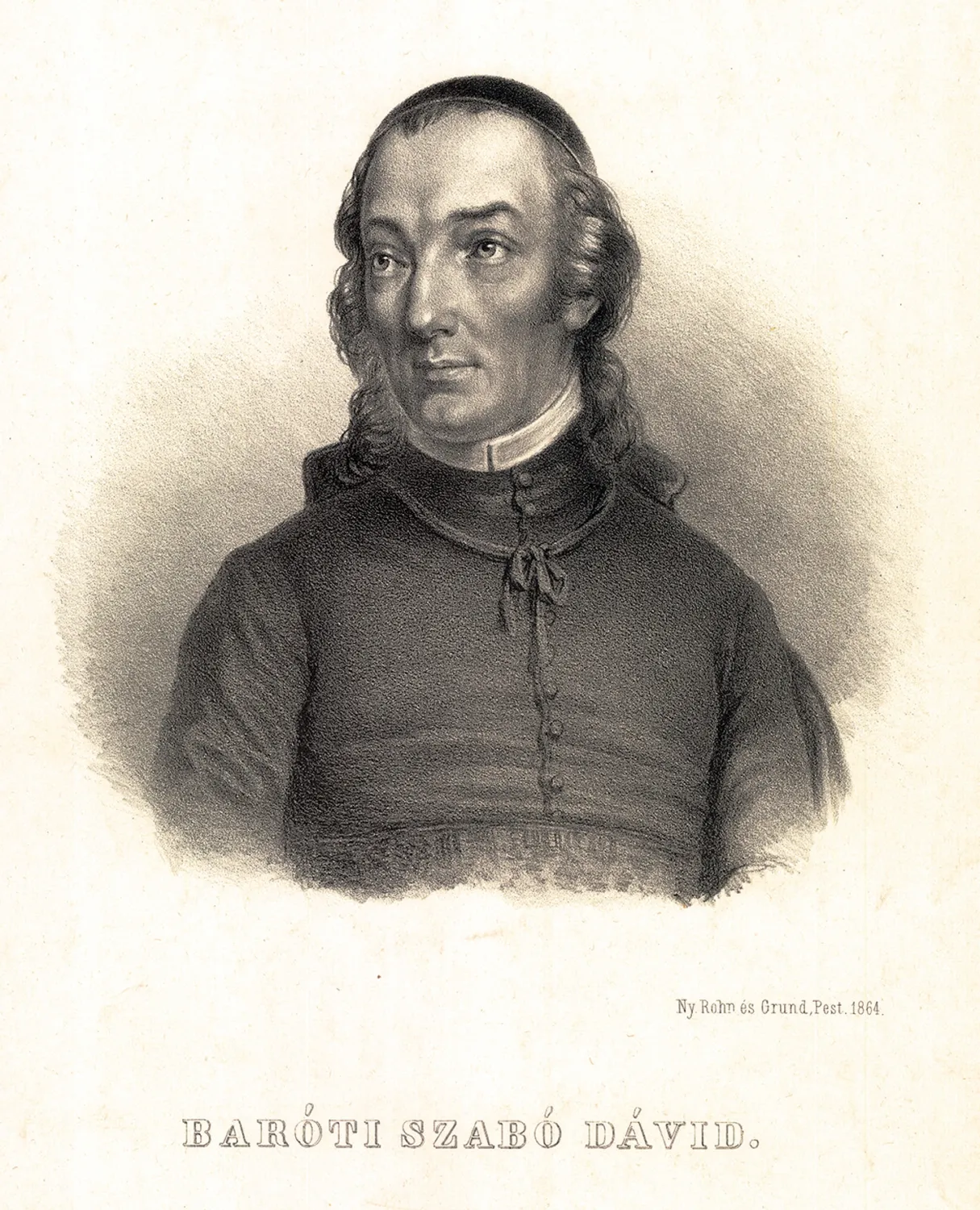
David Baroti Szabo
Other - other
* April 10, 1739 Barót – † November 22, 1819 Virt / Hungarian poet and language reformer, Jesuit, later secular priest and teacher ; ; After completing his basic training (rhetoric class), he entered the Jesuit order (Society of Jesus) on November 30, 1757. He completed his novice years (novitiate) in Trenčín, then in 1759 and 1760 he further developed his knowledge of Latin and Ancient Greek, and later became a teacher of the first grade of the gymnasium in Székesfehérvár. Between 1760 and 1763 he studied philosophy at the famous Jesuit university in Nagyszombat. In 1763–64, he taught the second grade of the gymnasium in Kolozsvár and was the supervisor of the seminary. In 1764–65 he was a poetry teacher in Eger and a Sunday sermon for students. He completed his theological studies in Košice between 1765 and 1770, at the end of which he was ordained a priest. In 1770–71 he was a teacher of poetry and rhetoric at the Oradea grammar school, director of the students' congregation, and historian of the monastery. In 1772–73 he spent his third probationary year in Bánya Beszterce. In that year the Jesuit order was banned, after which Dávid Szabó Baróti, as a priest assigned to the archdiocese of Esztergom, was temporarily assigned to teach rhetoric in Komárom. In 1777 he was appointed to Košice to teach the upper classes. He remained in this position until 1799, when he retired. As a reward for his literary endeavors, he received a pension of 600 forints from King Francis and moved to Virt with his former student, Benedekez Pyber of Györkényi, the son of his old friend and patron P. Ferenc, the chief notary of Komárom County, where he spent the last two decades of his life. ; He was a partner in the publishing house of the Hungarian Museum in Košice, in whose eight quarters (between 1788-1792) he published, in addition to numerous poems, excerpts from Milton's Paradise Lost, Virgil's first eclogue, and an epistle written in alexandrine to Batsányi (II. 135–37.), which, however, he did not include in later editions of his works. Several of his poems were published in the Magyar Hírmondó (1781–1782, 1792–94.) ; ; Works according to edition: ; • New volumes of poems of arom books. Kassa, 1777. (Ims. M. Hirmondó 1780. 3rd issue. 2nd edition: Vers-Kozorú and 3rd edition: Költeményes Munkái alatt.) ; • Peasant farmstead, which was compiled from Vaniere into six-foot Hungarian verses. U. there, 1779–80. Two volumes. (Ims. M. Hirmondó 1780. 78th issue. Improved edition in one volume U. there. 1794.) ; • Kisded dictionary, which presents the rarer Hungarian words in verses reminiscent of the alphabet. U. there, 1784. (2nd edition. U. there, 1792. This is a completely new work, much more extensive and purely in the form of a dictionary.) the 2nd edition of 1792 in the MEK; • A Wreath of Verses, which he took to the new measure, and over time he straightened out and composed from his later poems. U. p. 1786. Three sections. ; • Who is the winner in moderation? According to the dialect of the Transylvanians. U. there, 1787. ; • His poetic works. U. there, 1789. Two volumes. (In this edition containing many new works, the following was first published in full: The Lost Paradise, in six verses. Improved and expanded edition. Komárom, 1802.) ; • On the death of the dignified Baron General Lőrinczi Orczy. To the sorrowful homeland. Pest, 1789. ; • On the day of the Abauj county holiday. (The sensitivities of two Hungarian patriots on the joyous occasion of the so-called Abauj County. On the 16th day of St. George's Day 1790. In a booklet with Bacsányi's poem.) ; • To the Hungarian cavalry (on its glory in the Turkish war. Verses. 1789.) Place n. 1790. ; • A joyful poem on the joyous occasion of the so-called Szabolcs County. Whitsun 30. 1791. Košice. ; • To the city of free King Košice, when King Joseph, the Palatine of Hungary, would be the first to board the Tisza, having seen the noble knights who had risen from there. U. there, 1797. ; • Observations on orthography and grammar together with Hungarian prosody. Komárom, 1800. ; • Floral Hungary. U. there, 1803. ; • The first volume of Virgil's Hymns, or books I-V. Vienna, 1810, followed by the second volume, books VI-XII. and the ten eclogues, in Pest in 1813. ; • Some of his left-over poems were published in Remény (1851) and Sürgöny (1865. 221.), and from his unpublished papers, József Ágoston and Virgil Koltai published poems and letters in Figyelő (XII. XIII. 1882.), his letters to Kazinczy in prose and verse were published in volume I of Kazinczy Ferencz's correspondence and to Ádám Horváth, with his reply, etc. there, p. 580. ; ; KISDED SZÓ-TÁR, written by DÁVID BARÓTI SZABÓ, Second edition, expanded. In Košice, with the letters of János Ellinger. 1792.