
Church history of Bart village
Other - other
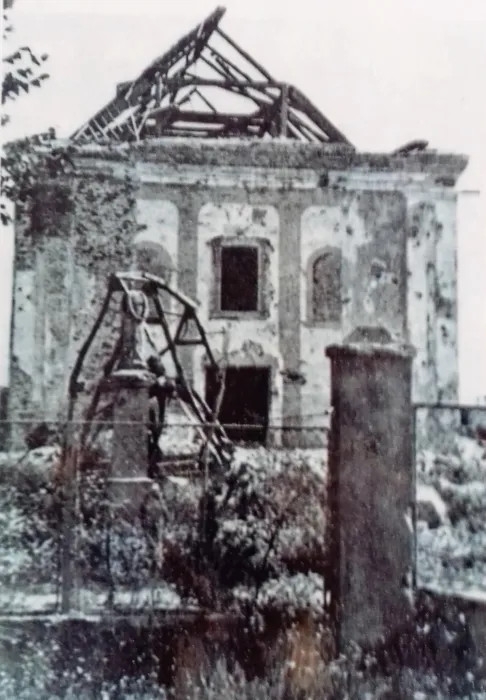
Bart (Bárt) first appears as a Hungarian large village in 1223, when a property dispute between the inhabitants of Bart and the Esztergom chapter was resolved. It is also mentioned in a later (end of the 13th century) document, according to which Péter Szölödi's son, Hant, sells Szelezsény to the Esztergom chapter. The sold estate was located in the neighborhood of Bart, Libád and Gyiva. After the childless death of Mózes Barti's son Jakab, King László IV donated this estate in 1272 to the chief of the mines of the Huntpázmán family, András, and his brother, Gergely, the provost of Esztergom. ; The local parish was founded around 1350, no precise records can be found. In the 15th century, it belonged to the landownership of the Esztergom archdiocese. According to the censuses of 1549, Bart belonged to András Báthory. In the urbarium (visitatio canonica) of Archbishop Miklós Oláh, written in 1560, we can read, which is the only one from the time of the Turkish occupation, that the pastors of the regions beyond the Danube had to flee, so the parish of Bart, along with the surrounding settlements, remained empty. According to the record, only in Szőgyén and Nagyölveden, there was an active pastoral service. We can also read here that in 1544 Mehmet Bey raided all the way to Léva, but returned from there with great losses. A similar fate befell Veli Bey, who in 1551, on his way home from his raid in Mátyusföld, was attacked by Lőrinc Zoltay with 93 horsemen near the village of Bart. The exhausted Turks were routed, twenty-eight of them were slaughtered, and fifteen were captured. ; The village of Bart is mentioned among the villages that surrendered to the Turks in 1593, by which time only seven portas remained in Bart. In 1647, taxes were paid for only two and a half portas. According to the 1696 census, the settlement was still largely deserted, with only two serfs living in it. Bart was completely plundered by the Turks, the people were killed, and others fled the village. Its lord at that time was the Archbishop of Esztergom, who was then starting to settle the village. There was an old church in the village, dedicated to the Exaltation of the Holy Cross. The church, built of stone, was completely destroyed by the Turks. This old church had previously been used by the Calvinists. The 1701 visitation mentions the village of Bart as the first daughter church of Nagyölved. The local parish priest, György Rudnay, the parish priest, Ferenc Farkas, is Catholic, and the schoolmaster, Péter Lenkei, is Catholic. The number of souls is one hundred and sixty-two Catholics, one hundred and sixty-six Calvinists, and two Lutherans. Bart's parish was restored in 1718. All this is proven by the church visitation record of György Sóvári Kellió, the provost of Esztergom, from 1732, according to which the following parishes existed: Bátorkeszi, Bart, Köbölkút, Kicsind, Kőhídgyarmat, Kéménd, and Muzsla. The entry in György Sóvári Kellió's church visitation record from 1732: ; Bart, since 1718, the year of the restoration of its parish, is the "Mother Church" of the prince-primate. In 1732, the number of Roman Catholic souls in Barton who could confess was 187. ; The visitation already mentions a makeshift church where masses are held. This was also dedicated to the Exaltation of the Holy Cross. This makeshift church was completely destroyed by a huge storm. Thus, it became necessary to build a new, solid church. In place of the makeshift church, a new Baroque church was built in 1732 on the old foundations, with the funds of Count Imre Eszterházy (Archbishop of Esztergom from 1725 to 1745). This was also dedicated to the Exaltation of the Holy Cross. The parish priest at that time was the venerable György Budai, the churchwarden András Csókás, and the schoolmaster István Nyulas. The church then consisted of a main altar and there was room for a side altar. The church also had two confessionals and a baptismal font. The church's celebration was held every year on September 14th, the feast of the Exaltation of the Holy Cross. After the canonical visit in 1735, His Excellency, at his own expense, expanded the church with a bell tower and a wooden tower. The wooden tower was completely rotten in 1755, so a new bell tower was built where the three bells were suspended. Its parish priest at that time was the Reverend József Devecsery. In 1755, the population of Bart was 433, of which 337 were able to confess. In the settlement, under the leadership of the Order of Saint Francis, a Cord-Bearing Society was formed among the faithful, which the parish priest tolerated because it did not infringe on his authority. ; Since the population was constantly growing and everyone was Roman Catholic, in 1793 the old church was completely demolished and a new single-nave classicist church was built, which was again dedicated to the Exaltation of the Holy Cross. In 1880, the interior of the church underwent alterations that were characteristic of Hungarian architecture. The church was expanded in the thirties of the 20th century with side naves in the style of that time. After the expansion of the church, parish priest László Simor donated an altar made of gray marble and a baptismal font made of white marble to the church. The church was hit several times during World War II, but was completely damaged when the tower was blown up (the Russians had an artillery observation post in the tower). Thus, the church gradually turned into a pile of ruins. Only the sanctuary and the walls of the naves remained of the church, as well as the two bells and the altar made of gray marble. Traces of shells can still be seen on the altar today. Since the settlement was almost completely destroyed in 1945, the people had to wait for the construction of the new church. But since the local population felt the need for prayer and lacked services, they set up a prayer room in the local school. The remaining or less damaged equipment was moved to the destroyed church and used as a makeshift. Unfortunately, the school was nationalized, so the prayer room had to be relocated to the parish. The makeshift was moved to the right side of the parish. This situation soon proved untenable, as the number of believers was increasing. ; At the initiative of Pastor Alajos Tóth, caretaker József Csókás and with the intervention of comrade Pavol Cinkovsky (then president of the Hungarian National Bank), the necessary permits for the construction of the new church were obtained at the competent authorities. After the drawings were completed, construction began on November 6, 1957. The masons and carpenters who arrived from Nitra ate with a different family every day. And every day, twenty local residents worked on the construction site completely free of charge and without pay. By the autumn of 1959, the roof was finished and covered with tiles. In December 1960, the floor was laid. The rear sanctuary and the nave are the remains of the old church. The higher side aisle was built in the style of Romanesque three-nave basilicas. In September 1960, a replacement bell was completed for the bell that was completely destroyed in the war. It was temporarily placed on a wooden bell stand. ; The first mass was celebrated on September 17, 1960 at the remaining gray marble main altar (donated by the former parish priest László Simor, today the side altar of the Good Shepherd of the Heart of Jesus). In 1960, the Holy Szórád Church in Bratislava was liquidated and two bells, a modern altar made of white marble and a harmonium were received from there as a gift. The main altar made of white marble was erected in January 1961. In August 1963, the iron staircase leading to the tower and the belfry were completed. After that, the bells were placed in the tower. The construction was completed on September 23, 1963. The external brizolite plastering work lasted until October 3, 1965. The painting of the church was done by the painters Imre Szúnyogh and Gyula Buchlovics in September 1967. In 1968, the vestibule was added in accordance with the new church. The cross on the main altar was donated by Péter Csókás with Klára Morvai and Sándor Csókás with Franciska Morvai. The statues of the Sacred Heart of Jesus and the Immaculate Heart of Mary were also transported from Bratislava from the Church of St. Szórád. The side altar of the Blessed Sacrament with two brown marble columns was donated to the church by parish priest László Simor, together with the white marble baptismal font. On the other side altar is a statue of Christ the King, which was donated to the church in 1938 by Simon Garai from Cseke and his wife. The Pieta statue was donated to the church by Ignác Brecska and Katalin Nyitrai. The statue of Saint Anthony was donated by the faithful. The small statue of Saint Teresa was donated by the Rosary Society for the benefit of the church. The church is also decorated with statues of Saint Joseph and Saint Anthony. In front of the entrance to the sanctuary, there is a relief of the four evangelists with the inscription "Go and teach" and the Holy Spirit in the form of a dove. In 1972, a Lourdes grotto was built in the vestibule, with a statue of the Virgin Mary of Lourdes and Saint Bernadette kneeling below her. There are thank-you signs next to the Lordesi statue cave, and a Madonna statue below it. (Holy See Councilor Alajos Tóth …) The missionary cross “SAVE YOUR SOUL” and the years 1928 ….. are located in the vestibule, on a stone pedestal. The fourteen stations of the Way of the Cross were made by Gyula Nagy, a painter. On September 17, 2000, Dr. Sándor Bartal, representing Budapest-Lipótváros, donated a Hungarian flag decorated with the image of Saint Stephen to the church. There are two wooden processional crosses and two processional flags in the sacristy. One with the image of the Immaculate Heart of Mary and the other with the heart of Jesus Christ. Behind the main altar we see a painting depicting the elevation of the Holy Cross. The calvary consisting of fourteen stations located in the church garden was erected in 1931 during the activities of parish priest László Simor. Until 1918, Roman Catholics belonged to the Esztergom bishopric. Then again, after the Vienna decision, until 1945.