
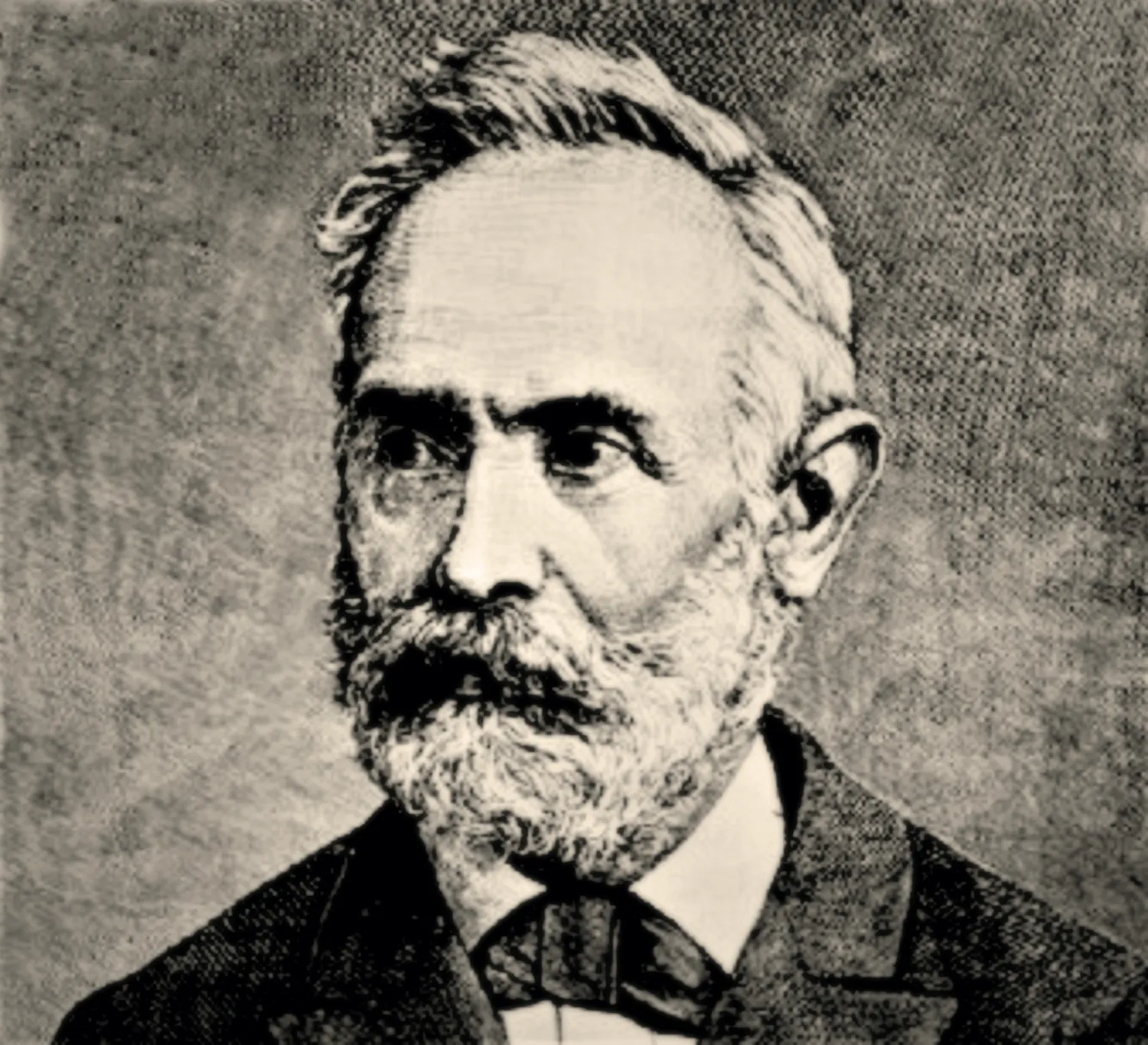
Ballagi Mor
Other - other
* Inóc, March 18, 1815 – † Budapest, September 1, 1891 / theologian, linguist, member of the Hungarian Academy of Sciences ; ; His original name was Móric Bloch. He was born into a Jewish family, had fourteen siblings. He learned Hebrew from his father and became acquainted with the Talmud. He trained as a Talmud teacher at Beth-Hammidras in Pápa, then studied philosophy in Nagyvárad. After that, he worked as a home tutor in Mór and Surány, while studying Greek and Latin. In 1836–1837, he also studied philosophy at the Pápai Reformed College, and in 1837 he studied mathematics at the University of Pest, and also published articles in various newspapers (primarily Hasznos Mulatságok and Pester Tageblatt). From 1839, he continued his university studies in Paris. In 1840, at the urging of József Eötvös, he wrote a pamphlet entitled Zsidókról, which aroused great interest in the Bratislava parliament. He participated in the program aimed at spreading the Hungarian language among the Jews. He translated and published the Five Books of Moses in Hebrew and Hungarian in 1840–1841, to which he added explanations taken from the Talmud. Based on this work, the Hungarian Academy of Sciences elected him a corresponding member. In addition to translating, he also dealt with linguistics, but also continued his theological studies in Tübingen, Germany. In 1843, he was baptized and converted to the Lutheran faith, later becoming a Calvinist. After obtaining his doctorate in 1843, he became a teacher at the local Evangelical Lyceum in Szarvas. In 1848/1849 he was the administrator of the revolutionary army in Békés County, then served with Lajos Aulich and Artúr Görgei. After the defeat of the War of Independence, he could not continue his teaching career, so he farmed on rented land in Kondoros. In 1851 he was appointed a teacher of theology at the Kecskemét ref. From 1855 he was a teacher of religious doctrine and the interpretation of the Holy Scripture at the Reformed Theological Academy in Budapest. In 1858 the Hungarian Academy of Sciences elected him a full member (as the first of Jewish origin). Two of his sons: Géza Ballagi (1851–1907), historian and lawyer, and Aladár Ballagi (1853–1928), historian, also became members of the Hungarian Academy of Sciences. From 1861 he was also a member of parliament. In 1877, due to his deteriorating health, he retired and from then on he worked exclusively on linguistics. He also published several German-Hungarian dictionaries. ; ; His main works: ; Hungarian proverbs (collection of proverbs, idioms, I-II., 1850, ; Elementary textbook of the Hebrew language, 1856, ; Biblical Studies I-II., 1865–1868, ; Complete dictionary of the Hungarian language I-II., 1866–1873, ; Brassai and the language renewal, 1876, ; The new development of our language, 1881, ; The historical continuity of language development and the Nyelvőr, 1884, The ortholog regulation of our vocabulary and the school, 1890.