
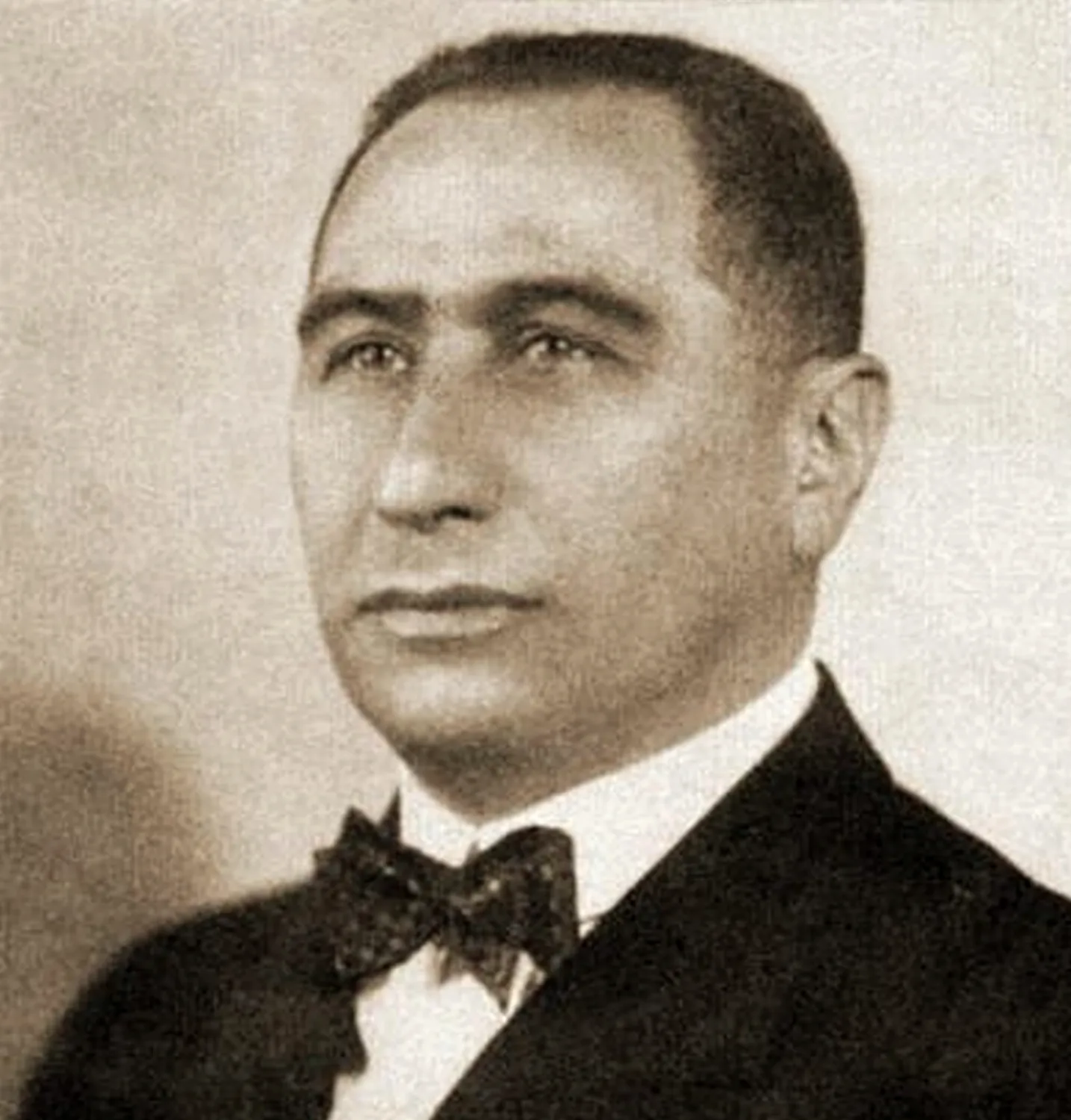
Leopold Aschner
Other - other
* Assakürt, 27 January 1872 – † Budapest, 18.9. 1952 / technical entrepreneur, industrialist, patron ; ; His father was a general merchant, so he only completed four middle school years, then became a merchant's assistant. After moving to Budapest, in 1896 he joined the Egger Béla és Tsa. Huszár utca company as an official, the predecessor of the United Incandescent Lamp and Electric Co. Ltd. In 1918 he became commercial director, and then in 1921 the company's first CEO. Thanks to the working methods he introduced, the company developed into a modern international corporation. He is credited with creating the Tungsram brand name, establishing the Tungsram factories in Budapest and Central Europe, and establishing the United Incandescent Research Laboratory in 1921 under the leadership of Ignác Pfeifer (1867–1941), who had been recalled from Germany. From 1937, Lipót Aschner entrusted the leadership of the Laboratory to Zoltán Bay (1900–1992). Pál Selényi (1884–1954), Imre Bródy (1891–1944), the young Ernő Winter (1897–1971) and Tivadar Millner (1899–1988) established the Laboratory's good reputation and later international prestige with their inventions already during Pfeifer's time. They introduced the production of radio tubes, and one of the most important products they developed was the krypton-filled tungsten filament incandescent lamp. Aschner recognized that one of the pillars of the development of the 20th century was professional education, which, if necessary, should also be supported financially. In 1935, he offered 2,500 pengós per year to the Minister of Culture Bálint Hóman (1885–1951), insisting on anonymity. He made a foundation of 300,000 pengós for the establishment of a department of atomic physics at the Royal Hungarian József Nádor Technical University. Zoltán Bay conducted his successful lunar radar experiments in 1945 in the laboratory of the United Bulb. Aschner had workers' apartments built, a swimming pool, a weekend resort base, a community center, and generously supported the Újpest Gymnastics Association. During the German occupation of Hungary in 1944, he was taken to a concentration camp by the Gestapo, from where he managed to escape to Switzerland in 1945, allegedly thanks to a ransom of 100,000 francs from Tungsram Rt. He returned home in 1948 and was the vice-president of the nationalized United Light until his death.