
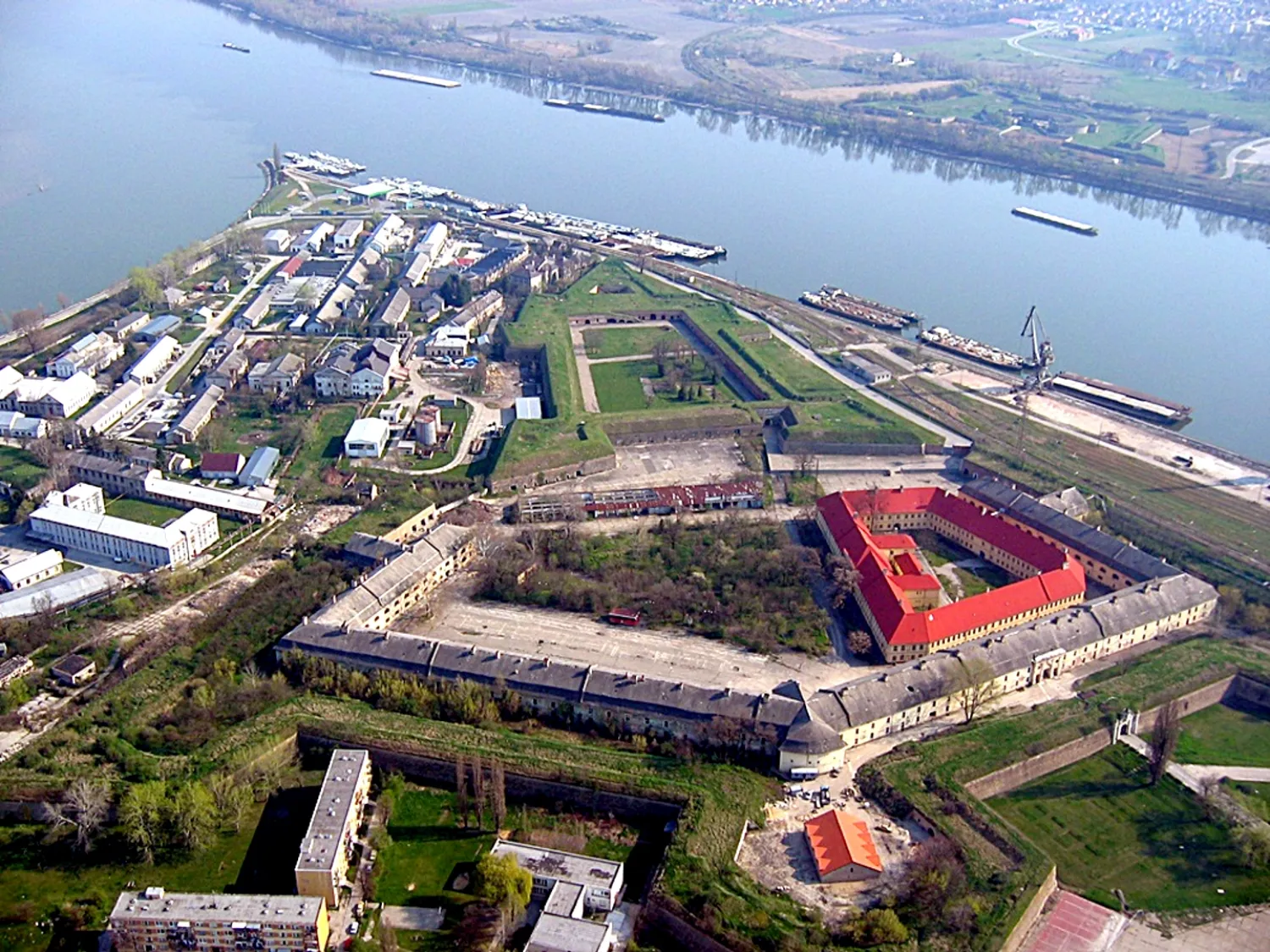
North Komárom Castle and Fortification System
Outstanding national value
Anonymus (born 1173 – † 1196) was the first to report on the location of today's Komárom castle, the inhabited parts of the area and the defensive possibilities provided by nature. In the Gesta Hungarorum, Anonymus says the following about the founding of the city: "But not only this did Ketel receive, but much more, since after the conquest of all of Pannonia, the leader Árpád gave him a large land for his loyal service near the Danube, where the Váh River flows into it. Here, Ketel's son Alaptolma later built a castle and called it Komárom. He gave two-thirds of the people he brought with him and those he won from the leader to serve this castle. After a long time, Ketel himself and his son Tolma were buried in this very place in a pagan manner..." Komárom was a royal castle, close to the western border of the country, so it was natural that it was constantly strengthened and improved over the centuries. The Tatar invasion, during which a considerable part of the country was destroyed, proved the necessity of these fortifications. After the Tatars left the country, King Béla IV greatly supported the construction of cities. In a short time, he granted significant privileges to 25 settlements, and Komárom was among them granted city rights in 1265. Béla IV sold the Komárom castle and the associated estates to Margrave Henok (Henel, Henul). However, the Margrave's sons were unable to pay their debts, so the king confiscated the castle and in 1265 presented it, together with the village of Komáromfalva, to Ispan Walter. He surrounded the castle and the area of the current Öregvár with walls. Although we have no data on this, we assume that these walls were built of stone, so we can date the construction of the first stone fortress or castle to the years 1265–68. King Matthias often and gladly stayed in the Komárom castle. He also had it rebuilt by Italian masters. In another of his works, in the preface to the Averolinus translation, he praises the beauty and grandeur of the royal palaces of Visegrád, Komárom and Buda. Bonfini writes more about the castle built by "the most outstanding Italian masters": "A little further on, in the corner of the island, the Komárom Castle, built on a large area, can be seen. Large palaces rise in its spacious courtyards, with beamed ceilings everywhere, made at enormous expense. The ship called Bucentaurus, built for trips on the Danube, is stationed here, its furnishings are palace-like: from the beginning to the end, a row of dining, sleeping and social rooms runs along it, separate for men and women." Although no engravings or drawings have survived from this era, it can be stated based on the data available to us that by the end of the 15th century, the Komárom Castle had become a building complex satisfying royal needs with its wonderfully constructed palaces. The century and a half of Turkish occupation changed the character of the castle and the direction of its further development. The royal castle, which served as the center of state offices and was reserved for the entertainment of the royal court, once again became the most significant element of the country's defense system, the scene of important battles and sieges. With the invention of the cannon, the principles of castle and fortress construction changed all over the world. In the case of Komárom, the need for change became clear in 1527. At that time, the armies of Ferdinand I besieged the castle, in which János Szapolyai defended himself with his soldiers. Ferdinand I captured the castle after a half-day siege and immediately took care of the renovation of the destroyed walls, which he entrusted to the Italian architect Decius. The repair work was completed in 1528. At that time, a rampart was also built between the castle and the city for better defense. We do not know to what extent Ferdinand succeeded in renovating the castle, but it is known that in 1529, Ferdinand II. Under Suleiman the Magnificent, the Turks managed to occupy it for a short time (the imperial garrison abandoned the fortress and the Turkish army besieged the empty castle). After the recapture, Ferdinand had the damaged defenses restored, but in 1535 he was forced to pawn the castle again to the Turks. After the fall of Buda in 1541, the Turks forced Ferdinand to undertake more serious fortification work. In 1544, he regained the castle and ordered its construction. He probably commissioned Pietro Ferrabosco to prepare the construction plans, who considered the construction of a multi-angled bastion system to be the best. On March 23, 1546, construction began on the present-day Old Castle in Komárom, using the new experiences in fortress architecture. The stonework was supervised by master Giovanni Maria de Speciecasa, and the waterworks by Mathias Dusco, Venzel Cservenka and Paul Puls. The construction was supervised by Michael Schick from 1546 to 1550, by Leonhard Müller from 1550, and by Francesco Benigno from 1552. The fortification works were led by Domenico Castaldo in 1551. Ferdinand asked master Castaldo to quickly build the eastern part of the fortress. The year 1550 was engraved on the memorial plaque above the gate of the Old Castle, which is probably the year the gate was built. The rebuilt Komárom castle stood the test in 1594: Sinan Pasha surrounded it with his army of one hundred thousand, besieged it for a whole month, but was unable to take it. We already have a precise plan from this period of the construction of the fortress (1572), and it is clear from this that the shape of the external defenses has not changed to the present day. During the Turkish campaign of 1663-64, the fortified town of Érsekújvár fell into the hands of the besiegers. With this, the Turks broke through the previously connected defense system, so during the reign of Leopold I, fortress construction became an important task again. Leopold I ordered the construction of two new fortresses: the Lipótvár near Galgóch, which served to protect the Váh River, and the so-called "Újvár" in Komárom. The fortress named after him was built in a short time between 1665 and 1669, while the construction of the Újvár lasted from 1663 to 1673. The works were carried out using the most modern Italian and French fortress construction experiences, based on the plans of the General of the Engineering Corps Franz Wymes. The New Castle, built with great care, was completed in 1673, according to the memorial plaque above the main gate. The western bastion and the part south of it were made of solid building material, and the northern wing was made of earth. The war events between 1800 and 1805 directed the attention of the Austrian military leadership to Komárom again, as military posts and bases were needed along the Danube. In 1807, excellent military engineers inspected Komárom, carried out the necessary surveys, prepared the plans, and then had the central fortress restored. At that time, the northwestern wings, previously made of earth, were rebuilt in brick. This was the third stage of the construction of the New Castle. The works began on August 20, 1808, and were completed on September 4 of the same year. There was a need for great haste, because the following year, fleeing Vienna, which had been occupied by Napoleon, the royal family found refuge in the newly built fortress. As part of the major works, a huge "U"-shaped barracks was built in the courtyard of the fortress in 1810, parallel to the walls, and a substantial command building was erected in the southern half of its interior in 1815. The construction of the New Castle was thus completed. Although minor and major repairs were carried out on it throughout the century, the original shape of the castle was not changed. Between 1827 and 1839, the Old Castle was also rebuilt internally, during which a new dungeon system was created in the fortress walls. With the shift in the center of gravity of the defense in the 19th century, In the 17th century, a new type of fortress was created, more precisely a defensive fortress system, which can be divided into two main elements, namely the central fortress (citadel – in the case of Komárom, New and Old Fortress), and forward fortresses or fortress chains. In 1809, the construction of the huge protective ring took place, consisting of six bastions connected by a rampart. This fortress chain was built from the ground, well beyond the city wall built in the 17th century, between the Little Danube and the Apály Island. The fortification works were directed by the Palatine of the country (Patron József), after whom this part of the fortress system was named the Palatine Line (Palatine Verschanzungen, Palatinal-Linie, Linea Palatinale). After the preparatory works, the final construction of the huge fortress line in stone and brick began. The five bastions (werk) and the fortress wall connecting them were built between 1839 and 1847. The year 1844 on the eastern facade of the Pozsony Gate next to Bastion I is therefore not the date of the start of construction, but the year of the construction of the aforementioned gate. The defensive line, built 2–2.5 kilometers from the central fortress, was intended to protect the area between the Danube and the Váh. The five bastions are connected by fortress walls and other defensive works, so the building complex forms a closed line. The ground plan of the bastions is pentagonal. The construction of the Váh Line took place in the mid-1860s of the 19th century, almost twenty years after the construction of the Nádor Line. This is reflected in its architectural concept and solutions. The architectural work accelerated, especially as a result of the Austro-Prussian War of 1866. The fortress chain consists of six main fortresses (batteries VI, VII, VIII, IX, X, XI), of which only the first two fortresses (batteries VI, VII) correspond to the concept of a bastion (werk). The gate and some casemates of the last bastion of the Váh line, the XIth bastion, have remained intact. Its function was to close the defensive line and at the same time connected the outer defenses of the New Castle with the Váh line. Despite the fact that the protective ring of the Komárom fortress system was interrupted and some parts of the fortress were demolished in the first half of the century, essentially the entire structure still stands. Some parts of the central fortress and bastion I were demolished, of which only the Pozsony Gate and a part of the retrenchment survived. Part of the fortress wall between bastions II and III was used for road construction, while parts III and IV. The section between the bastions was demolished during the construction of the railway line to Bratislava and Gúta. A longer section of the fortress wall between the IX. and X. walls disappeared from the Váh line. Recently, the renovation of several bastions has continued in connection with enterprises, and the city provides a long-term lease for these, while the ownership remains unchanged. We hope that this heritage of the city will remain for a long time and will also become a World Heritage Site.