
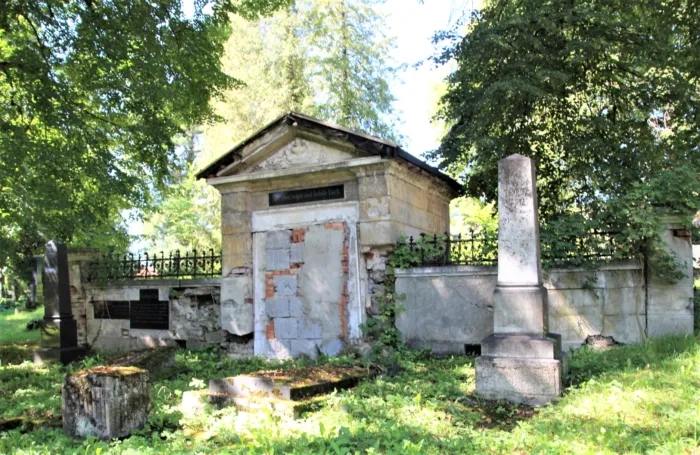
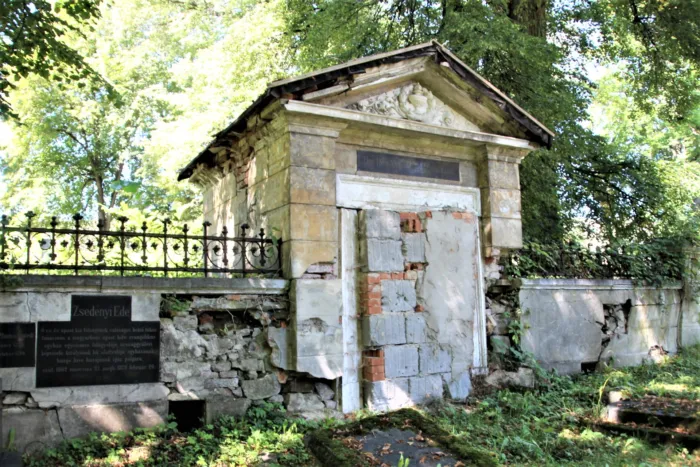
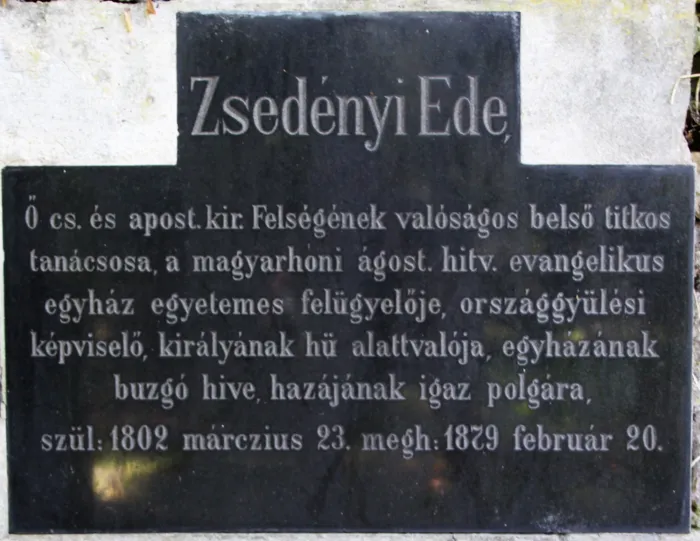
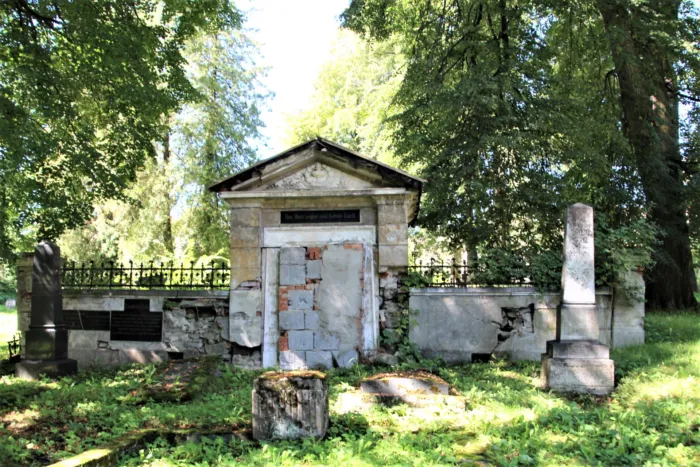
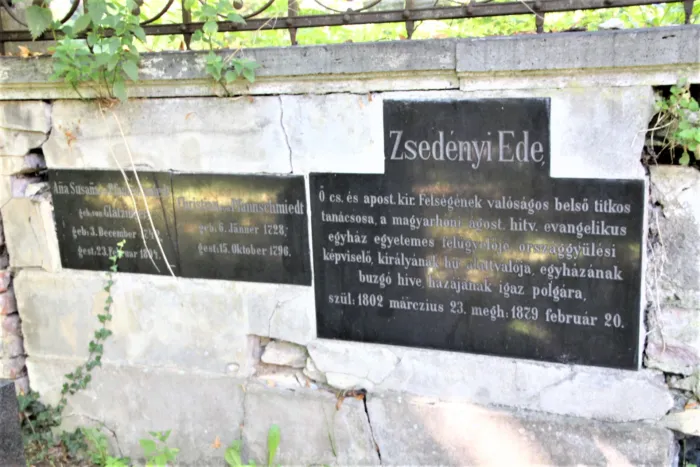
The resting place of Ede Zsedényi
Cemeteries, tombstones, grave sites
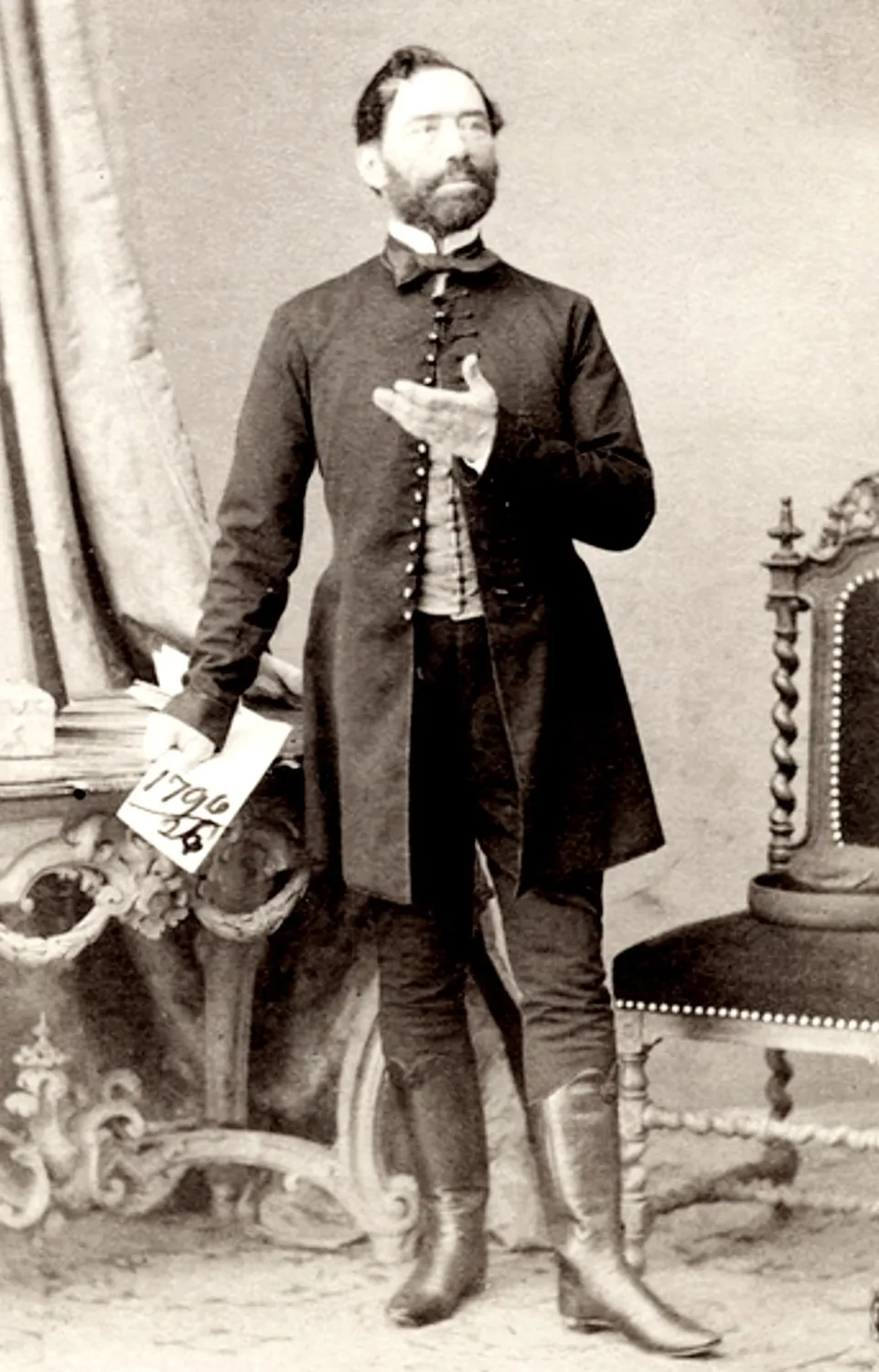
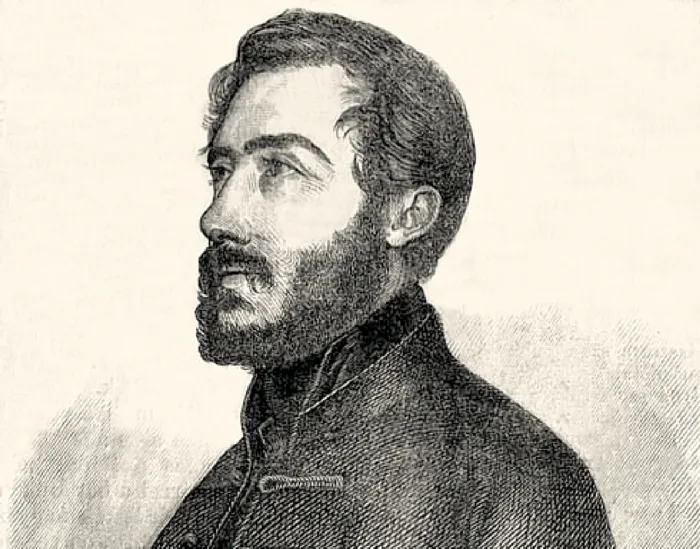
Ede Zsedényi Lőcsei (born Ede Pfannschmidt, Lőcsei, March 21, 1804 – Budapest, February 20, 1879) was a politician, parliamentary envoy, then a member of parliament, and an Evangelical church district supervisor. ; He was born into a Cipszer family, one of his ancestors having moved to Hungary, to the former Szepes County as a German imperial nobleman, where they soon became one of the most prestigious Protestant families in the county. In 1649, his ancestor received Hungarian nobility from Ferdinand III with the surname Lőcsei. ; After completing his studies, Ede entered politics. Together with his wider family, he Hungarianized his name from Pfannschmidt to Zsedényi in 1824. From 1833, he was the government-party envoy of Szepes County, and was also its leader in the 1839-1840 parliamentary assembly. During the revolution and war of independence of 1848–49, he took an old-conservative position and remained with the court, and in 1848, as a ministerial advisor, he accompanied King Ferdinand V to Innsbruck. For a while, he displayed such an old-conservative (or "47") attitude that he even countersigned the letter of March 20, with which Vienna wanted to please the nation instead of constitutional achievements. ; At the main hearing of the trial of Lajos Batthyány, which began on August 16, 1849, Zsedényi testified in favor of the former prime minister, but - despite being known as a man loyal to the emperor, and therefore not biased towards Batthyány - this did not change the verdict. However, the role of Josip Jelačić and the questionable measures of the camarilla soon disillusioned him from his faith in the court party and forced him to retreat. He followed the events then and later, and he was very active in the interests of Protestant autonomy. At the Késmárk meeting of the Tisza Lutheran Church District, he vigorously protested against the Protestant patent of 1859, for which he was brought before the law by the absolute power and sentenced to several months of imprisonment. The case also brought him national fame. After the patent was revoked, the Tisza Church District elected him as the church district supervisor, as the co-chairman of Superintendent Károly Máday. He held this position until 1875. ; In 1860, despite this, he again took up work at the Chancellery, where he also left his post with the retirement of Miklós Vay. Only after the compromise did he appear in parliament again, at first as a member of the Deák Party, and then, after the merger, as a member of the Freemason Party. In 1875, he had a falling out with the then president of the Academy of Music, Ferenc Liszt, and interpellated the famous composer in parliament as a member of the finance committee. Following the debate, the Zenészeti Lapok wrote about the incident: "Never before have such scandalous, primitive, and more sensitively offensive statements been made in parliament...". ; He used his considerable wealth, which he had acquired through his proverbial thrift, for evangelical church and school purposes. He left his valuable library to the Levant parish. ; One of his relatives, Béla Zsedényi, also became a politician, and was the president of the Provisional National Assembly in 1944-1945, and then a member of parliament until 1947. ; Works: ; - Speech of the parliamentary delegate of Szepes county (Levant, 1844) ; - Ungarns Gegenwart (Vienna, 1850) ; - Die Verwandtigkeit des Ministeriums und Ungarns Zustände (Vienna, 1851) ; - Vertheidigungs-Rede (London, 1860) ; ; After the death of Ede Zsedényi, the title page of the issue of Vasárnapi Ujság published on February 23, 1879, commemorates him as follows: ; ; The House of Representatives has a deceased, one of its oldest and most respected members, - Ede Zsedényi, after a prolonged illness and a few weeks of serious illness, passed away on the 20th of this month at 10:00 a.m. d. 1/2 in the 77th year of his life. The House, upon receiving this news, immediately suspended its deliberations at 11:00 a.m., thus wanting to give expression to its worthy grief at the first moment. ; His grief is worthy, indeed, because in the deceased, a very old figure of our public life, constantly respected for his talents, character, activity, and selflessness, has left the stage of life. Ede Zsedényi, the famous conservative envoy of Szepes County at the Bratislava Estates' Parliaments, the friend and party partner of Ferencz Deák in the Houses of Representatives since 1865, a very talented member of the Liberal Party and an authority in financial matters and the chairman of the Finance Committee at the latter Parliaments, a great preacher of the principle of thrift in word and deed, a man of impeccable character and patriot in all areas and at all stages of his life: he was truly worthy of the respect that surrounded him in life and the pain that is expressed over his coffin. ; And under the impression of this pain we undertake all the less to give a detailed and exhaustive picture of his life and public career, - because - we had the opportunity to do so even during his lifetime. In our newspaper a few years ago (issue 43 of 1875) we gave his portrait and biography, for which we obtained the data from him himself, and only last year, during our parliamentary pictures, we repeatedly remembered him. We refer our readers to these publications, and here we only compile a few sketchy features of the deceased's character. ; Ede Zsedényi (surname Pfannschmied) was born to Lutheran parents in Levoca in the Spiš region, and he never denied his Spiš and Lutheran nature. He represented his native county, or rather one of its districts, in every parliament since 1832 /6-ki. * Since the 1875 parliament, he always spent his days and weeks free from official and public affairs in this county, and until the end of his life he remained the most constant figure of the wildly romantic region of the plateau guarded by the Carpathian mountains, the spa and mountain landscape of Tatra Füred, the lakes and pine forests of Bérez, where everyone knew and considered the noble-hearted, eternally young in spirit, hardened in body and steadfast veteran as his father. He never forgot the interests of his county alongside the interests of the homeland, and he was always able to reconcile them, and Szepes rightfully looked upon him as the guardian of its interests and as its pride and the apple of its eye. He was just as loyal a son of his church, and always one of its strongest pillars. His spirit was built on its foundations: studying exclusively in Protestant institutions - only law at the Bratislava Royal Academy - he was convinced for the rest of his life that the Protestant educational system and schools were the best in the world, or at least in our country. In this conviction, he preserved and defended not only Protestant church autonomy but also school autonomy, and he was not willing to give up even a single feature of it or let it fall into the hands of the state. One of the unforgettable memories and a turning point of his life is the defense of Protestant autonomy, which was attacked by the 1859 patent, and the tenacious struggle he waged for it, which led him through prison to victory. And this means all the more to Zsedényi because he was a retired court councilor, who was the first to be stripped of his title, rank and pension and sentenced to prison. In our country - for easily understandable reasons - it was customary in the past and in the present to identify Catholic and conservative tendencies and tendencies, but Zsedényi, as a conservative, did not deny his Protestantism and when the two did not fit together, he sacrificed the conservative and the courtier to the Protestant, and a man with a special sense for material interests, undoubtedly loving money and wealth, and thrifty to the point of stinginess in his own person: he sacrificed this attitude to his religious convictions without hesitation. ; Besides, he did not accumulate wealth for himself, his frugal life, his strict Spartan character, he desired very little not only from sybaritic pleasures, but also from the ordinary requirements of comfort, he increased his wealth, which grew year by year, in extremely simple and inexpensive clothes, with a poor appearance and a dull household. Neither did his family, — because he remained unmarried throughout and no direct descendants expected a rich inheritance from him. But that he was not a shrink who blindly loved money for its own sake, he proved in his life with great sacrifices. Not with a single outburst, but usually year after year, first as the supervisor (secular president) of the Tisza monastery district, then as the universal chief supervisor of the Hungarian Evangelical Church, he ended his presidential speech at every annual meeting, zealous for Protestant interests, by saying that he had now placed two, then four, now ten, then twenty thousand forints as a foundation on the district table, always intended for the common faith or covering of the most pressing needs of the church and school at that time, for clerical and teacher guardianship institutions, the poor teachers' relief fund, certain secondary or higher educational institutions, poor churches, etc. With wise thrift, he collected wealth for the public cause, and we believe that his will will worthily crown the series of his already illustrious sacrifices. ; His political career was more varied, divided into two main parts, but not essentially contradictory and not inconsistent with himself. A brilliantly talented and sharp dialectical orator of the Bratislava parliaments, who enjoyed popular popularity in society as a cavalier and a leading man, and from the pulpit he preached the doctrines of the old Hungarian constitution in a conservative spirit against the liberal reform trend, with so much intelligence and such sincerity of conviction that even his opponents could not deny him respect, let alone sympathy - when he later accepted a court office, everyone knew that he did not sell himself from the benches of the liberals, but followed his convictions. 1848 and what followed afterwards disappointed him in many ways, and the patent of 1859 completed the work of conversion for him. So that when in 1860 the conservative statesmen took over the task of bridging the return to the constitution (at that time they thought: to the old Hungarian constitution), Ede Zsedényi did not want to participate in this work, he parted ways with his old comrades, and firmly and without reservation joined Ferenez Deák. He remained by his side in 1865-6, when Majláth, Sennyei, Apponyi and Bartal made one last attempt with the policy of "opportunity", and as an unwaveringly loyal member of the Deák Party he enjoyed the joy of the restoration of the constitution in 1867. Since then he has remained in the bosom of this party, and when it merged with the former center-left he also joined the liberal party. He had enough complaints against the government, especially financial concerns, he never had any and always warned against waste and careless management, he knew and wanted to manage in millions and pennies, the old "Sparmeister" was bored, sometimes laughed at, but he did not give in and if only they had listened to him! Now he has finally given in. We last saw him in the chair of the finance committee, during the discussion of the current budget. Broken in body and soul, exhausted — but still zealous for the principles of thrift and labor. ; He fell silent. And he will not raise his voice again, warning, admonishing! May his name, his memory, live long on the benches, from which his powerful voice has been heard for nearly fifty years! And may he be an example in labor, thrift, conviction and patriotism, for a long time, for generations. ; The crypts of the Okolicsányi-Zsedényi and Pfannschmiedt families, which are in rather poor condition, can be found in Sector IV of the cemetery.