




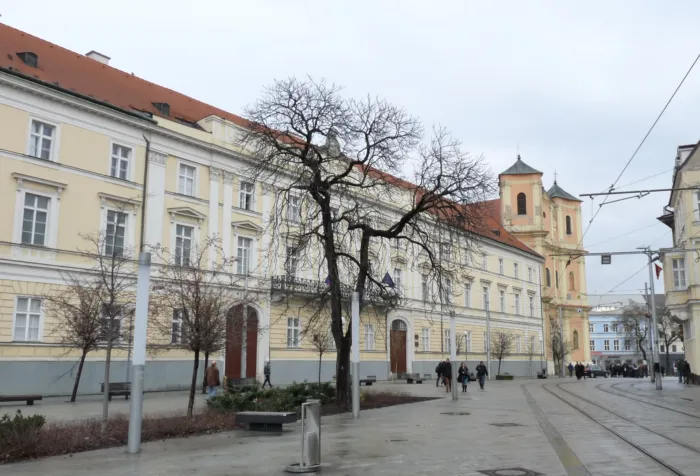
County Hall
Building, structure
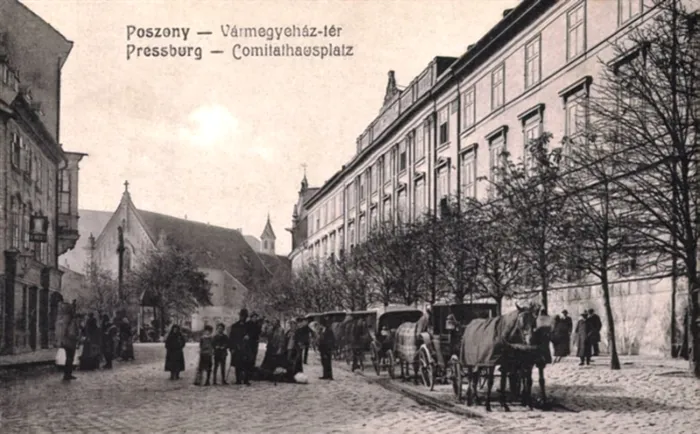
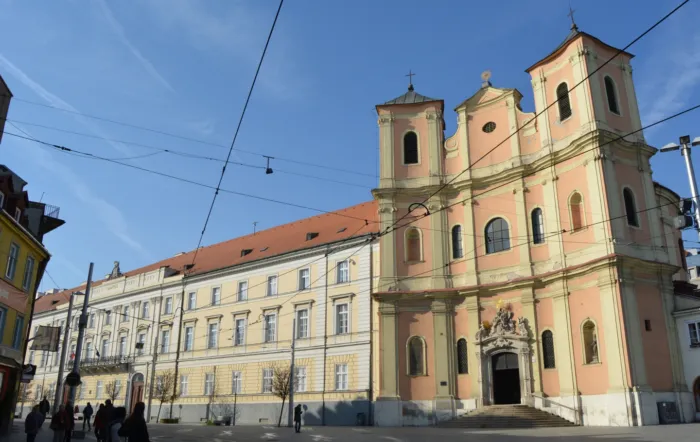
But the county showed how much it had progressed with the times, mostly through the construction of the county hall and the prisons. The seat (formerly the Trinitarian monastery) was in ruins, and the prisons did not meet the needs. The county appointed a delegation and on July 10, 1826, it decided to have the seat rebuilt, without placing a greater burden on the taxing people. It stated that the construction costs would be borne by the county orders through donations and that the taxing people would only be obliged to provide transportation. In order for the taxpayers living near Bratislava not to be overburdened with transportation, it was decided that the cost of transportation required according to the estimate should be divided among all taxpayers and that the population actually serving the transportation should be compensated with the full value of the transportation, December 1839. On the 2nd, it was decided to build not only a county house, but also prisons that met the new needs, also at the expense of the nobility. On the 3rd of February, 1840, arrangements were made to distribute 60,000 forints among the nobles of the county, which was later found to be incorrect, among the temporary appropriation. On the 12th of December, 1842, a report was received, according to which large donations had been made for the construction, the total amount of which, however, was not specified. On the 26th of May, 1844, a report was received that the construction plans prepared by Feigler had been reviewed and found good by the Budapest master builder Hild. According to this, the construction would have cost 78,379 forints and 28 kreuzers. ; on the 3rd of September, 1844, the foundation stone of the county prison was laid, which took place amidst great celebration. The Palatine of the country, the national authorities in Bratislava and the county orders in large numbers were present, accompanied by a large military escort. After the usual speeches, which were delivered by Count Ferdinand Leopold Pálffy, the governor of the county, and Antal Kisfaludi Liptay, canon of Bratislava, and István Szemrtnik, the county notary, the Palatine "deigned to lay the foundation stone in a cavity prepared next to the southeast foundation wall of the vault under the prison chapel, with the usual solemn ceremonies together with the founding charter". The charter lists the names of the supreme authorities, the officers and judges of the county, starting with the king. During the proceedings, mortars were pounded, music was played, and finally the notary thanked the Palatine for his appearance, and the ceremony ended. The cost of building the county hall and prisons was detailed at the general meeting held on September 23, 1847. According to this, the construction cost of the two buildings was 133,386 forints 38 kreuzers pp., or 280,110 crowns. ; In the county archives and especially in the minutes of the general assembly, there are many more, more or less interesting, but still mostly local interest resolutions. However, the researcher does not find one thing. You will not find any resolution from which one could conclude even a minor clash between the landlords and the former serfs, and one of the veterans of this county, Béni Bittó, is right, who, partly based on his own observations, partly on contemporary records and oral tradition, states the following: "The nobility of the county, with the exception of Counts Károly Zichy and József Pálffy, were all aulic and strongly influenced the middle and lower nobility who occupied the county offices in their political party positions, and therefore the liberal trend was able to rise in the county only at the cost of great struggles, but to the praise of the nobility, in matters of the relationship between the landlord and the serf that fell under the care of public authorities, with very few exceptions, they were chivalrous enough to guard against any influence, so that here the county chief fiscal, as the official protector of the serfs, had a much easier and more pleasant job." "It was like in any other county, and the implementation of the 1832-36 landlord laws (all of which originated from the pen of Ferencz Fekete,11 former vice-governor and county commissioner) was not implemented anywhere in the country at such a rapid pace and in such a liberal spirit as in Pozsony County."