
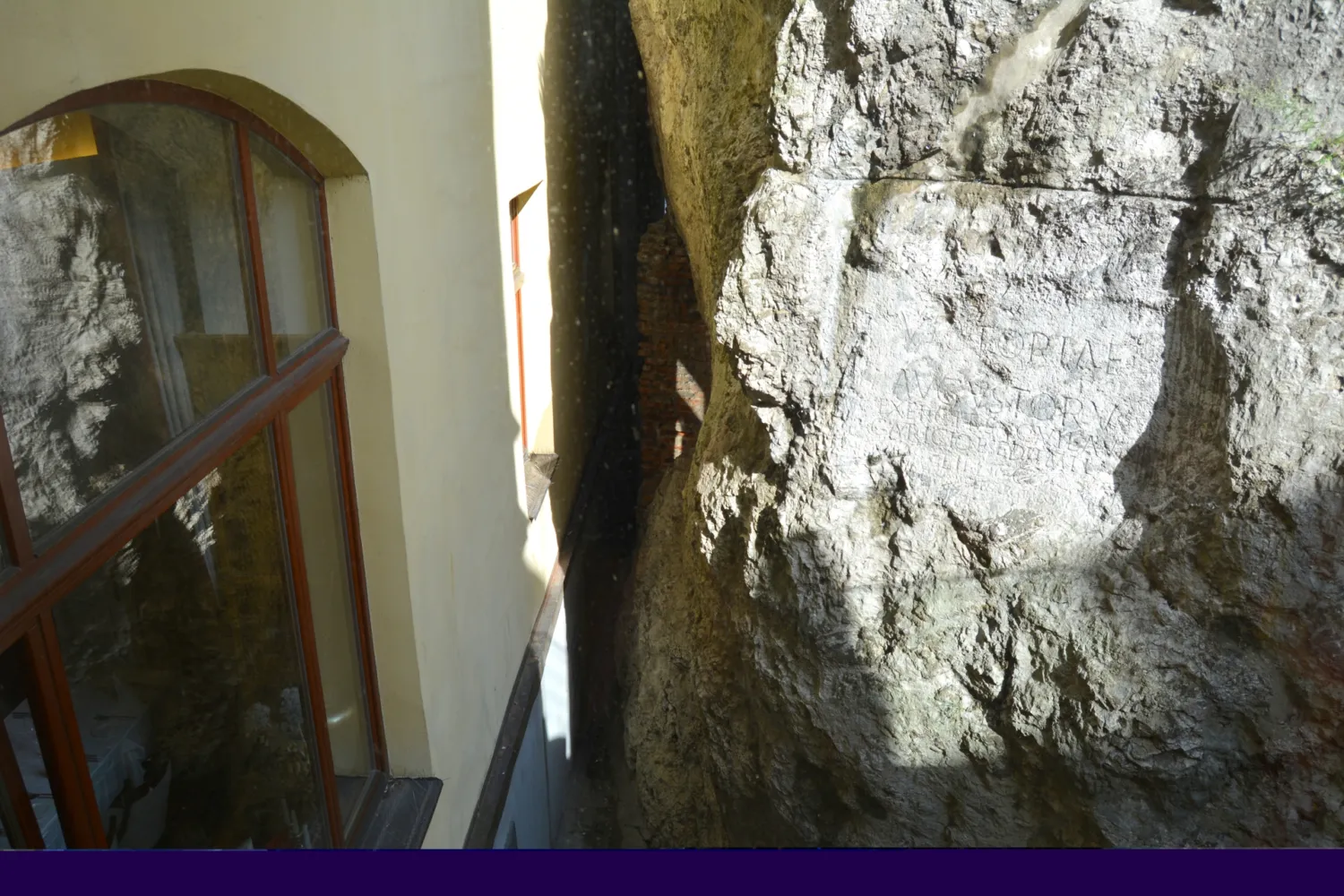
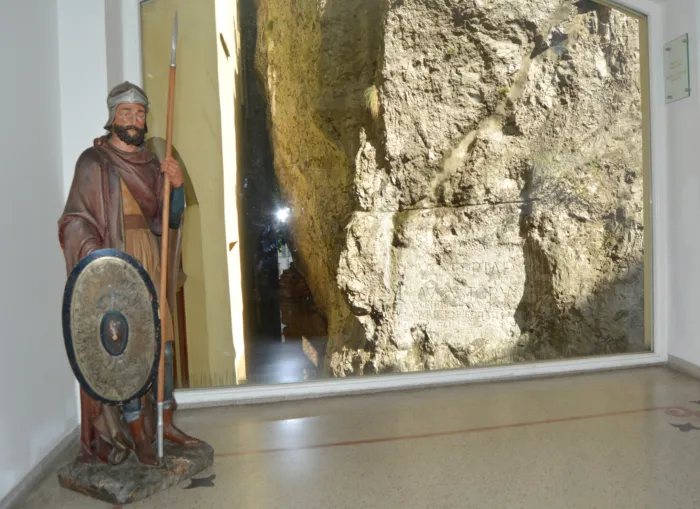
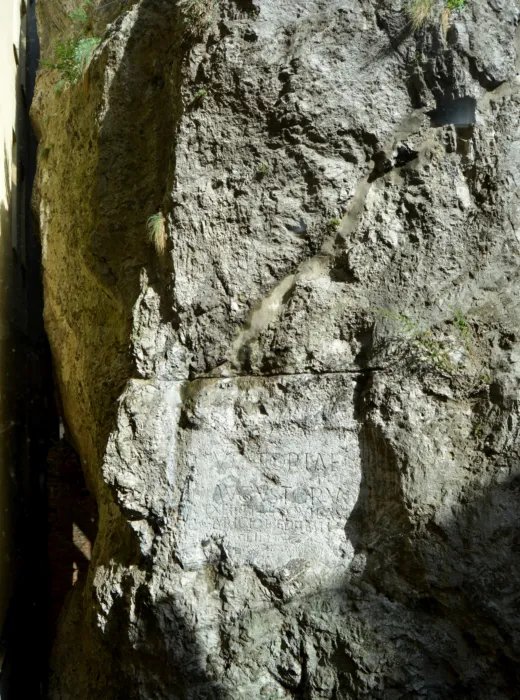
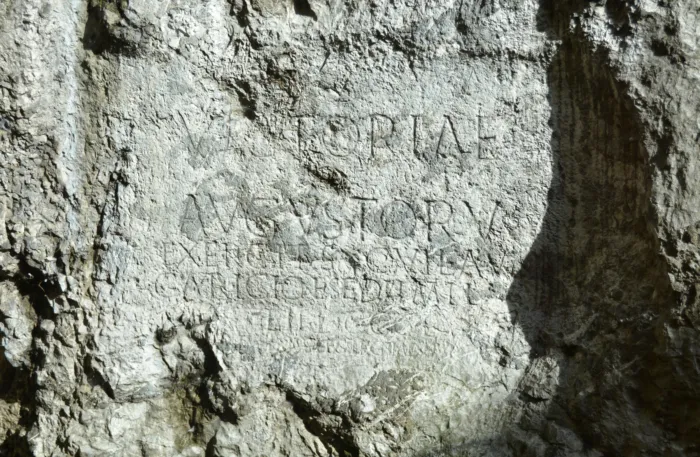
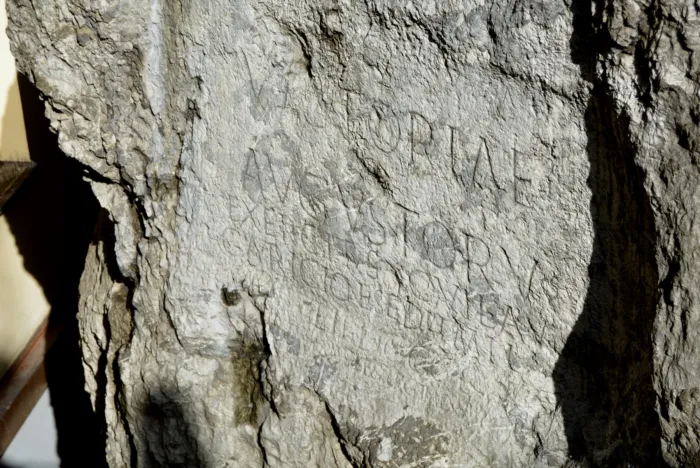
Latin inscription on the Trenčín castle rock
Statue, monument, memorial plaque
The later Trenčín Castle Rock preserves an unusual find. In the last years of the Marcomannic Wars (165-180), a Roman special unit of 855 soldiers wintered in enemy territory in the place of today's Trenčín, ancient Laugaricio, which was located about 130 kilometers from the safe border of the Roman Empire. The inscription, dated AD 179/180, commemorates this heroic victory. The battles against the Germans and the glorious victory were immortalized on the Column of Marcus erected in Rome. The column can be seen today in Piazza Colona in Rome. Incidentally, the Column of Marcus Aurelius was modeled on Trajan's Column, which immortalized the moments of the conquest of Dacia. ; The inscription on the Trenčín Castle Rock did not escape the attention of travelers who visited here. The first known records related to the memory date from the Middle Ages. The inscription was first mentioned by Hans Dernschwamm (1497-1567) in his work Inscriptiones Romanae a lapidibus in teritoris Hungariae at Transylvaniae repertis anno 1520-1530 collectae. In addition to him, the engraving was mentioned in their works by M. Zeiller, M. Szentiványi, J. B. Magin, S. Timon and many others. The known data about the inscription was published by Mátyás Bél (1684-1749) in his volume of Notita Hungariae novae historico-geographica concerning Trenčín. ; Within a few decades, a dense forest developed in front of the inscribed monument. Since people did not see the monument, it was forgotten after a few years. Until in 1852, in a big storm, the strong hurricane-force wind uprooted the poplar trees standing here, thus making the Roman monument visible again. The local priest Lajos Stárek (1803-1863) made an invaluable contribution to the rediscovery of the inscription and its public awareness. At that time, he was preparing to publish his book about Trenčín, entitled Der Wegweiser in der Trentschiner Burgruine und Umrisse der Geschichte der königlichen Freistadt und Burg Trentschin. Since he did not want to postpone the publication of the book because of the new inscription, he only makes a brief comment on it. On the fifth page of his book, he notes that an inscribed field had been discovered, which has not yet been deciphered. He published the uninterpreted version of the stone monument in the Pressburger Zeitung on May 13, 1854. Less than a month later, on June 10, 1854, his interpretation of the inscription was published in the Pest Catholic Newspaper. Of the six-line stone monument, only the first two lines could be read correctly. Based on Stárek's reading, the Roman soldiers erected a sanctuary and altar in honor of Jupiter in honor of the emperor. ; It is assumed that the incorrect reading of Lajos Stárek also played a role in Theodor Mommsen (1817-1903) listing the inscription on the Trenčín castle rock as a forgery under number 225 in the Corpus Inscriptionum Latinarum III. volume he edited. ; József Hampel (1849-1913) made invaluable contributions to ensuring that the inscription was placed in its rightful place. Hampel first visited the city of Trenčín in 1868. At that time, he learned about the monument located there, which he tried to read. His attempt was crowned with only partial success, as he could not decipher some parts of the inscription. On his second visit in 1890, he looked at the inscription on the castle rock again, of which he also made a plaster copy. He sent the copy to Theodor Mommsen, who, together with Otto Hirschfeld (1843-1922), studied it with the exception of the last line and declared it to be original. The new reading of the inscription was first published in the 1893 issue of the Archaeologiai Értesítő. Based on the copy, Mommsen dated the inscription (according to the shape of the letters) to the end of the 2nd century or the beginning of the 3rd century. He sent the reading they made to Alfred von Domaszewski (1856-1927), who was then the editor of the Corpus Inscriptionum Latinarum. The inscription from the Trenčín castle rock was included in the latest volume of the CIL again, but as an authentic historical source under the number 13439. ; The inscription was placed on a pre-worked wall section at a height of approximately 5-6 meters. The six-line inscription covered an area of 122×80 cm. Mommsen and Hirschfeld, with the exception of the damaged last line, have prepared the following reading: ; Victoriae / Augustoru(m) / exercitus cui Lau / garicione sedit mil(ites) / l(egionis) II DCCCLV / [Cl(audius) Const]ans leg(atus) leg(ionis) II adi(utricis) cur(avit) ; The army that was stationed in Laugaricio for the emperor's victory was 855 soldiers of the second auxiliary legion. Claudius Constans, the commander of the legion, took care of (the inscription). ; The six-line inscription reveals that the special unit (vexilatio) was made up of soldiers from Legio II Adiutrix, who were garrisoning Aquincum, and who had wintered in Laugaricio. Laugaricio was supposedly located somewhere near the castle rock, but due to the current built-up area of the city, archaeologists have not yet been able to find traces of the temporary camp. ; Mommsen noticed that there was a relatively large gap between the first two lines. On closer inspection, he thought he had discovered circular recesses, which he thought might have contained bronze decorative elements. Unfortunately, due to a damage at the beginning of the sixth line in one of the most important parts of the inscription, the exact name of the commander of the vexillatio was not known. In the addition, the commander's name was replaced as Claudius Constans. ; This name was included in the readings for another 62 years, when in 1955 another inscribed monument was accidentally discovered, from which the commander's original name was revealed. Archaeologists found a 23-line base in the distant Algerian city of Zana, which in ancient times was called Diana Veteranorum. The stone monument came to light from a Byzantine wall layer as a secondary use. The inscription contained the "biography" (cursus honorum) of Marcus Valerius Maximianus, which was written in the 19th-20th centuries. In line 1, Laugaricius and the second auxiliary legion are mentioned. The 23-line statue pedestal was erected by the very noble council of Diana Veteranorum with the money collected. From the inscription we learn details about the career and civilian life of a very successful soldier. ; From the 23-line engraving it is revealed that he came from Poetovio (today Ptuj). We also learn about the troops in which he served. His career is largely related to the Marcomannic wars. The inscription, among other things, reports on several of his commissions and decorations. One of these was the commission of Marcus Aurelius, which covered the transport of grain from the Danube to the Pannonian army. It is also revealed that he killed Valao, the king of the Narists, with his own hand, for which he received a horse, weapons and phalerae. He was also decorated in the war against the Germans and Sarmatians. Later, the emperor Marcus Aurelius commissioned him to teach a lesson to the Brisean robbers who were wreaking havoc on the border of Macedonia and Thrace. In 179, Marcus Aurelius and Commodus raised him to the senatorial rank and made him commander of the Legio I Adiutrix stationed in Brigetium (now Komárom). He spent the winter of 179/180 in Laugaricium in the Quadi region as commander of a special unit of the Legio II Adiutrix. After the death of Marcus Aurelius, in 180, Commodus again decorated him for his merits in the campaign against the Germans. After his death in 193, Commodus was subjected to damnatio memoriae, which meant that his name was removed from all inscriptions. On the inscription, in addition to Commodus's name, the name of the Legio III Augustae corps was also engraved, since the soldiers of this corps acted against the emperors I and II Gordian. The rest of his career can be linked to Lower and Upper Moesia, the provinces of Dacia Porolissensis and Numidia. The inscription was erected in the early or mid-180s. No other inscriptions associated with Marcus Valerius Maximianus are known so far, so we do not have any further information about his life and death. ; Baron Armin Popper had a hotel built in front of the inscription on the Trenčín castle rock at the beginning of the 20th century. The hotel, which opened on January 1, 1902, was initially called the Erzsébet Hotel. In 1921, its name was changed to the Tátra Hotel. In the early 2000s, the hotel underwent renovations. Since 2012, it has been renamed the Elisabeth Hotel, referring to its original name. Today, the inscription on the Trenčín castle rock can be viewed by those interested from the first floor of this building.