
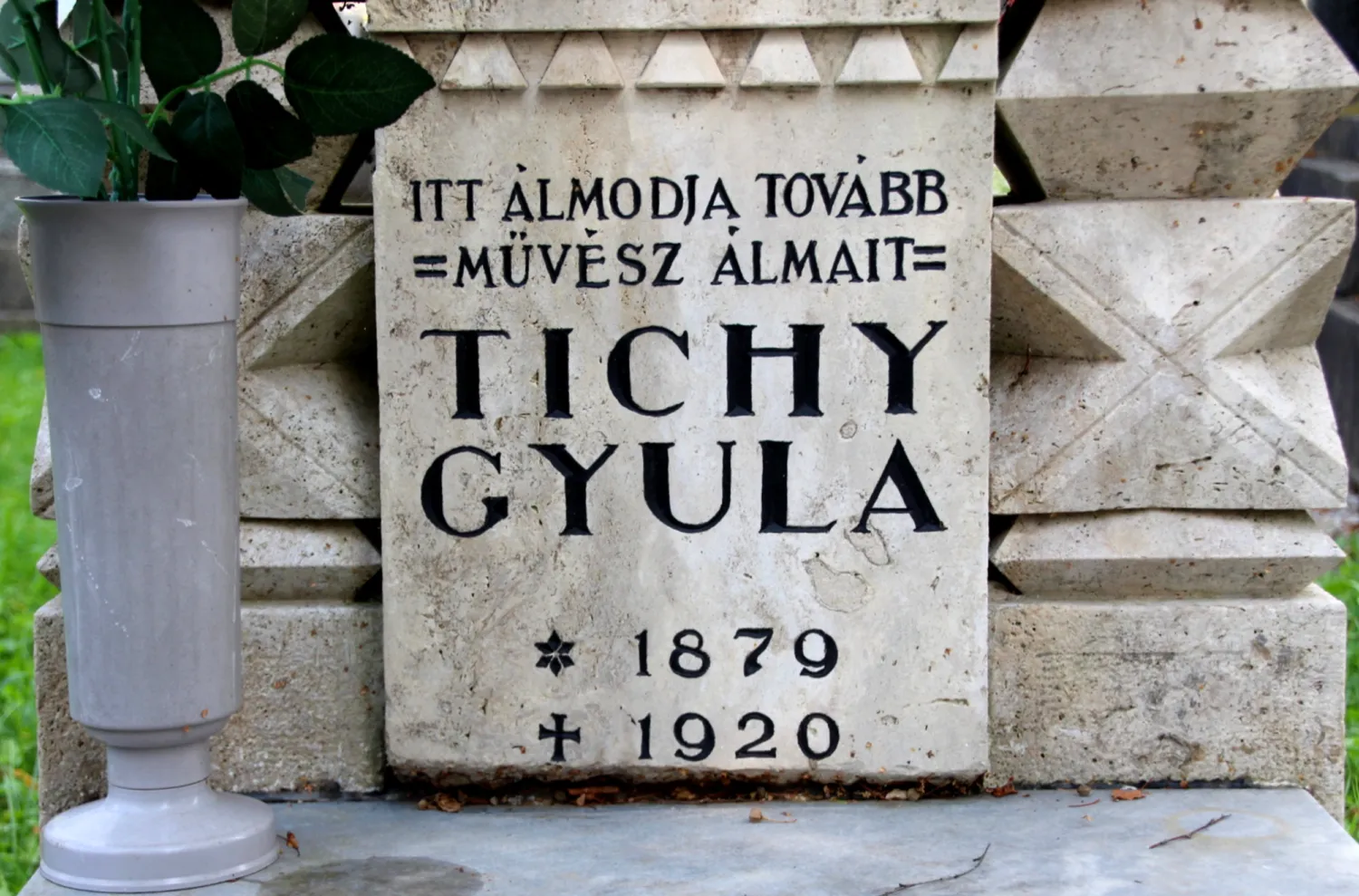
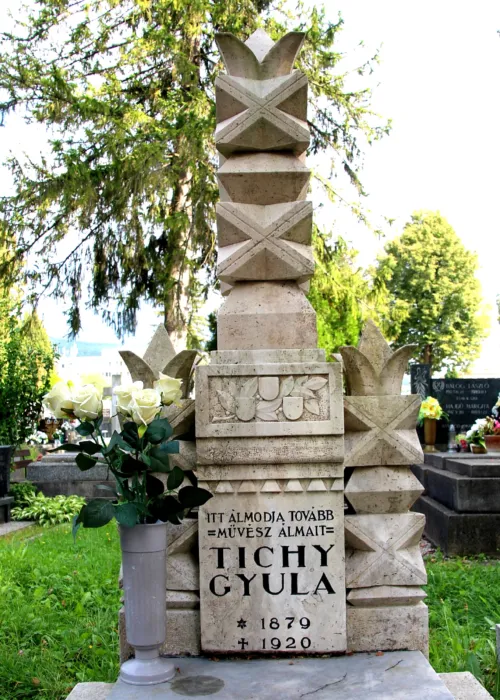
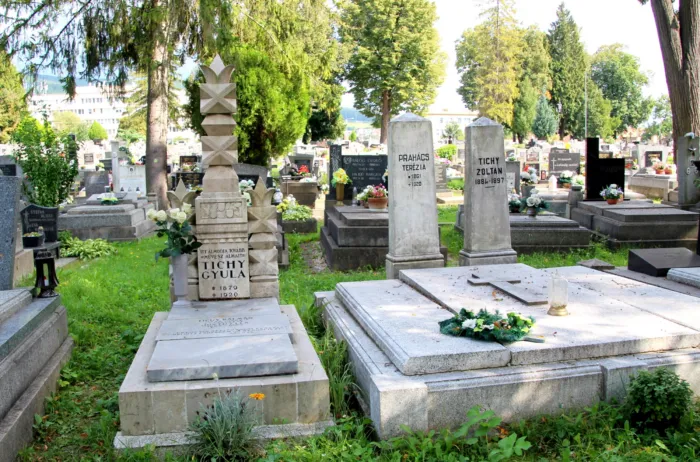
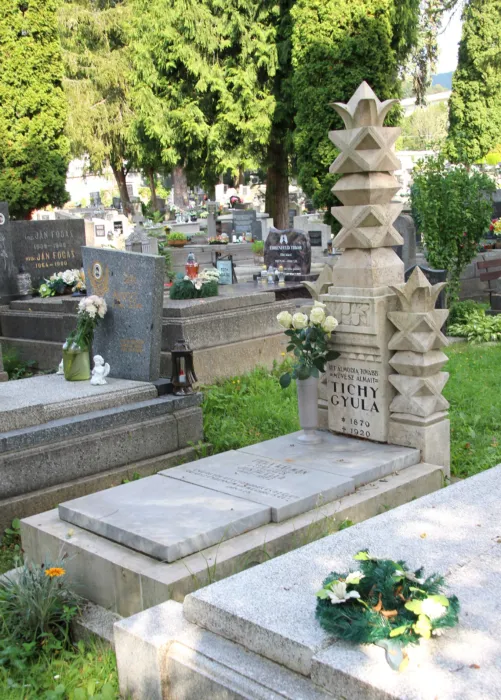
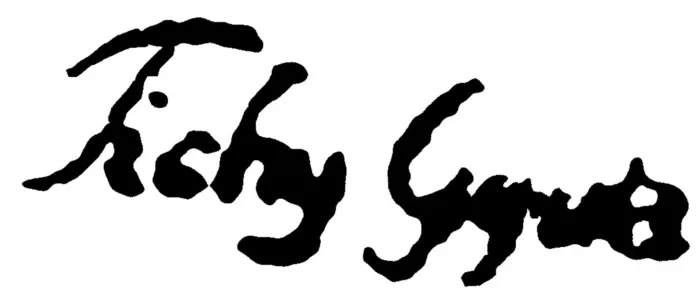
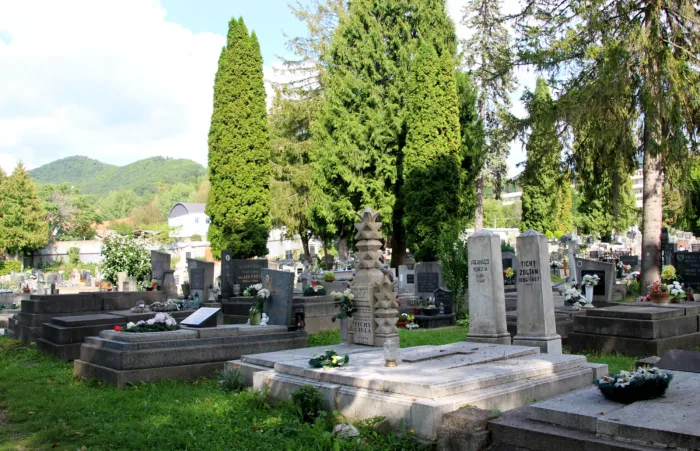
The grave of the painter Gyula Tichy
Cemeteries, tombstones, graves
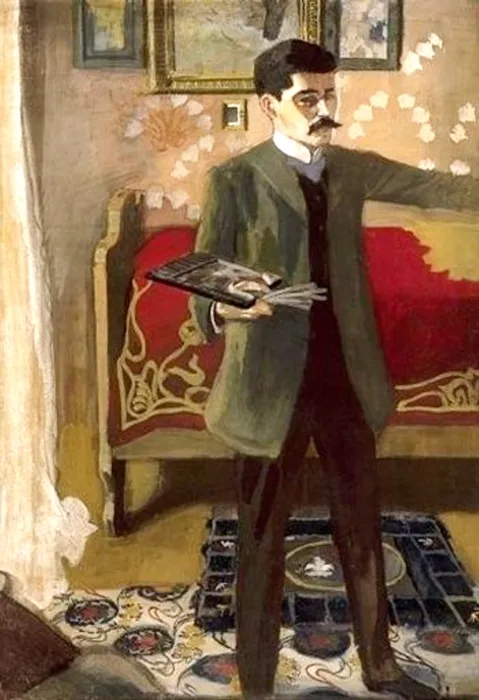
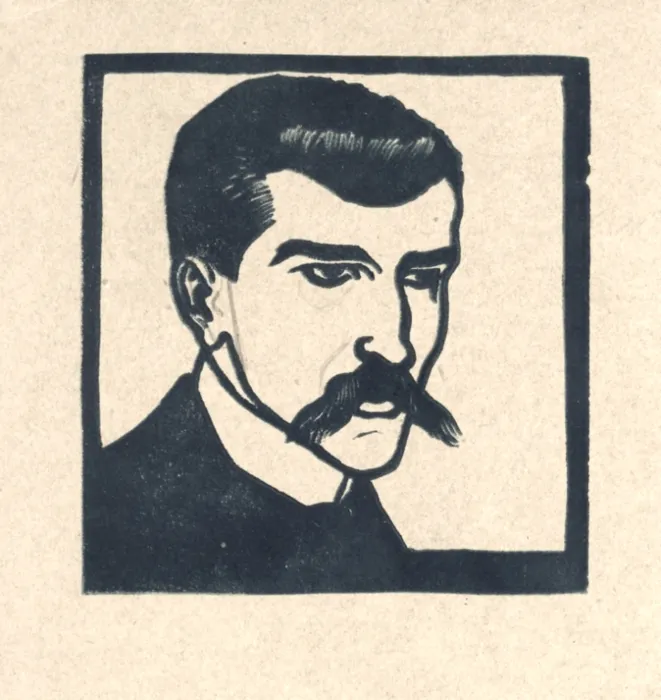
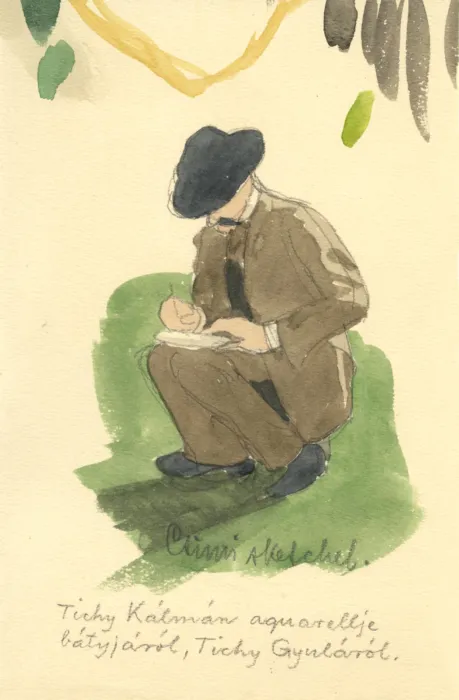
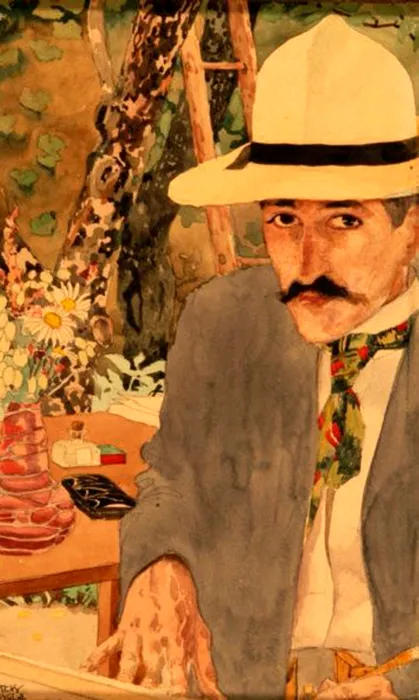
Gyula Tichy (Rimaszombat, August 28, 1879 – Rozsnyó, June 20, 1920) was a painter, graphic artist, and brother of painter Kálmán Tichy. ; Gyula Tichy graduated from high school in Rozsnyó, and his talent for drawing was evident during his high school years. His talent began to develop mainly under the attentive guidance of his father and aunt. “My brilliantly happy childhood and sunny youth received color and light from them,” he confesses in his 118-page booklet titled Autobiography. In this booklet, he writes mostly in alphabetical headings about his works, the circumstances of their creation, his readings, the influences on him, contemporary writers, artists, and plans. In high school, he also edited an illustrated school newspaper, in which he mainly drew caricatures of his fellow students, but also created illustrations for Dante's Inferno. However, at the urging of his godfather, the talented young man chose a safer path than an artistic career. However, it seems that his fate was sealed when, after recovering from a severe typhus, he no longer continued his technical studies. In the following academic year, he enrolled in the Budapest Sketch School, where he studied painting with Bertalan Székely and László Gyulai between 1898 and 1903. It is true that machines, the world of physics, and the secrets of the universe continued to occupy him. This is evidenced by the works he created at that time: Apocalypse I., II., Tudós, Jóslat. Later, he switched to the fine lines of etchings, and the themes and style that could be expressed well with them. His role models were Alfonz Mucha and Gustav Klimt. However, a growing gap develops between his increasingly lofty desires and his artistic knowledge, and this results in a crisis for him. In the summer, he stays with Simon Hollósy in Nagybánya, and as he writes: “Here I learned that I know nothing, that I have to learn everything again”. From then on, all his time is taken up by observation down to the smallest details and self-education filled with hard, tenacious, persistent work. His self-confidence is also increased by the encouragement of Bertalan Székely. He also went on a study trip to Venice, the memories of which appear in small watercolors, combining the impressionistic, colorful, fresh brushwork he acquired during his stay in Nagybánya. Venice becomes one of his eternal memories, to which he made a pilgrimage twice more during his short life. Later, following the ancient method, he copies the paintings of Veronese, Tintoretto and other painters, thus trying to master Italian art more deeply. Upon returning home, he began to paint with great enthusiasm, and although a productive period followed in his life, he still felt that he was struggling with the technique of oil painting. ; In the autumn of 1904, he was elected as a drawing teacher at the Evangelical High School in Pest. However, the newly built, still steaming walls of the Fasori High School attacked his health. He became seriously ill, had to leave his job and return home to Rozsnyó. But the illness that confined him to bed and the long process of recovery were good for him to perfect the genre of drawing on his own with great willpower. In 1906, he finally found the technique that suited his individuality, tempera painting. He created his most significant paintings with this method, and was liberated in his style at once. This was when, among many other works, My Queen's Wife I., and then II., Prince Endre in Byzantium were born. These literary-inspired historical paintings are characterized by their decorativeness, the use of deep but pure colors, and the flat representation, with which he follows the art of Art Nouveau. However, he is depressed by the suffocating atmosphere of the petty-bourgeois Rozsnyó and its lack of understanding and interest. At the same time, he is inspired by Dürer's work, and the series of Kuruc drawings of 1907 starts from these Dürerian traditions and follows the style of old woodcuts. At this time, four of his illustrations at the National Salon exhibition make a splash, and he enthusiastically sends some of his other works to the Műcsarnok exhibition. However, he must be disappointed, because the art officials are not yet where he is. The academic, conservative members of the committee do not accept his works as art. They exclude his work entitled My Queen's Wife, and they choose one that he himself does not consider significant. ; His bitterness is relieved by the newly discovered technique, linocut. In a short year, he becomes a fully mature artist of this genre. First, he transfers his woodcuts, which were planned under the influence of Dürer but never realized, to linocut, and in addition to monochromatic engravings, he also tries polychrome ones, for which Japanese woodcuts were the model. His linocuts finally achieve a resounding success at the 1909 international graphic exhibition. From then on, his works are published in the newspaper A Ház. On his thirtieth birthday, he is elected as a member of the KÉVE artists' association, of which he was a member until his death, and through them several of his exhibitions were realized. ; He spent the summers of 1908 and 1909 in Feled, commissioned by the Applied Arts Society, where he collected folk art material. This influenced his later works: in his paintings we can see the buckets of the streets and fairs of Rozsnyó, the peasants who went to the market, and the richly decorated dresses and headdresses of young peasant girls. Another significant success of the 1909s was the publication of his book of drawings entitled Egy tusos üvegő meséi, which caused a great response and also stirred up emotions. It was written about him that “A wonderful mixture of Hellenism and Japanism. Freely, lightly drawn forms, in an environment that is as small as a banknote. It is as if one were reading some poetic enigma by Endre Ady and not finding any cadence in it…” But he also received criticism: “Unfortunately, experience shows that such books are mostly published at the author’s expense, for a very narrow circle of friends. Let’s be honest, our artists are also at fault in this. They walk such a lonely path that not everyone feels like following them there.” ; In addition to the collection in Feled, the election as a KÉVE member and the publication of the album Egy tusos üveg meséi, another event occurred in 1909. He took up a job as an art teacher at the Evangelical High School in Rozsnyón. Although his livelihood became assured, he suffered from the lack of understanding from his colleagues, from not finding an intellectual partner, and the monotonous work also became a burden on him. Fortunately, the understanding of his family and the success he achieved at the KÉVE exhibitions did not allow him to fall into a crisis. In 1911, he created what was literally the largest work of his life, the 124x210 centimeter painting Masks, which he made in the Stracena Valley. He twisted the canvas onto two rods and painted it step by step, twisting it. When he returned home and stretched it on a frame, he was surprised that he hardly had to adjust it anymore. This work is a kind of summary of his career up to that point. He cites Csontváry's monumental compositions. His other small-scale drawings represent an effort ahead of his time, with which the later drawings of Kassák or Moholy Nagy in the 1920s can be compared. However, for Tichy, these are only an episode in his oeuvre, and it was not continued or completed. ; Tichy begins writing a novel, a science fiction work entitled Prisoners of Mars, the completion of which is prevented by the outbreak of war, then the conditions that followed, and later by his death. Finally, his younger brother Kálmán finishes it and has it published in sequels in the Magyar Néplap in Bratislava. In the novel, which also shows the influence of Verne and Jókai, he describes the implementation and use of today's television, sleeperless rails, various radiations and remote controls, ahead of his time. At the end of his life, he writes rather than paints: there is no hope for his eight-volume work, Journeys into Space. He illustrated the notebooks with interesting lunar and Martian landscapes. ; “I would be like a compass, the steel tip of which is stuck in Rozsnyó, and the pencil end writes its letters for Hungarian cultural history in Pest, if the eraser of forgetfulness does not erase them” – he writes in his Autobiography. And indeed, forgetfulness is a cruel master, because until the early 80s it did not allow Gyula Tichy’s legacy to be seen. The storms of history played a role in this, the fact that the majority of his artistic legacy is privately owned, and art historical research also eluded him. ; Gyula Tichy died on June 20, 1920, at the age of barely 41. His tomb, which was most likely built based on the plans of his younger brother, the painter, local historian, ethnographer and literary critic Kálmán Tichy, can be found in the public cemetery. The tomb, carved from marble, is made up of three columns (one taller and one shorter), modeled after a headstone. Later, the ashes of Kálmán Tichy were also placed in this covered tomb. ; ; Most important works: ; ; Paintings: ; My Queen Mother I., II. (1906) ; Prince Endre in Byzáncban (1906) ; Masks (1911) ; Jákob and Lea (?) ; ; Graphic albums, series: ; Kuruc drawings (1907) ; Tales of an ink glass (1909) Online ; Easter (1912) ; ; Book illustrations: ; Kálmán Árkosi Ferenczi: The Windmill of Pálfalva (stories, 1911) ; Sándor Hangay: Naked Men Before the Storm. Spiritual Portraits (1912) Online ; Sándor Hangay: The Gospel of Satan (poems, 1911) ; Gyula Krúdy: Escape from Life/Escape from Death (short stories, 1993) ; Dreams of My Own (short stories, 1904) ; ; Exhibitions: ; Kunsthaus, Munich, 1914 ; Guild of Saint George, Budapest, 1916 ; Memorial Exhibition of the Tichy Brothers, Hungarian National Gallery, Budapest, 1979 ; Gallery of Art Collectors, Budapest, 1996 ; Museum of Hungarian Culture in Slovakia, Bratislava, 2009 ; Rovás Academy, Košice, 2014