
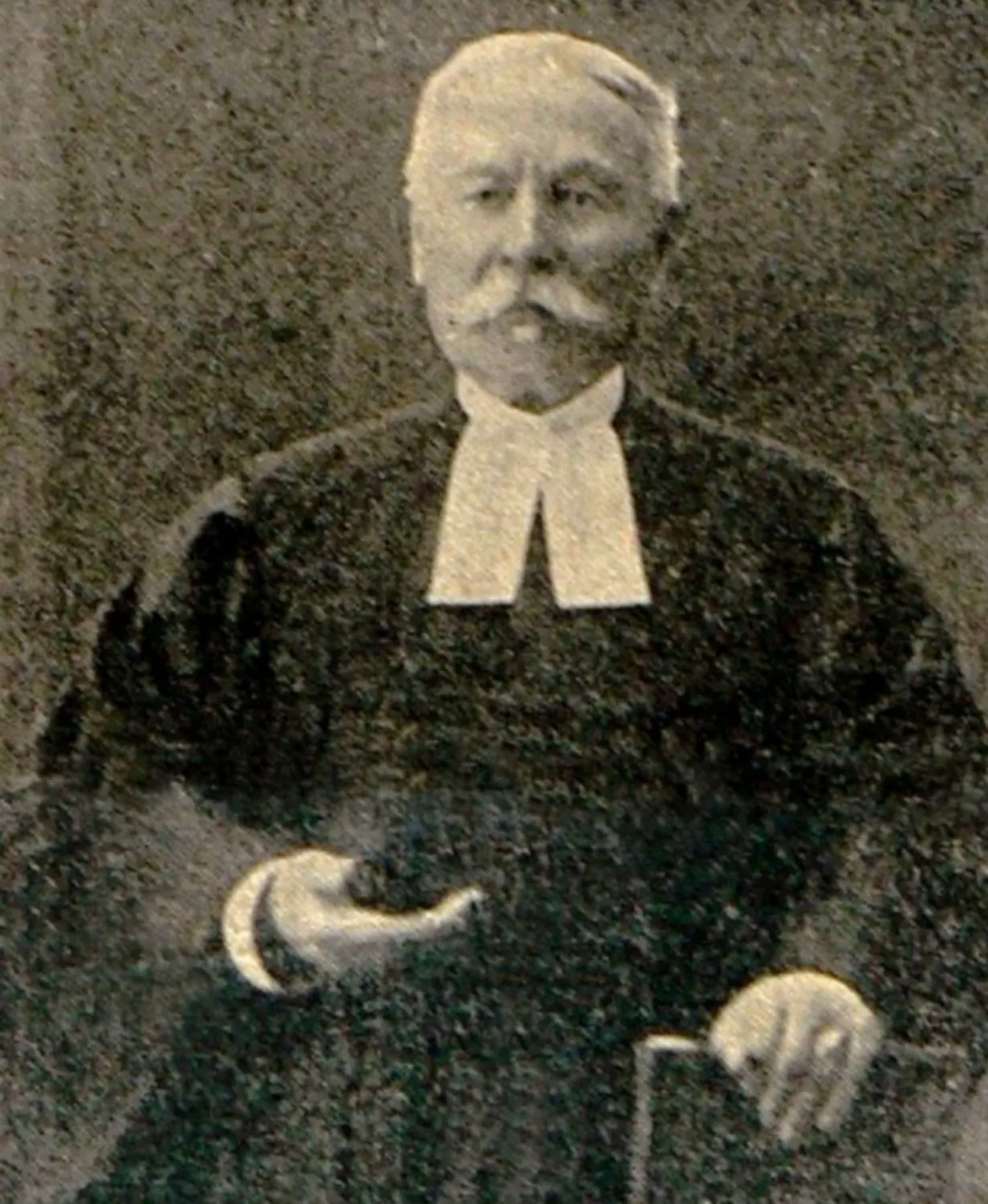
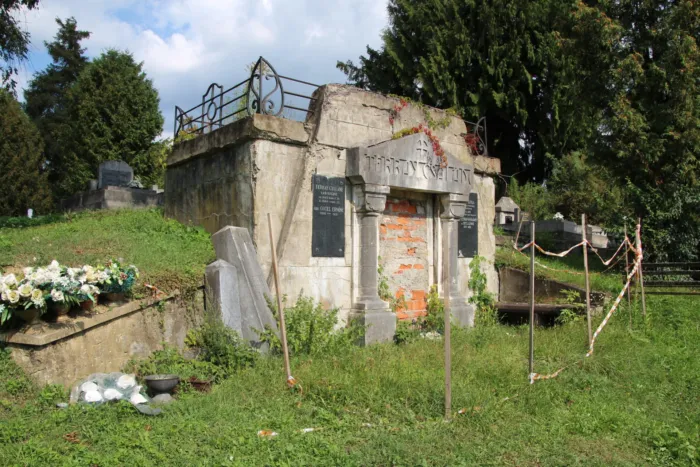
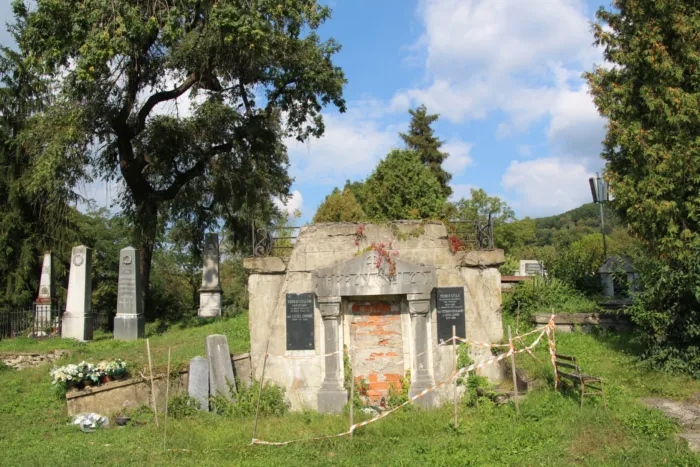
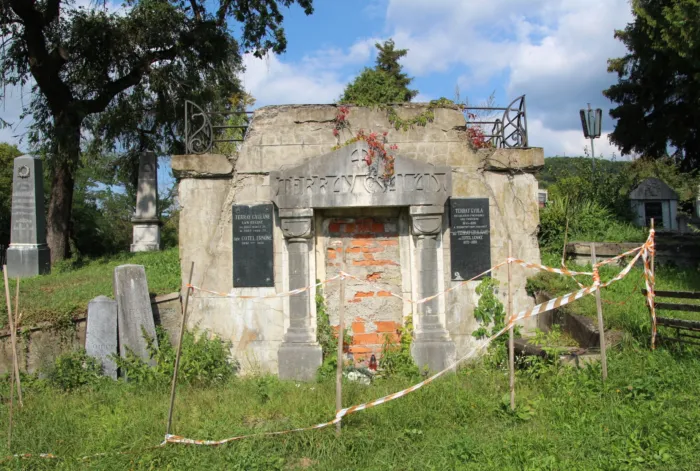
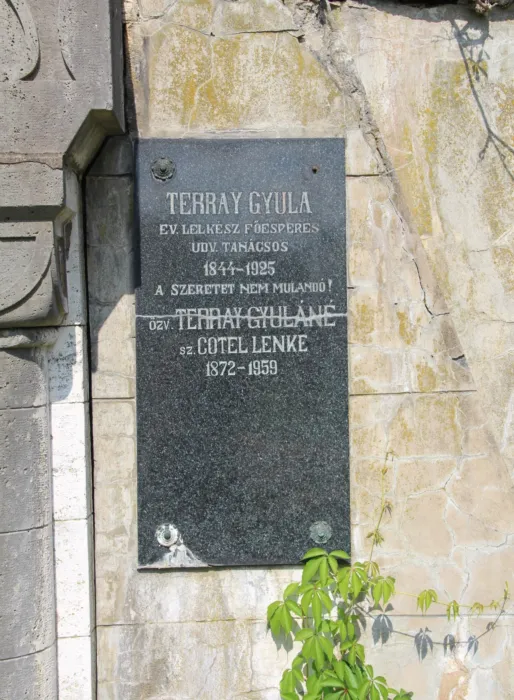
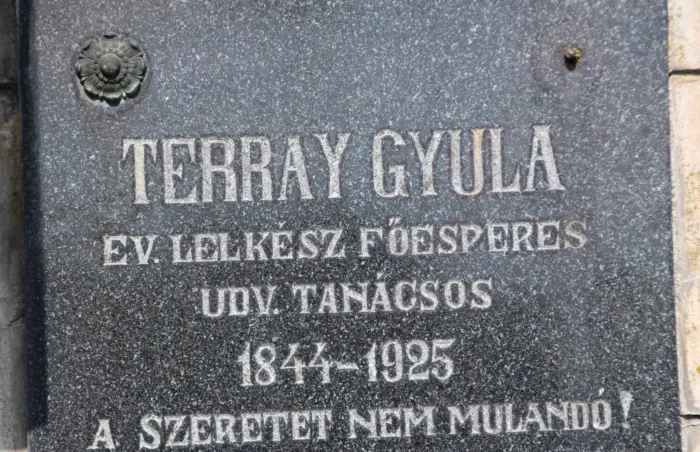
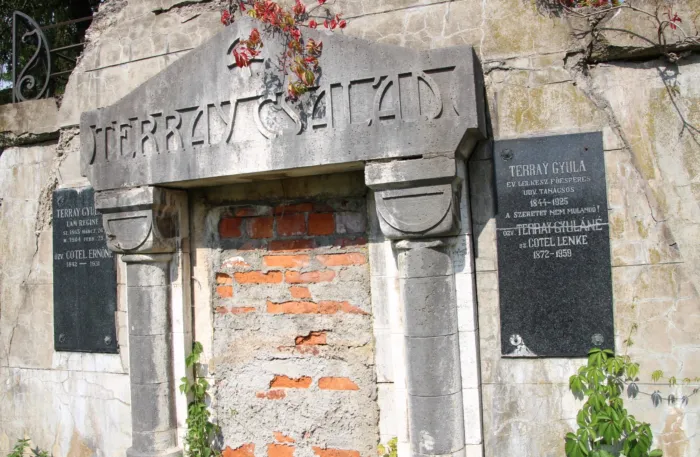
The grave of the Lutheran archdeacon Gyula Terray
Cemeteries, tombstones, graves
Gyula Terray (Vizesrét, Gömör county, November 16, 1844 – Rozsnyó, August 15, 1925) was an Evangelical archdeacon and pastor. ; In the issue of the Evangelical Family Newspaper published on July 16, 1911, we can read the following about Gyula Terray: ; "As we already mentioned in our last issue, Gyula Terray was appointed court councilor by the king, whose biographical data is presented below: ; Gyula Terrey was born on November 16, 1844 in Vizesrét (Gömör county) to Pál Terray, the forester of the Duke of Coburg, and Emília Korosiánszky, a nobleman. He completed his high school education in Rimaszombat, Késmárk, and Rozsnyó, and his theology in Budapest at the united Protestant Theological Academy and in Tiibinga in Németh. ; He began his public work in 1864 in Szécsény, Nógrád county, the seat of the Pulszky family. He was ordained a priest on February 13, 1866 by Bishop Károly Máday. He was a chaplain in Nyíregyháza for one and a half years. As a reward for his faithful work, the 22-year-old chaplain was awarded the title of rewarded him with a license and allowed him to be elected as a regular pastor in Nandrás, Gömör. ; In February 1870, he became a teacher in Rimaszombat. He obtained his teaching certificate in Igló on July 16, 1872. ; At the beginning of 1873, he became the first pastor in Salgótarján, where he organized the church and after completing this work, he was elected pastor of Sajóarnót, which was included in the diocese of Hegyalja, where in the short space of four years he not only completely raised the ancient, articular church that was about to fall apart from its ruins, but also founded a completely Hungarian church from the Tot-speaking church. For his work here, he received public recognition at the 1879 church district general assembly. ; In the autumn of 1878, Süvete, which was included in the diocese of Gömör, invited him to be its pastor. He spent 12 years in this church. During these 12 years He completely renovated the church buildings, established a pastor's pension fund, a kindergarten fund, a funeral association, an organ fund and a public library, and instead of the deceased teacher, he led the school for 8 years and taught free of charge. This work was the introduction to the unexpected success with which he also enlightened the church. ; During his pastorate in Süvete, he received several awards. He held the position of chief notary in his diocese. He was elected archdeacon on December 5, 1885. In 1887, he was elected as a church district auditor, court judge and member of the church district pension institute committee. After the death of Bishop István Czékus on February 6, 1890, he was nominated as a bishop by a significant part of the church district. ; For years, he was the county He became a committee member, later a permanent caucus member, and was honored with the election presidency three times in the Kövi constituency during the representative elections. ; His work as archbishop is characterized by a threefold direction. He keeps the financial condition of the churches of the largest diocese in the Tisza district entrusted to his leadership and the diocese itself in order, with his assistants, with persistent consistency and rigor. He pays excellent attention to education. He strictly controls the teaching of the Hungarian language and the dissemination of the Hungarian spirit, and he governs the diocese in a decidedly Hungarian national, uncompromising, but nevertheless non-violent direction and with results that demonstrate great progress. The late Bishop Czékus expressed his satisfaction with him in an unusual way by voting in the minutes of the 1889 general assembly of the diocese in his episcopal report for the order and progress experienced in the churches and schools of his diocese. ; On the occasion of his election as archdeacon, he laid the foundation for the “diocesan domestics” with a donation of 200 crowns, which he has since increased to 6,700 crowns from various sources. He celebrated his ten-year jubilee as archdeacon by establishing a fund called the “Gömör boarding school” with a donation of 400 K, together with his co-president, Árpád Szent-Iványi, whose task is to support the daughters of the Gömör pastors who were raised in the boarding school of the Rozsnyó district civil girls’ school, and which has so far increased to 7,000 crowns. ; He made his work as a pastor in Rozsnyó memorable by organizing the girls’ school and orphanage initiated by Bishop István Czékus within the church, and it can be said that he actually became the second founder of both. He created the position of assistant pastor in the church, without burdening the church, and the institution of deaconess. Furthermore, in addition to financially strengthening the mother church, he collected a capital of over twenty thousand crowns for the daughter churches, each of which he took over burdened with debt, without taxing the faithful. He made foundations of a thousand crowns from his modest income at various institutions, raised scholarship funds representing twelve thousand crowns at the civil girls' school, and a deaconess fund of 2,400 crowns from various sources. ; He has actually functioned as a vicar on several occasions and, according to the constitution, has been permanently holding the position of vicar for many years. He is the ecclesiastical chairman of the financial committee of the church district and a judge of the supreme, or universal, court. ; His literary activity is also significant, as several of his publications have been published in newspapers and many of his church speeches have been published. Among these, the speech with which he buried Prince Imre Thököly in his capacity as a vicar bishop in Késmárk is outstanding. ; Having now held the position of archdeacon for twenty-five years, in recognition of his outstanding merits, the diocese has decided that he will continue to use his services and celebrate his archdeacon jubilee, and that his fellow pastors and the diocese will establish separate foundations in his name. ; Therefore, a man so rich in merits deserved the royal award from the highest place, which was the culmination of his tireless work and merits. ; We all know that this high award, in which until now Prot. "He has not received the title of pastor or archdeacon, he fully deserved it, may the God of grace grant that he may enjoy this well-deserved honor in good strength, health and with a cheerful heart for a long time to come, undisturbed, as the most beautiful reward for his work: grateful recognition." ; Gyula Terray gave up his soul to his Creator on August 15, 1925, in the 80th year of his life. His grave, which cannot be called in good condition, is located in the public cemetery in Rozsnyó. ; ; Works: ; Mourning speech, which was delivered on the day of the funeral of Queen Elizabeth of Hungary on September 17, 1898. Rozsnyó. ; Memoirs from the memorial ceremony held in Rozsnyó on September 20 and 21, 1902, on the occasion of the 100th anniversary of the birth of Lajos Kossuth. U. there, 1902. (with László Réz).