
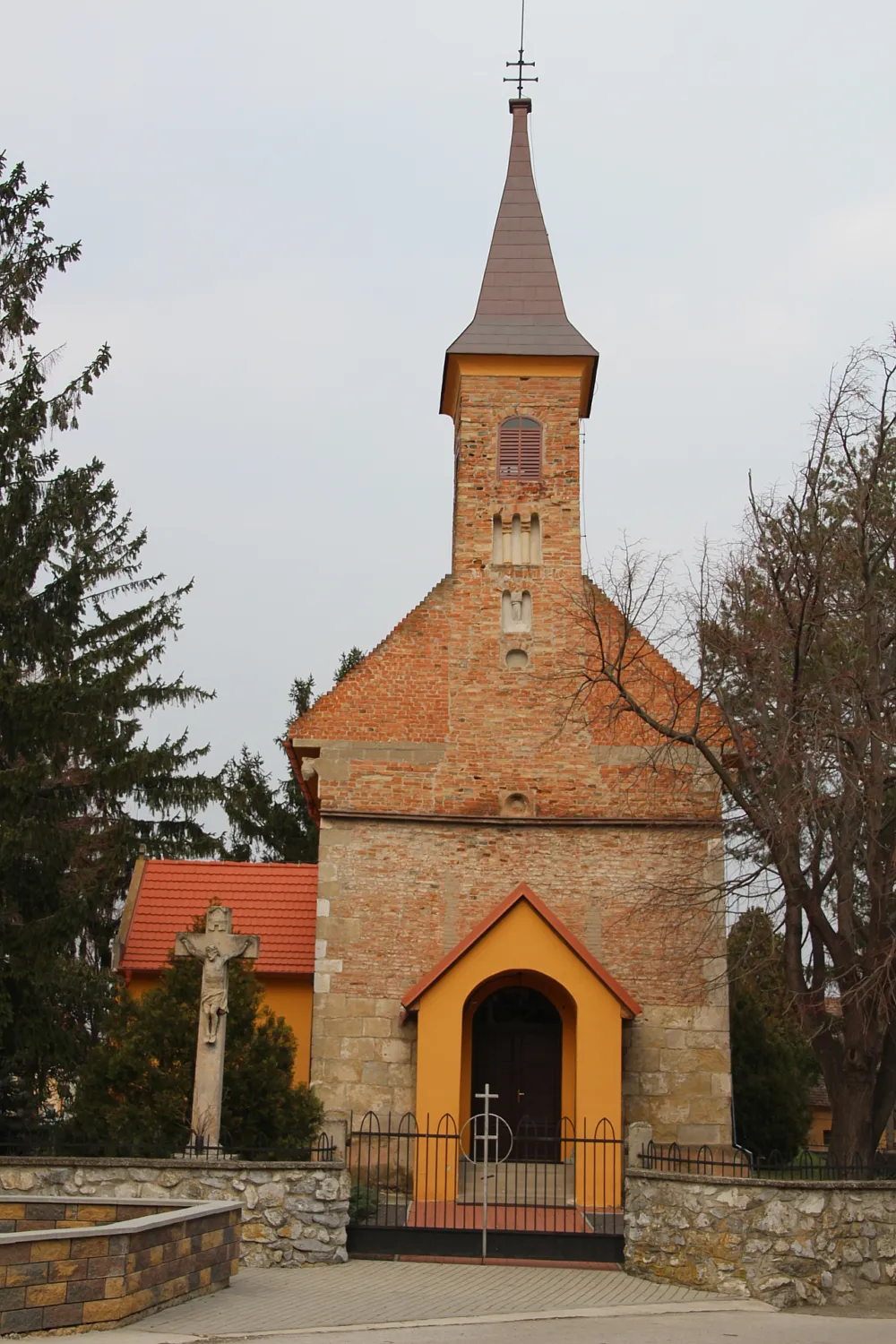
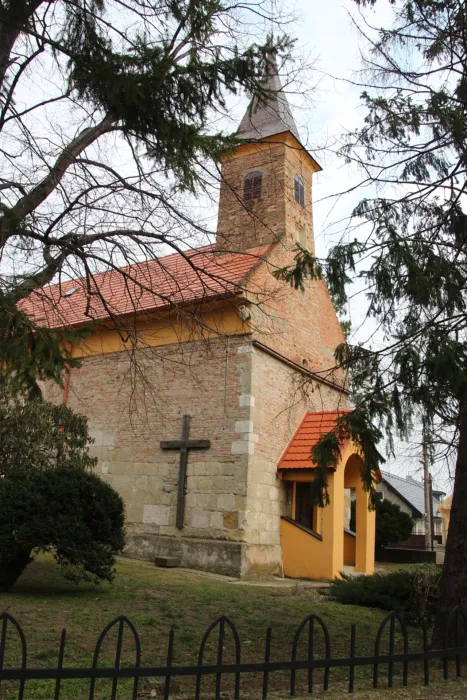
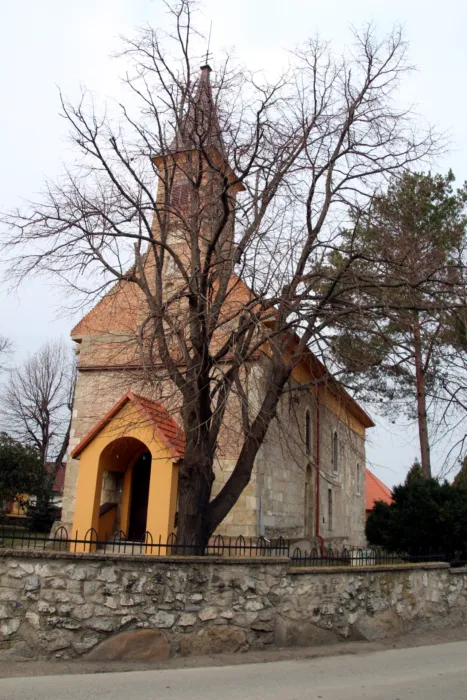
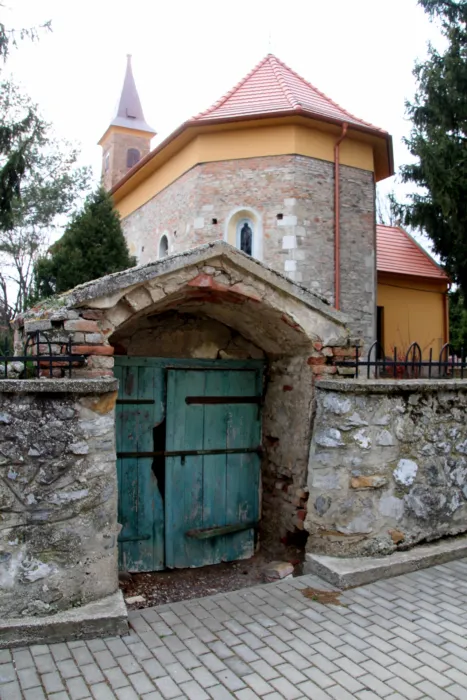
Roman Catholic church dedicated to the Virgin Mary
Building, structure
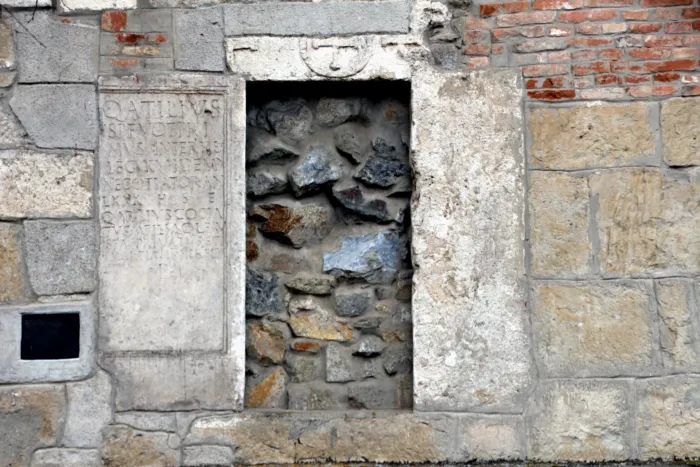
The name of the village is a contraction of the word Boldogasszonyfalva. The name of the settlement, which existed until the 16th century – like its Slovak equivalent, Matka Bozia and its later German version, Frauendorf – refers to the ancient Church of the Assumption of the village. A mortgage deed authenticated before the Bratislava chapter 660 years ago, on May 1, 1343, first mentions the “stone church built in honor of the Virgin Mary”. Its origin can be dated back to around 1276, when the owner of the area, who was also the patron of the village, Jakab Tolvaji, decided to found a parish. The portico of the western side of the first church, resting on two pillars, is still visible evidence of this patronage. A small, semicircular sanctuary was connected to the elongated nave of the typically 13th century village church. The entrance was open on the south side, and above it three Romanesque funnel windows let in light. The columns supporting the gallery also supported the square tower rising above the facade. The double and triple twin windows visible on the tower bear the typical form features of the 1200s. ; The Árpád-era church, built of brick and – secondarily used – carved stone, was expanded in the following century. The village became the property of the Poor Clare nuns of Óbuda in 1358, and soon Boldogasszonyfalva became the estate center of the Franciscan female order in Bratislava County. The nave of the church was extended to the east in the 1360s, and beyond the triumphal arch it was closed with a polygonal sanctuary of the same width. The new section of the building was vaulted in the 1400s. The considerable wall thickness did not require the construction of external buttresses. The simple ribbed vault has a shield-shaped form dating back to the 15th century. It is typical of the last decade of the 19th century, the era of our Jagiellonian rulers. ; In 1605, Bocskai's army marching against Bratislava captured and then set fire to the walled parish church of Bolgodogfa, which was defended by the Catholic citizens of Senj with weapons. The damage was repaired within six years, but during another war led by Gábor Bethlen – between 1619 and 1621 – the building was damaged again. The Senj people, who had converted to the Calvinist faith in the meantime, did not renovate it, and most of its building materials were carried away. Its restoration took place after 1706, when the Catholics regained the village. The cost of the works was covered by the Order of St. Clare nuns in Bratislava. ; Until 1963, the Bolgodogfa church was unknown even to the monument profession. During the archaeological research that began at that time, details hidden under the layers of plaster, encompassing all architectural periods, were revealed. The Romanesque gate of the southern wall was discovered, with a particularly beautiful carved stone cross in its semicircular tympanum, and then a Roman tomb chapel emerged from the wall fabric. Most of the ashlars of the seven-by-seven-meter pagan sanctuary were used to build the 13th-century church. According to an inscribed stone tablet found on site, the antique building was the burial place of Quintus Atilius and his family in the middle of the 2nd century. ; ; Q ATILIVS ; SP.F.VOT.PRI ; MVS.INTER R EX ; LEG XV.IDEM. ; NEGOTIATOR.AN ; LXXX. H S E ; Q.ATILIVS COCIA ; TUS.ATILIA Q L EAV ; STA.PRIVATUS.ET ; MARTIALIS.HERED ; P ; L ; ; According to the translation by Dr. Kolník Titus: ; Quintus Atilius Primus, son of Spurius of the Voturia tribe, was born in the 15th century. legion interpreter, captain among the coastguards, wholesale merchant, was laid to rest here at the age of 80. Quintus Atilius Cogitatus, in honor of the soul living with Atilia, Quintus' freedwoman. ; This find is also special because it is considered the oldest written find in Slovakia. Its content is of unique value for Slovak history from the first century AD. ; The tombstone was built in the nineties of the first century, or at the latest in the thirties of the second century AD. These data are known from there, because the legions in which Q. Atilius served were stationed twice in Carnu and its surroundings, i.e. in the area of present-day Bratislava (in the years 70-138). Based on this, its owner lived and died around these years.