
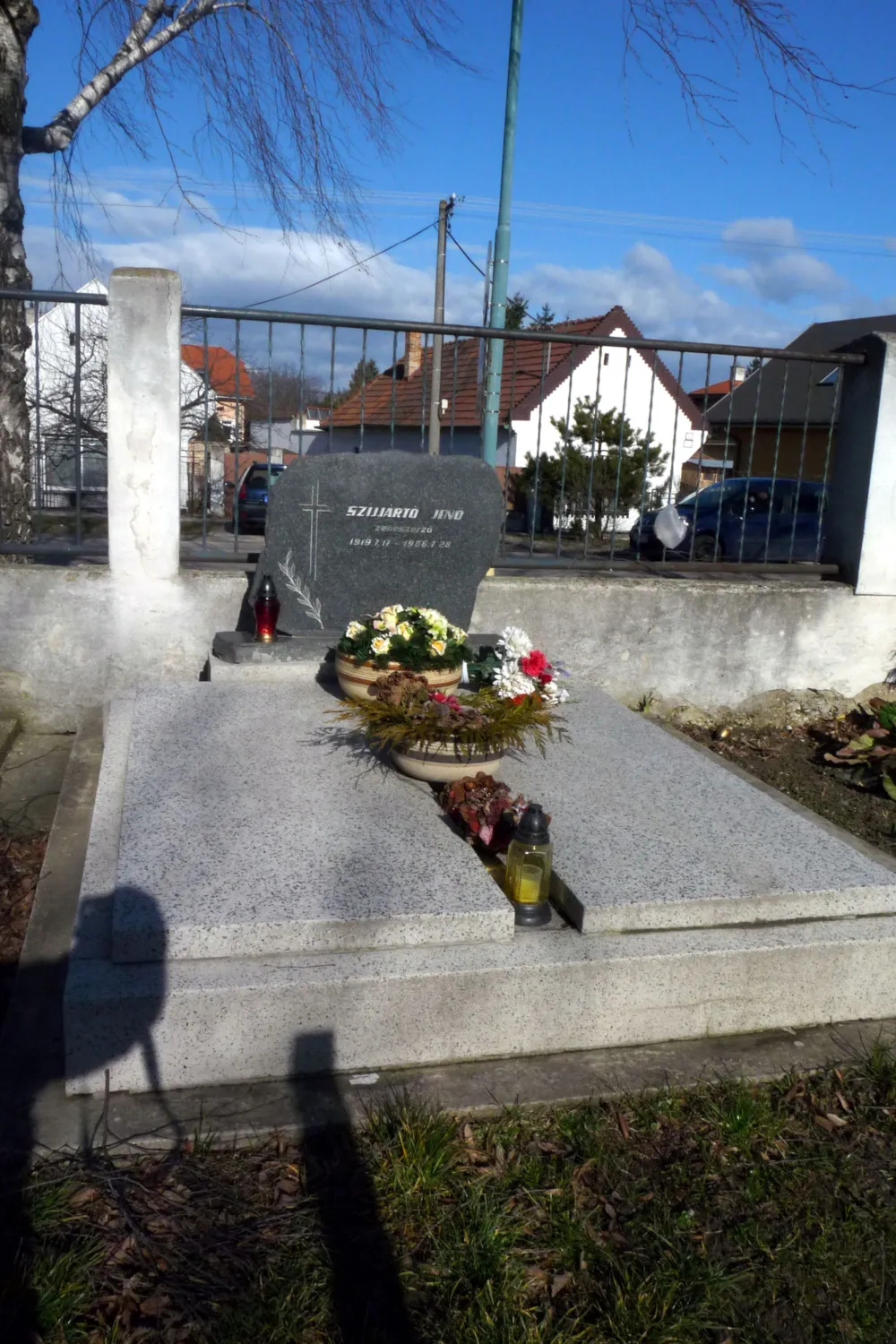
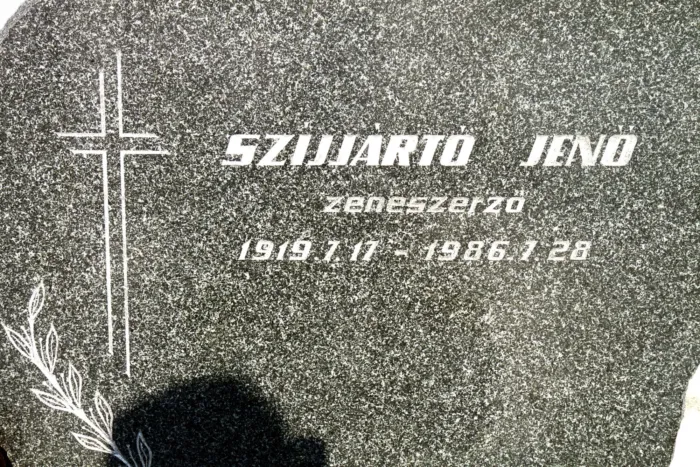
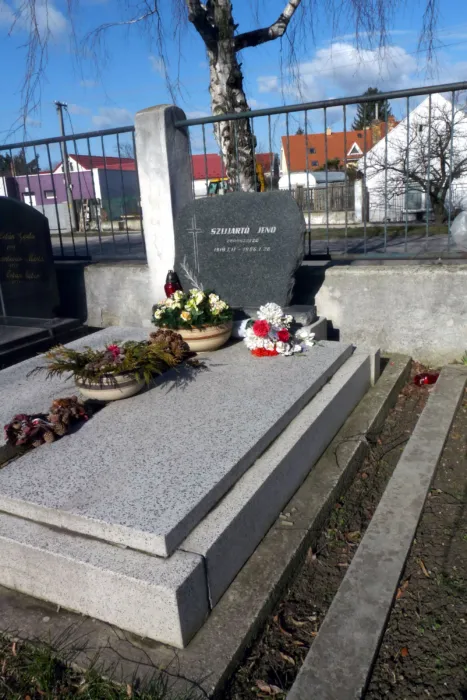
The funeral of composer Jenő Szíjjártó
Cemeteries, tombstones, graves
Jenő Szíjjártó was born on July 17, 1919 in Gölnicbánya. His musical talent manifested itself early, and the difficult years of his childhood and youth, as well as the historical and political lows that characterized Czechoslovakia at the time, did not deter him from dedicating his life to music and becoming the standard-bearer of Hungarian culture in the Highlands. In 1920, all members of the family lost their citizenship, as his father took part in the events that erupted as a result of the Trianon peace treaty, so Jenő Szíjjártó could not continue his education after elementary school due to lack of citizenship. In 1928, the family moved to Nitra. Through private diligence, practicing on a borrowed piano, he prepared to become a student at the Bratislava Conservatory. He only had the opportunity to do so in 1941, when he began his studies in Composition as a student of Alexander Moyzes, which he continued with János Visky at the Liszt Ferenc Academy of Music in Budapest from 1943 to 1945 as a scholarship holder. He studied piano under József Ditrói-Csiba, and regularly attended lectures on folk song analysis by Zoltán Kodály. His studies were ended by the siege of Budapest. He survived the fighting in Újpest. The deprivation and the horrors he experienced took such a toll on him that only careful nursing could save his life. He managed to return to Nyitra, to his mother. He was deprived of his rights along with other Hungarian compatriots, and lost his citizenship again, so he was only able to attend the Bratislava Conservatory again in 1948, where he expanded his previous studies with a conducting course. He graduated in 1951 as a student of Kornel Schimpl. In the meantime, in 1948, he organized and conducted a large-scale Bach concert in Nitra, which was broadcast live by the Czechoslovak Radio. ; From 1951 to 1953, he worked as the music director of the Czechoslovak Radio. He had to fulfill only one condition for the position of conductor of the Czechoslovak Radio Choir: to Slovakize his name from Szíjjártó to Szlótár. He did not ask for it! As an invited conductor, he was happy to conduct both the Slovak Philharmonic Orchestra and Choir, but he did not compromise his principles. ; In 1953-54 – after giving up the Czechoslovak Radio, which provided a secure livelihood and recognition – he became the conductor, artistic director and in-house composer of the newly formed, professionally organized Népes (Czechoslovakian Hungarian Folk Art Ensemble). He wrote choral works and arrangements of folk songs. When the state authorities abolished Népes in early 1955, he continued to work in the apparatus of Csemadok (Czechoslovakian Hungarian Workers' Cultural Association), and then was employed by the National Education Institute. His folk song collecting activity also falls into this period: he recorded more than 500 Hungarian folk songs in 27 upper-country villages. It was at this time that he wrote his best-known folk song arrangement, the composition Esti számány Zsérén, which combines three folk songs from the Zobor region that he had collected himself. In 1956 he returned to the Czechoslovak Radio, where he worked as a music director until his retirement in 1984. In 1959 he married Ilona Varga, who became the custodian and administrator of his artistic legacy after his death. ; In 1961, at the 1st National Hungarian Choir Festival in Zselíz, he conducted his work We Want Peace!, composed for the occasion to the poem by Sándor Weöres, in front of a full choir of 1,200 singers. He considered this event one of the greatest professional successes of his life. ; It is thanks to Jenő Szíjjártó that the Central Choir of Hungarian Teachers in Czechoslovakia was founded fifty years ago, in November 1964, whose most important mission was to train conductors for the Hungarian choral movement in Slovakia that was reborn after World War II. However, he had to leave the leadership of the Teachers' Choir in the same year due to ideological objections from the state authorities. The choir, which in 1994 took the name of the Hungarian Teachers' Lajos Vass Choir of Slovakia, paid tribute to its former founder, Jenő Szíjjártó, in July 2002 by singing five of his works on tape for archiving at the request of the Hungarian Radio's Folk Music Section, conducted by Ferenc Sapszon. ; A significant event for the Hungarian musical community in the Highlands is the triennial choir competition called Kodály Days, which continues the broken tradition of the 1961 National Hungarian Choir Festival in Zselíz, which he organized. It was organized for the first time in Galánta in 1969 and has been the biggest celebration of the Hungarian choir movement in the Highlands ever since. Until his death, Jenő Szíjjártó was the chairman of the jury of the choir competition and the conductor of the choir. ; From the early 1980s, recordings of Jenő Szíjjártó's arrangements of folk songs for choirs performed by leading Hungarian choirs and conducted by excellent conductors were made on the Hungarian Radio. These were regularly performed on the Hungarian Radio's programs, establishing the composer's fame in his homeland. ; His work as a composer is characterized by about 60 pieces of music: works written for orchestra and choir, arrangements of folk songs, choral works written on poems. ; As a composer, conductor, choir organizer and as a person, Jenő Szíjjártó was consistent, goal-oriented, just and extremely demanding. With his passion for music, his eloquence, his engaging nature, and his relentless commitment, he brought many to the cause of Hungarian singing and music culture in the Uplands. His charismatic personality still influences the musical vision and art of the representatives of the Uplands Hungarian choral movement who followed him. His death on July 28, 1986, at the age of 67, came as a surprise to his admirers and former colleagues. ; On the occasion of the 70th anniversary of his birth, in 1989, the choral collection entitled Az anyai szó, summarizing his works, was first published by Csemadok. In 2001, Nap Kiadó published the first edition of the collection entitled Virágok wetélkedese – szálagatás széműből gyömöből gyömöből . In 2005, he received the posthumous award of the Minister of Culture of the Slovak Republic for his outstanding life's work. In 2007, the Bratislava-based Median publishing house published his pieces for children under the title Children's Poems Set to Music. In 2008, he was posthumously awarded the Knight of Hungarian Culture. In 2009, the portrait film Music and Soul – Life Pictures about the composer Jenő Szíjjártó, directed by Mária Haraszti, was presented at the Buda Vigadó and then at the Bratislava Casino. ; Árpád Tóth, the current guest conductor of the Slovak Hungarian Teachers' Vass Lajos Choir, managed to bring the composer back into the public's interest when he performed several of Jenő Szíjjártó's works on the choir's program, and in 2012 he wrote a book about his work entitled "Because the law is the mother's word, gravity". ; The Hungarian Heritage Award recognizes the tireless organizational work and compositional work of Jenő Szíjjártó, who created a movement, and at the same time fills the entire Hungarian community in Slovakia with great pride. ;
Géza Horváth