
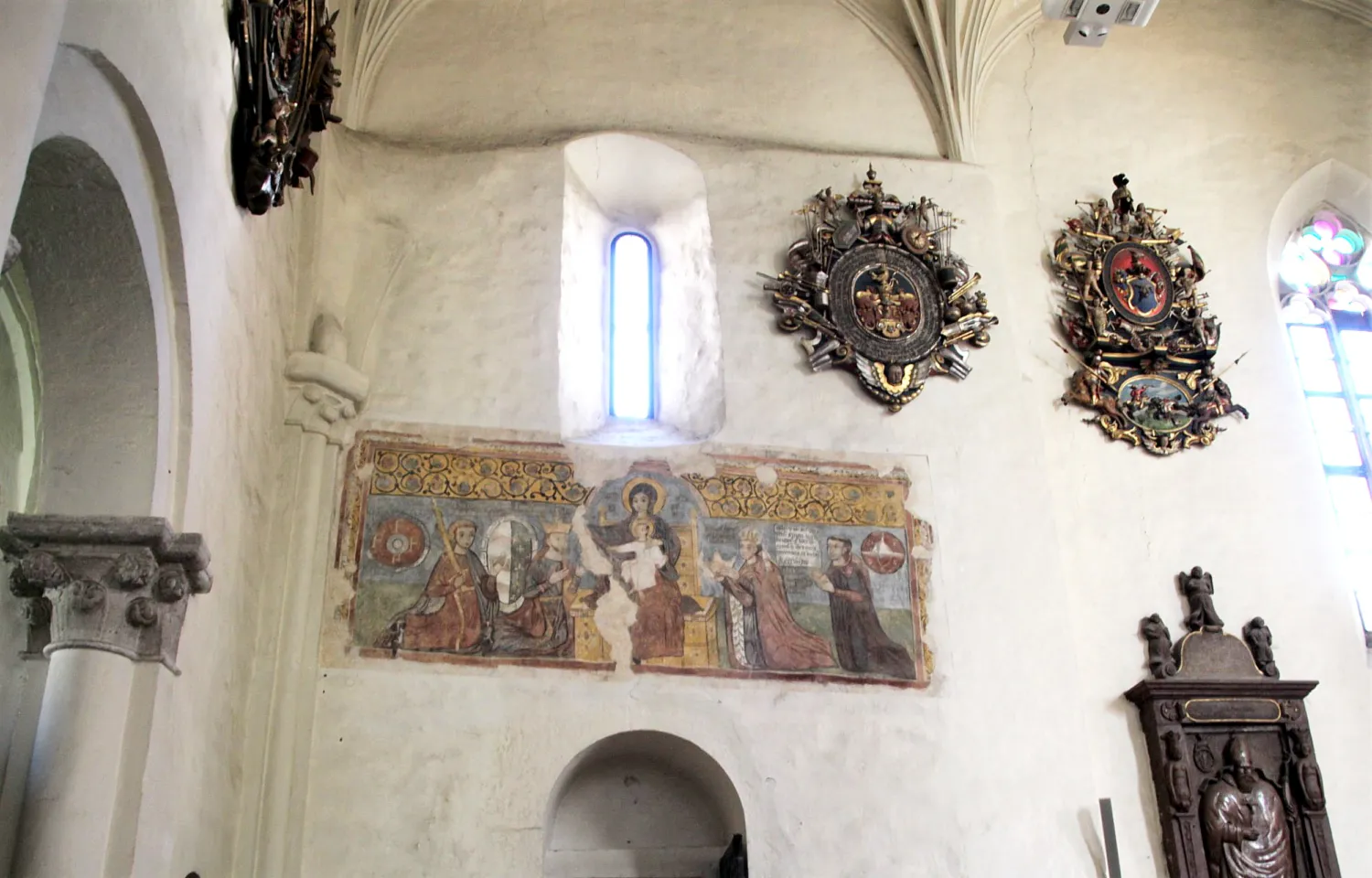
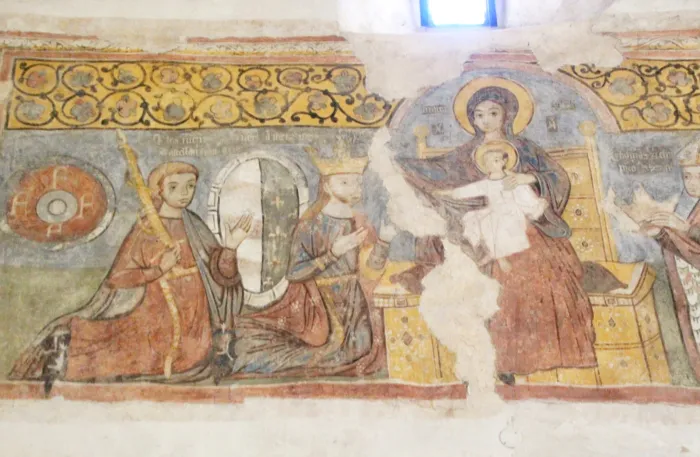
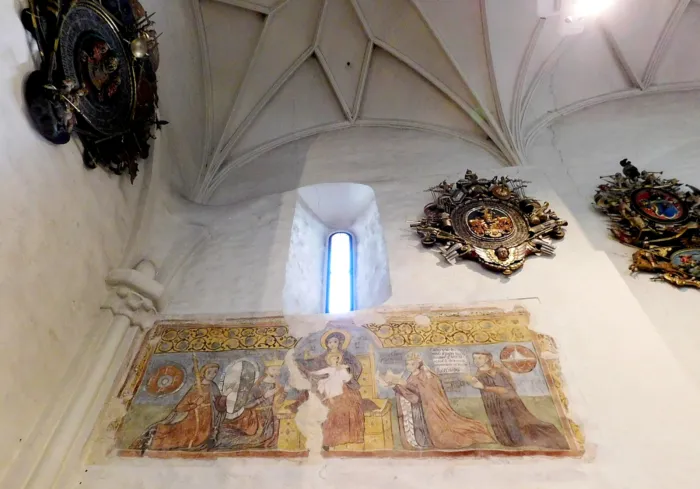
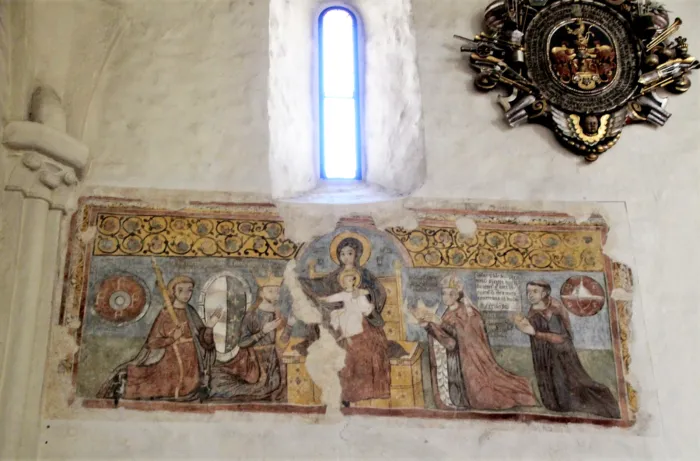
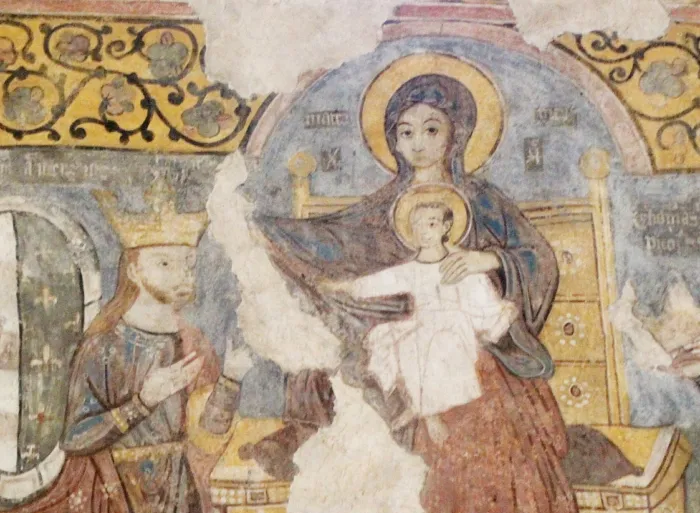
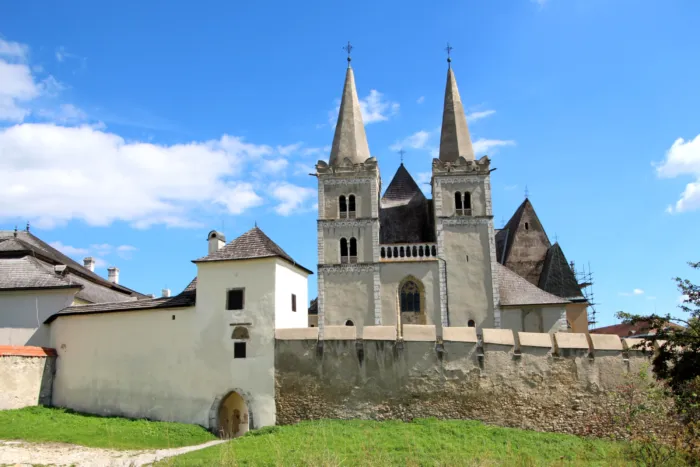
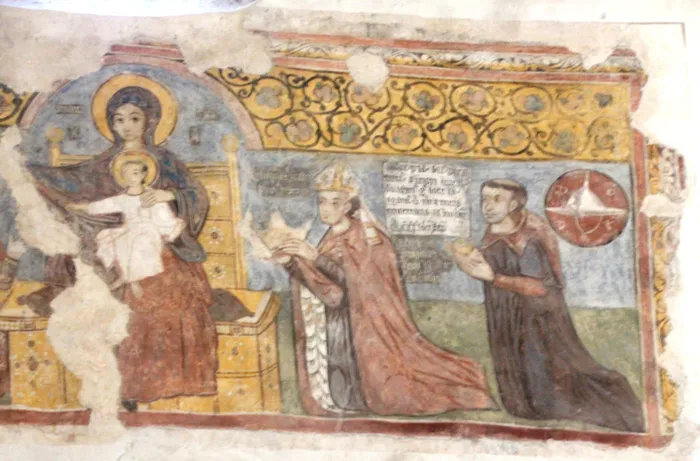
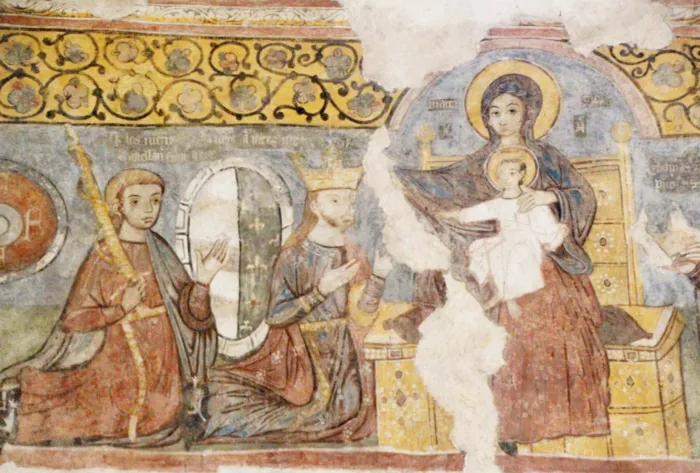
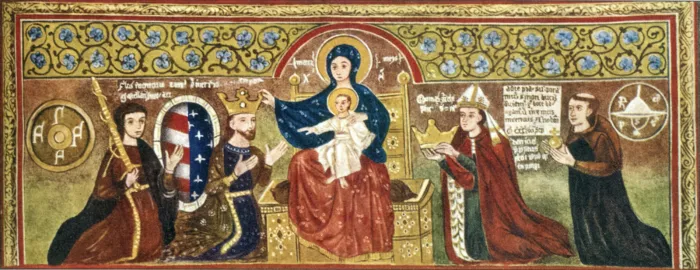
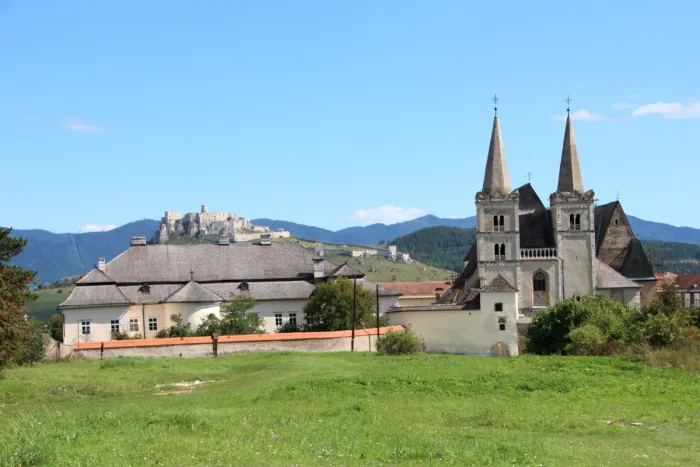
Virgin Mary of Szepeshely crowns Charles Robert, mural
Sacral small monument
"In the former seat of the Spiš provostship, in Szepeshely, the cathedral preserves a wall painting of historical interest. Its value is enhanced by the fact that it is also marked with the exact year. It was removed from under the lime around the middle of the last century and immediately afterwards repainted as part of a restoration. ; Above the entrance to the northern side of the cathedral, the picture, enclosed in an ornamental frame, depicts the coronation of Charles Robert. In the middle, on a Romanesque throne set with precious stones, sits the Virgin Mary, wearing a blue cloak hiding a purple dress with a gold border, in a frontal position. In her arms is the child Jesus, who, according to Ipolyi, resembles a similar figure in the icon of the Bakács Chapel in Esztergom. With her right hand, the Madonna places the crown of Saint Stephen on the head of the kneeling Charles Robert. The king wears a blue-green robe with an embroidered border. Behind him is his sword-bearer, according to the inscription above his head, Franciscus de Sempse, Ferenc Semsey, the vice-prince and chamberlain of Spiš, kneels, holding an ornate sword in his right hand. To the left of the throne are two more kneeling figures, whose identities are also evident from the inscription above their heads. The first is Tamás, Archbishop of Esztergom, wearing a golden-edged mitre and a purple cloak falling from his shoulders, offering the crown to the Virgin Mary with both hands. Behind him is a tonsured and hooded figure, Provost Henrik of Spiš, holding the orb of the state. A few lines of a Marian hymn can be read between the archbishop and the provost. From it we learn that this mural was commissioned by Provost Henrik in 1317: ; ; Ad te pia suspiramus ; Si non ducis deuiamus ; Ergo doce quid agamus ; Virgo mei ét meis miserearis ; Anno domini MCCC decimo septimo. ; Henricus prepositus fecit istud opus inpingi. ; ; (To you, gracious Virgin, we pray, ; If you do not guide us, we will go astray, ; Teach us therefore what to do ; Have mercy, oh Virgin, on us. ; In the year of the Lord 1317. ; Provost Henry painted this work.) ; ; In the upper part of the composition, a frieze with vine decoration, which makes up a quarter of it, runs along it, reminiscent of the peculiar enamel pattern often found in Límoges, embedded in copper. At the inwardly curling ends of the vines, a small flower opens. ; The emblems visible below, which probably refer to the kneeling figures, and the shield with the lilies of Anjou, drawn in perspective, rising behind Robert Charles, may, according to Divald, be the work of a later painter. Merklas correctly notes that these are not to be understood as shields of arms, but as attributes of the corresponding figures. ; Ipolyi a Magy. Tud. He introduced this mural in his sublime speech at the Academy on January 23, 1864, and at that time he also sketched its historical background in a plausible manner. With the extinction of the House of Árpád, the country was taken over by partisan lords who were dividing the country. Robert Charles, who came from the House of Anjou, was only able to break the oligarchs and gain royal authority for himself through bloody battles. The loyal Saxons of Spiš played a large part in consolidating his throne, as they fought alongside him in his last battle against Máté Csák and the Omods on the battlefield of Rozgony in 1312. After this decisive victory, Robert Charles was finally crowned with the crown of Saint Stephen. It is very likely that the people of Spiš also played an important role in the coronation ceremonies. The fresco in Spišeshely immortalizes this memory. A document from the Spiš chapter suggests a more detailed reason for its establishment. light. According to this, the king personally visited Spiš in 1318, where he was received with great celebration and pomp. It is therefore plausible that Provost Henry wanted to express his homage to his king by painting the mural. ; András Péter, in agreement with Arnold Ipolyi, believes that this fresco shows a strong Sienese influence. His master is associated with Simoné Martini. Ipolyi directly implies that we are dealing here with an Italian artist who came out of Simoné's school. ; However, this view is wrong. A thorough study of the works of the Siena painters confirms Tibor Gerevich's view, according to which the Spiš mural has very little to do with Sienese or even Italian painting. In terms of formal language, the differences between the work of the Siena masters and the work of the Spiš painter are striking. The faces of the Siena Madonnas are less full, their eyes are narrower and almond-shaped. The face of the Spiš Madonna round, his eyes are button-shaped, his eyebrows are more arched and drawn higher above the eyes than in Siena. This round facial representation is otherwise typical of Hungarian painting, especially in the 15th-16th centuries. The distance between the nose and mouth, however, is smaller in our Maria than in the Sienese ones. The bambino in Szepeshely is thin, old, in Siena he is round, full of life, with curly locks. We could reach a similar result by analyzing the forms of the other figures. And if there is a little thing in the Szepeshely mural that reminds us of Siena, such as the long-sleeved hands, the folds of the clothes, it also fades into worthlessness in the difference in quality that exists between these works of art. In technical knowledge, our painter is far below the Sienese standard. Where are the softly falling folds of clothes, the noble facial representations of the Sienese here! ; We should not draw too far-reaching conclusions based on the composition itself, the arrangement of the picture. This depiction of the Virgin Mary and the child on a throne in the center of a larger composition is a stereotypical phenomenon in medieval painting. In both Italian and German art, we can sometimes find surprising analogies. It is as if the gestures, how the Madonna holds her child and the movements of the little Jesus himself had been copied from each other by different masters. In most cases, the explanation for this lies not so much in the interactions, but rather in the common, Byzantine iconography and morphological source. ; The idea that guided the painter from Szepeshely, the presentation of the divine origin of royal power, could have been conceived very well on Hungarian soil, and it did not require inspiration from Naples or Siena, since our kings have been under the patronage of the Virgin Mary since Saint Stephen. ; The picture, enclosed in a narrow Gothic frame, suggests a local, Hungarian master. The clothing, facial type, and provincial nature of his figures, which profess Hungarianness, are shown by the rigidity and often clumsiness of the forms. The international aspects of the composition prove that his master was also familiar with contemporary foreign works. It can be assumed that, as is customary, he spent his student years wandering abroad."