
St. Michael's Roman Catholic Church
Building, structure
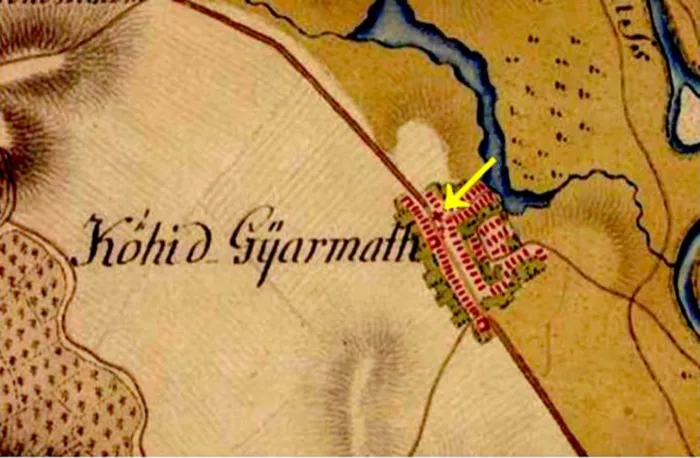
The parish of Gyarmat was probably established at the turn of the 13th and 14th centuries. Nothing proves its antiquity better than the fact that the papal tithe register issued in 1332/37 already mentions the Gyarmat parish. Here it is listed as a church in the parish district under the provost of Zöldmez named after the martyr Saint George, and is listed as “Armat, Armati”. The register summarizing the papal tithe of the parishes of Esztergom County in 1332/33 determined the amount of the tithe paid for Gyarmat at six garas. The first parish priest known by name among the priests active here dates back to this era. From 1322 to 1337, a parish priest named Pál, “Paulus de Armati”, served in Gyarmat. ; The church visitation register that survived from the time of the Turkish occupation reveals the sad state of affairs in 1560. Most parishes were either vacant or abandoned and had been destroyed. In 1560, such a vacant but still existing parish was found in Gyarmat with the remark that “its old church, dedicated to Saint Michael and belonging to the patronage of the Esztergom chapter, still stands.” During the century and a half of Turkish occupation, most of the villages did not even have a priest. At the end of the 17th century, only five villages in the county had a parish priest, including Kőhidgyarmat (1682). ; Lipót Kollonics, Archbishop of Esztergom, ordered the first church visitation after the Turkish times in 1701. This census is invaluable. The answer to the first two questions is particularly interesting, namely 1. what condition the church is in, 2. who or who, Catholics or heretics, built it and when, which points to the antiquity and condition of the church, as well as its financial situation. We can learn the following about Kőhidgyarmat: “Nobody remembers when and by whom the church was built. Its patron saint is the martyr Saint Maurice. During the war, it completely collapsed, there is no roof, only its walls are standing. It has no property. The feast of its consecration is held every year on the Sunday following the eighth day of Saint Maurice. There is a gilded silver chalice with a paten. During the wars, all the property of the church was destroyed, and the place was depopulated.” ; The 1732 archdeacon's visitation states that: "Kőhid-Gyarmat is an old mother church, belonging to the Esztergom domain of the chapter. The ceiling of its church, built in honor of St. Móricz, is now being transformed into a stucco one. For his feast day (September 22nd), they will ask for forgiveness as quickly as possible. Its sacristy is vaulted (it used to have a beamed, wooden ceiling). It has three altars, a pulpit, a choir, and benches. It also has a wooden tower with a bell." ; Despite the fact that the previous, ancient church of St. Michael had undergone several transformations, it could no longer satisfy the new demands arising from the strong increase in the population. Therefore, instead of the old church that had suffered much, the Esztergom chapter had a completely new church built in 1742-46, using the old ruins. ; Since the records suggest that the new church was built on top of the old one, the area was subjected to a ground-penetrating radar survey in 2017. The survey revealed the existence of a Romanesque church, which is located in the ground plan of the current church. Two ground levels were revealed throughout the nave, the deeper one (80 – 100 cm) indicating the ground level of the medieval church. The original nave was a 12 m long, 8 m wide, rectangular structure, offset by a 5.5 x 5.5 m semicircular apse, which was provided with buttresses for static reasons. The foundation wall is approx. 120 cm wide. Significant anomalies can be observed in the current sanctuary and sacristy, which suggest foundations of unknown origin (it appears as if a longer section of broken-line masonry – a protective wall – had been attached to the apse). The results of the ground-penetrating radar survey indicate the completion of archaeological and architectural-historical excavations.