
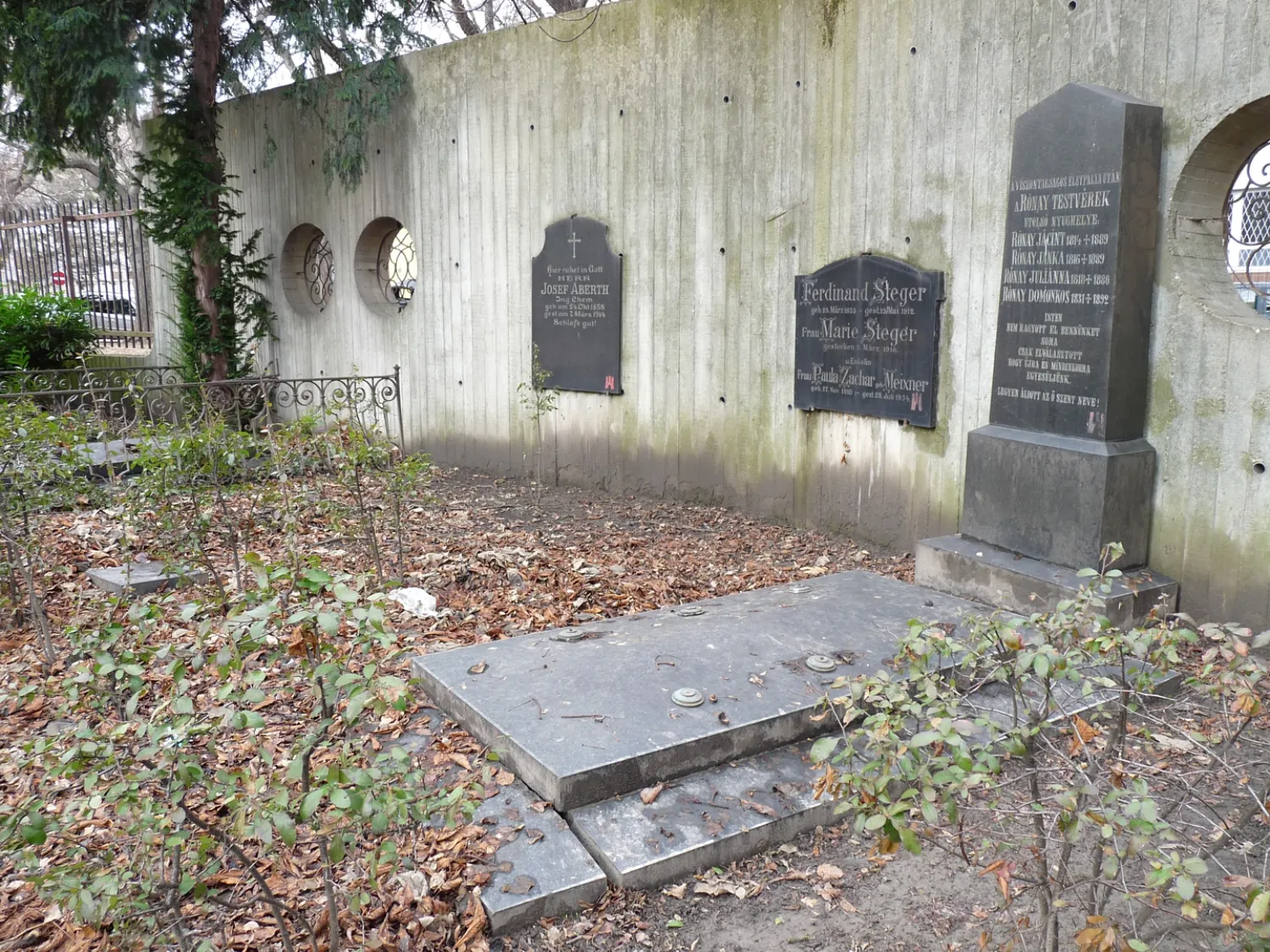
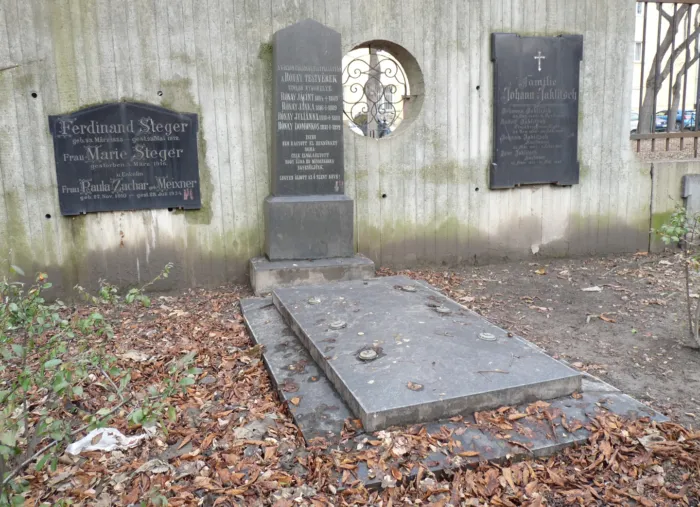
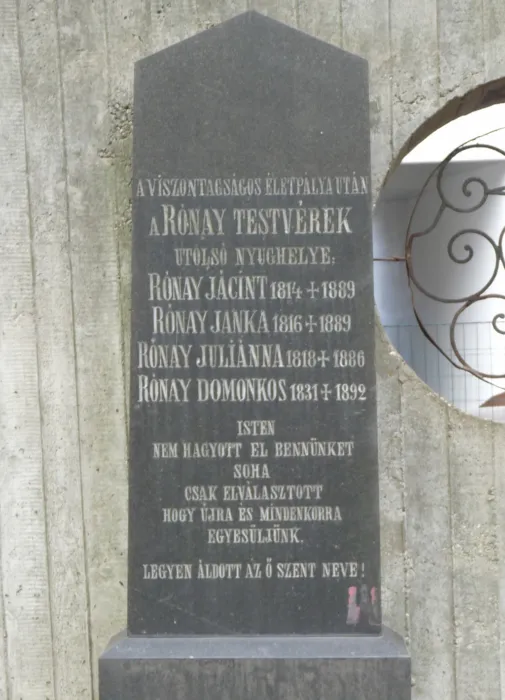
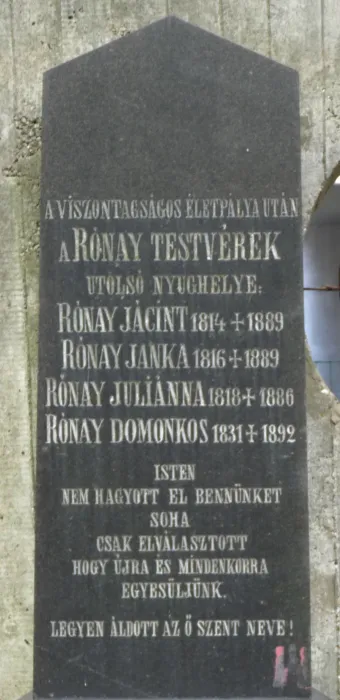
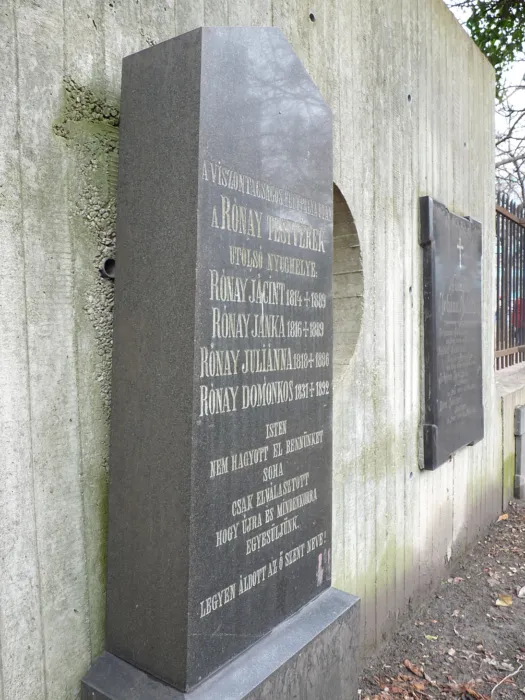
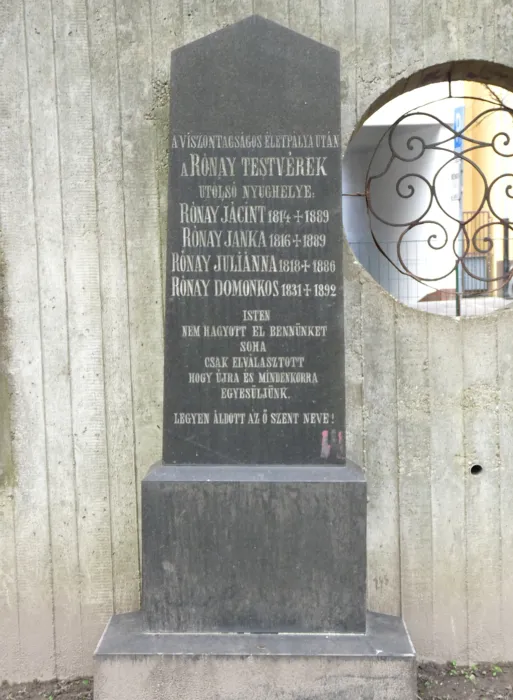
The grave of Jacint Rónay
Cemeteries, tombstones, graves
János Jácint Rónay (Leitzinger until 1848) (Székesfehérvár, May 13, 1814 – Bratislava, April 17, 1889) was the grand provost of Bratislava, elected bishop of Szkodár, a real inner privy councilor, Benedictine teacher, natural scientist, writer, member of the Hungarian Academy of Sciences. He dealt with psychology, including characterology. He introduced Darwinism to Hungary and was the first to spread it. He was the tutor of Kossuth's children, as well as of Crown Prince Rudolf and Archduchess Maria Valéria. ; He was baptized with the name József by his parents. He studied in his hometown and in Esztergom, and then in 1831 he entered the Order of Saint Benedict of Pannonhalma. After studies in Győr, Bakonybél and Pannonhalma, he was ordained a priest in 1839. ; Between 1840 and 1849 he was a high school teacher in Győr, the order's main high school. In 1841 he obtained a doctorate in humanities. ; His scientific work covered a wide area. He was an advanced natural scientist, the first and best-known representative of Darwinism in Hungary in his time. In 1847 he was elected a corresponding member of the Hungarian Academy of Sciences. He gave his inaugural lecture on December 29, 1847, entitled "On the human brain and its influence on intellectual life". ; His knowledge exceeded the average person's standards until the War of Independence of 1848-49, but it was only the War of Independence and its failure that made his life extremely interesting and productive. In 1848 he became the camp chaplain of the Győr National Guard. On April 1, 1848, in Győr, on the Main Square (today Széchenyi Square), after the speech calling for revolution by the Benedictine alumnus of Győr, Sándor Lukács, he recited the prayer of the Pest national guards. On April 9, he went to Bratislava with the Győr national guards. Returning to Győr, he addressed a proclamation to the Hungarian clergy entitled: Address to the Hungarian clergy. Following his team from May 1848, he participated in the defense of the Komárom castle, assisted in the construction of the ramparts himself, and was then present at the Battle of Schwechat. He returned to Pannonhalma, where the abbot declared him a prisoner of the monastery, which he only annulled after the Hungarian victories. ; Upon news of the spring campaign, abbot Mihály Rimely placed him in Bakonybél, so that he would be further away from the revolutionary events in Győr. He was soon recalled and the abbot was sent to Győr by Herman Császár to rescue their fellow monk, who had been sentenced to death by the revolutionary authorities for making hurtful and insulting remarks about Kossuth. With the help of General Pöltenberg, he saved his fellow monk from execution. On May 29, Sándor Lukács appointed him as a church orator in Győr and entrusted him with the management of diocesan affairs. ; As his first measure, he sent a circular from the Bishop's Palace to the priests of the diocese, in which he called on the clergy, and through them the faithful, to a general uprising and final resistance. After the suppression of the War of Independence, he was forced to flee, hid at home for a while, and then crossed the Hungarian border on May 26, 1850, and left Hungary. Between 1850 and 1866, he taught Latin and Greek to medical students in London, and distinguished families entrusted their children to him (he also taught the children of Lajos Kossuth). During his years of emigration, he was in contact with many famous people. Among Hungarians, he was in contact with former Minister of Justice Sebő Vukovics, Colonel Sándor Mednyánszky, General György Kmetty, and he also often visited the English island of Guernsey to see Victor Hugo, who was living in voluntary exile there. In England, he perfected his philosophical, geological and animal studies. Through his scientific work, he also exchanged several letters with Darwin. In 1861, in his absence, he was elected as a member of the parliament of Székesfehérvár, and a member of the city council of Győr. ; He was a versatile scientist, very receptive to new ideas. While working as a high school teacher in Győr, he wrote his psychological works that marked a new direction in Hungarian psychological literature. During this time he also wrote several romantic plays, and later had books on theatre published. Between 1862 and 1866, his articles sent home from emigration were published in Hungarian newspapers, in which he (for the first time in Hungarian scientific literature) described the theories of Charles Darwin. Several of his works were published in his absence by Hungarian publishers. ; He was a defining figure in the political and, above all, scientific life of the emigration, and he also played an important role in the publication of Count István Széchenyi's pamphlet, "Blick". In the meantime, after several attempts, Kruesz Krizosztom, the abbot of Pannonhalma, and János Simor, the bishop of Győr, obtained permission for him to return home, and he was able to return home in 1866. In 1867, he became a full member of the Hungarian Academy of Sciences, then its notary and an advisor to the Minister of Culture. ; In 1867 he participated in the organization of the Hungarian Historical Society, and then between 1867 and 1871 he edited the official journal of the Hungarian Academy of Sciences, the Academic Bulletin. ; Between 1871 and 1872 he taught the heir to the throne Rudolf Hungarian history. In 1872 he left the Benedictine order, became a priest of the archdiocese of Esztergom, and then the king appointed him grand provost of Bratislava. In 1873 he became titular bishop of Scutari. He never sought any position, title, or rank, his impeccable character, deep knowledge, and pure heart won people over. He always gave the 3,000 forint honorarium from the royal court to the poor. Between 1875 and 1883, on the recommendation of Prime Minister Gyula Andrássy, he was the tutor of Archduchess Mária Valéria. ; From 1883 he lived in retirement in Bratislava until his death on April 17, 1889. ; He left his rich library to the Bratislava Public Education Association. He donated his diary, manuscripts, letters and collected newspaper articles, as well as his valuable paintings to the Pannonhalma Archabbey. His bust and portrait are in the Pannonhalma Archabbey Collection, and a street in Győr bears his name.