
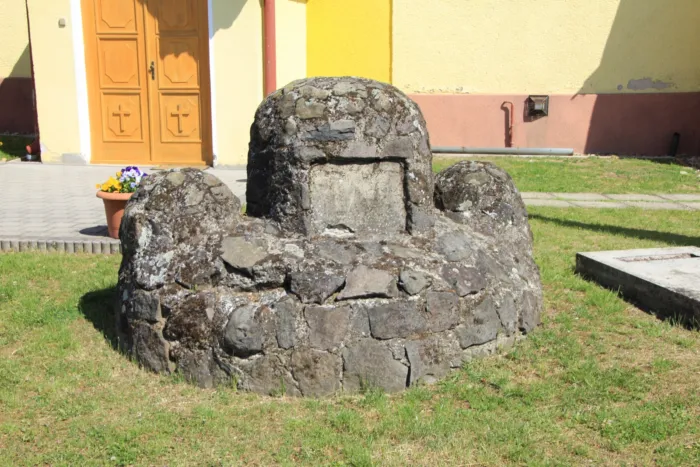
Old national flag stand
Statue, monument, memorial plaque
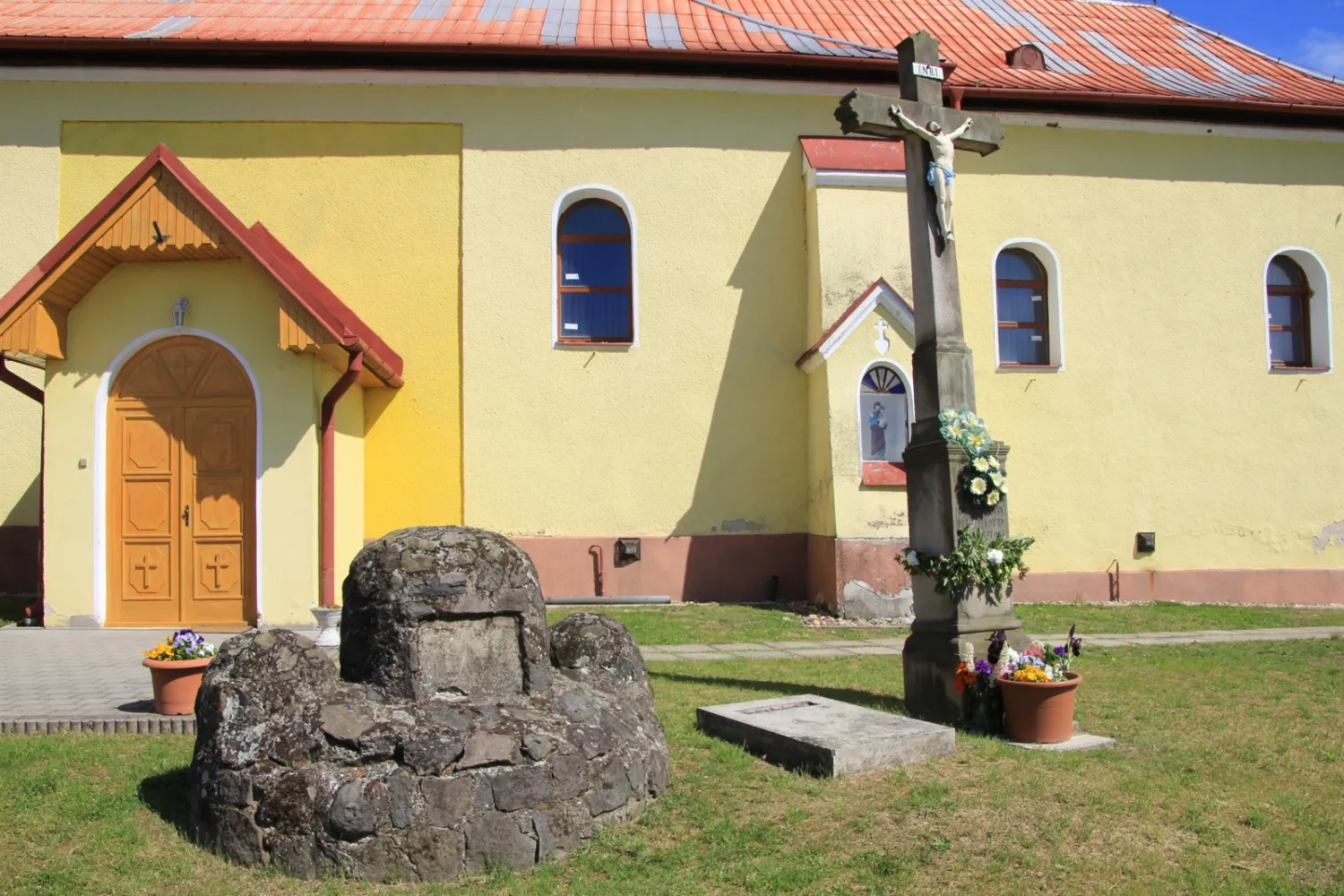
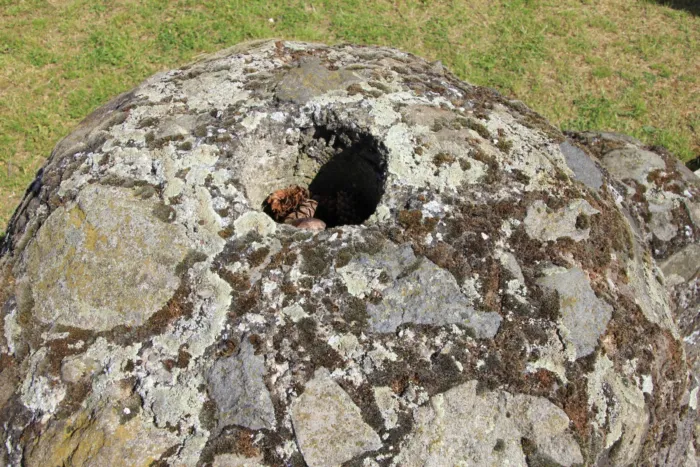
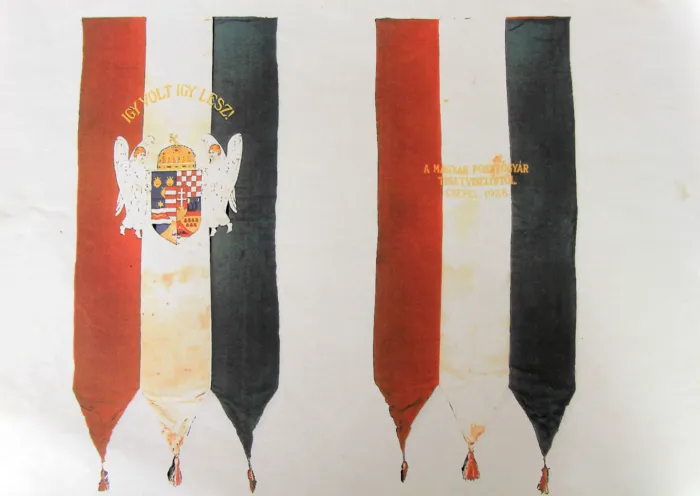
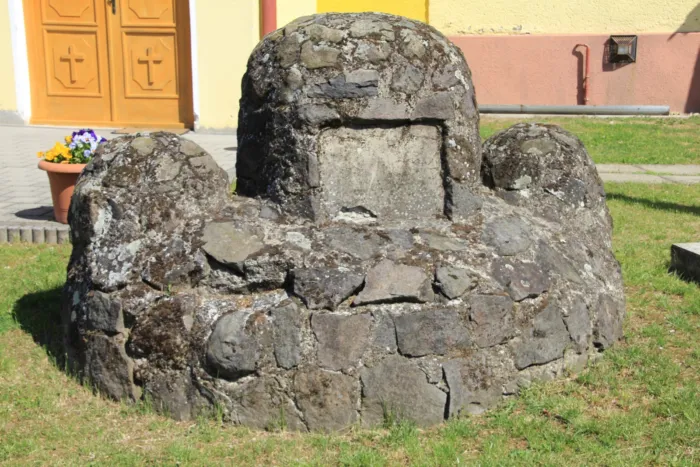
The pedestal of the old national flagpole still stands not far from the chapel. It is a triple mound of hard stone set in concrete mortar. The white marble memorial plaque and the flagpole were once placed on the middle mound. The national flag was donated to the village by the workers of the Csepel cloth factory. A ceremonial inauguration took place on March 15, 1939. The flag was placed in the church vestry and was ceremonially raised every year on March 15 and August 20. This last took place in August 1944. The flag was kept by sacristan Pál Bojtos for a long time, and then it was transferred to the National Museum in Budapest. Its history was elaborated by Ferenc Szalay. ; ; Ferenc Szalay: A brief history of the Kőkesz national flag ; ; North of Balassagyarmat, approx. There are five villages within ten kilometers: Terbegec, Gyürki. Kőkeszi, Sirak and Szelény. The latter village was Slovakized at the beginning of the first Czechoslovak Republic, in 1920, by the importation of Slovak settlers. According to the data from 1938, the proportion of Slovaks in Szelény was 38%. The vast majority of the population of the other villages still speaks Hungarian. In Terbegec, Gyürki and Kőkeszi, Hungarian-language education had been available since 1950, until it was discontinued due to the low number of students. At that time, concentrated schools were established 8-9 km away, where better conditions were provided. However, in Sirak and Szelény, elementary schools are still operating today [they have also been discontinued since the writing of this article], and have been in Slovak since 1945 without interruption. The question is, do these schools have the necessary number of students? ; Unfortunately, our ranks were greatly thinned by the population exchange and then the deportation to the Czech Republic in 1947. Day by day we witness how unfavourably the ethnographic map of this area is changing for the Hungarians living here. ; After this introduction, let us turn to a brief description of the history of the Kőkeszi national flag. ; The decorative national flag, made in 1938, was donated to the village of Kőkeszi by the officials of the Csepel cloth factory in memory of the liberation of the village on November 9, 1938. The national flag and its pedestal were placed in front of the church. The triple pile of chimney stones placed in concrete mortar still stands intact today. Its dimensions are 1 m below ground level, 160 cm above, 165 cm wide, and 230 cm long. Unfortunately, the 45 x 35 cm white marble plaque placed on the middle mound has disappeared and the flagpole and mast are also missing. I do not remember any inscription on the plaque. The plaque disappeared around 28 Dec. 1944, during or after the siege. ; The material needed for the construction of the three mounds, as well as the remuneration of the builders, were arranged by Pál Lábody, who lives in the neighboring village of Sirak. ; The ceremonial inauguration of the decorated national flag took place on 15 March 1939 in the morning hours. The commander of the military administration gave a nice ceremonial speech. I no longer remember his name or rank. Teacher Árpád Neusch thanked Ernő Lábody, who was present there and represented the Csepel cloth factory, for this gift. Then I recited the National Song. Then, the border patrol detachment stationed in Kőkeszi, led by Ensign Bidnay, marched in a ceremonial procession in front of the flag. During this, the flag was raised to the top of the mast, then lowered back to half-mast. After the ceremony, there was a short festive lunch at the school. At that time, I dared to ask the military commander why the flag was lowered back to half-mast. The commander replied: “Son, the flag can only fly at the top if we get everything back.” ; The flag also included about 2-3 kg of mother earth, which was placed in a canvas bag, which was kept in the sacristy of our church for a long time. ; The flag was normally placed in the vestry of our church. It was ceremonially raised every year on March 15 and August 20. On the occasion of the ceremonies, a guard of honor was taken down. The flag was last flown on Aug. 1944. It was raised on the 20th. ; How and why did the beautiful flag end up in Kőkeszi? Let's go back in history! ; In the book “The Returned Upland” (edited by Csatári I. and Ölvedi J., Budapest, 1939), the name of Pál Lábody is found at the bottom and in the middle of page 143, (18659 resident of Sirak. His children: Irén, Melénia, Vilmos, Aranka. Pál Lábody died in 1945. I knew him too. He was a very ordinary Hungarian man. After the Czech occupation, János Medvec came to the village of Sirak in 1920 to teach, who supposedly came from Szepesolaszi. Teacher Medvec spoke Hungarian excellently, but from the moment he appeared, he worked very diligently for the Slovakization of the village of Sirak. He organized Slovak-language teaching in the villages of Gyürki, Sirak, and Szelény. He had new schools built in Gyürki and Sirak. These were built with the money of Matica slovenská. ; Teacher Medvec in 1936 married Pál Lábody's daughter, Aranka. Ernő Lábody married in Balassagyarmat, married Erzsébet Bodonyi. Later he worked in the Csepel cloth factory. He lived in Budapest until his death in 1974. ; János Vitéz Széles, who also taught in Kőkeszi in 1908, married Pál Lábody's daughter, Irén (after 1938 Széles was a police inspector in a Budapest district). ; Here I dare to think that the beautiful and noble idea started from the Csepel cloth factory, was still only wanted to cover the past of teacher János Medvec before 1938. ; After 9 Nov. 1938, Medvec wanted to continue teaching, but in Hungarian. That's when my father (1891), Kálmán Szalay, who was also its organizer and director before 1938, intervened of the Hungarian National Party in the countryside. My father only asked the military authorities to place a teacher named Medvec in a Slovak village where they wanted to teach in Slovak. “Of course” Medvec did not accept this proposal, because he farmed on his father-in-law’s estate about ⅔ of it. ; Although Medvec had a very bad past from the point of view of the Hungarians living here, they did not harass him anymore. He was never accused of what he had repeatedly stated, namely that the time would soon come for the unification of the northern and southern Slavs. In turn, he filed a large compensation lawsuit in 1941-43 against those (Kálmán Szalay, István Egry, László Gömöry and Árpád Neusch) who wanted to transfer him. Teacher Árpád Neusch was transferred to Transcarpathia in 1941, because he and his wife were excellent they spoke both Slovak and Russian. ; János Széles Vitéz even proved that teacher Medvec was of German origin, which he also showed on official documents. The Hungarian court called on the parties to reconcile, since both the Slovaks and the Germans were allies in the war, to shake hands, which happened. My father and his companions paid 50 pengő legal costs each. ; The authorities and the gendarmerie began searching for the national flag in early 1946. The then parish priest, Reverend István Alár, and the parish priest Pál Bojtos were brutally ordered to hand over the national flag. However, they claimed that the church had been broken into by unknown perpetrators during the front, and then the flag had disappeared. ; The flag was only found in 1962, after the tragic death of Pál Bojtos. Pál Bojtos's wife, widow. Bojtos Mrs. Vincéné found it in her father-in-law's straw bag. Mrs. Vincéné Bojtos kept the flag from 1962 until 6 December 1987. This is when I came into possession of this very valuable object for me. The next day I sent a letter to the Hungarian National Museum asking if they would accept the flag. But the widow, Mrs. Vincéné Bojtos, asked for the flag back three days later, because it was true that it had come to me without her knowledge. I returned it because I learned that she had previously promised it to a real Hungarian. In the meantime, I was waiting for the answer to my letter. It arrived without delay, which I was very happy about, and what it contained. I showed it to the esteemed temporary keeper of the flag, who, after reading the letter, was happy to return it to me. He also very much approved of the flag going to the National Museum. ; Barely two weeks later, I was able to keep the flag again. I was waiting for the opportunity to personally hand it over to Museum, but this did not work. So I sent it by post from Balassagyarmat at the end of May 1988. ; I received a nice certificate from the National Museum on June 15th. Thank you very much. ;
Kőkeszi, 1988
;The writing was preserved by Ilona Kosík, which can be read in the columns of a magazine (only these two pages have survived).
;  ,