
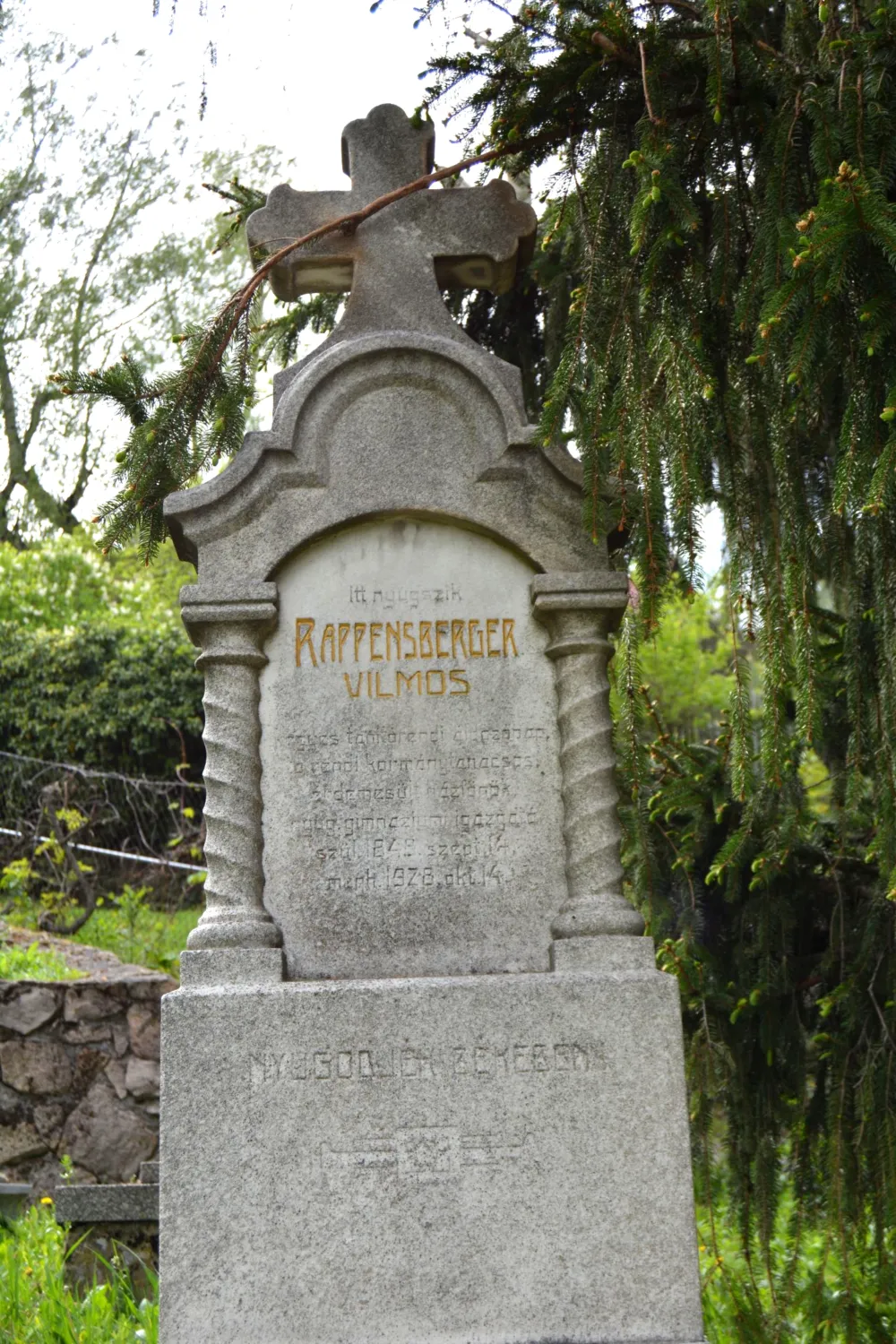
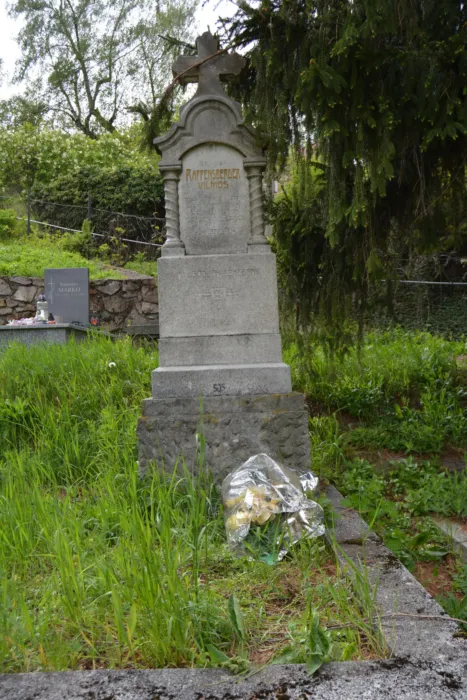
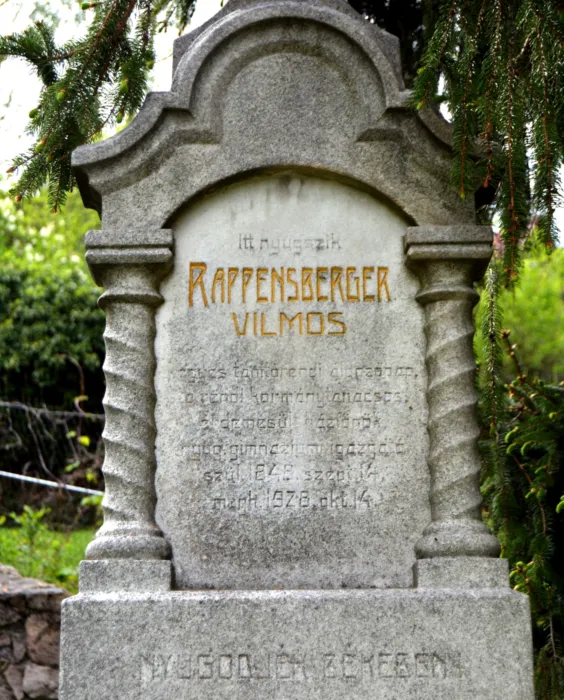
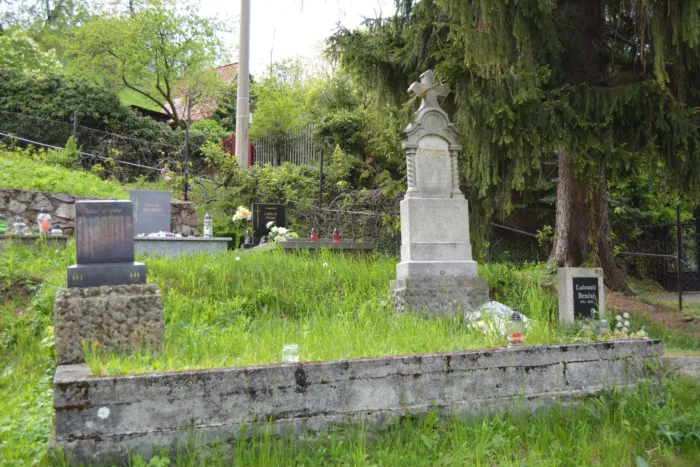
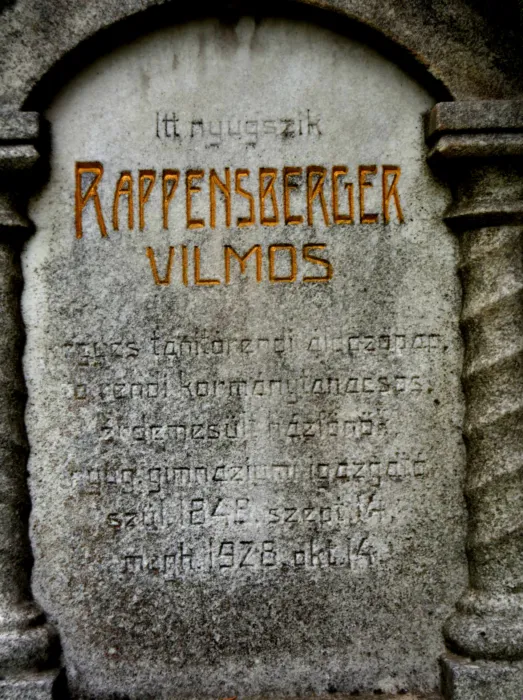
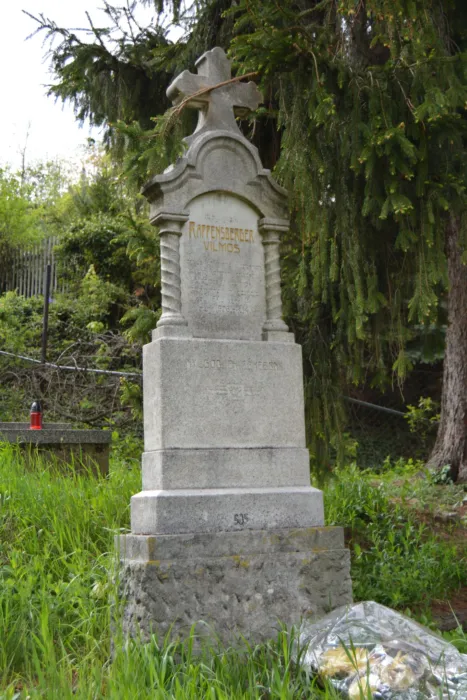
Grave of priest teacher Vilmos Rappensberger
Cemeteries, tombstones, graves
We also praised the work of Vilmos Rappensberger, a Piarist monk, historian, traveler, and natural history and chemistry teacher, in our volume Honti arcképcsarnok (Csáky K., 1998. p. 101), but we did not indicate the place and year of his death. We also did not write about the fact that the last stage of his career also tied him to his homeland. The scholarly monk was born in Bélabánya, the year of the War of Independence, on September 14, 1848, into a mining family. He completed six grades of high school in nearby Selmecbánya, and took his matriculation exam in Nitra. He entered the Piarist order there in 1866. After his novice year, he studied theology, and after completing this, he was ordained a priest in 1872. He continued his studies at the University of Pest from 1876, where he obtained a teaching certificate in natural history and chemistry in 1879. He taught in the gymnasiums of the Piarist order: in Rózsahegy, Nyitra, Szentgyörgy, Budapest, Kisszeben, Trenčín, Mosonmagyaróvár and Nagybecskerek. In the meantime, he was a superior and school principal in several places. From 1876, he devoted almost all his free time to travel. He traveled throughout Europe, and also visited Asia and Africa. He regularly published articles and reports about his travels. Several of his writings were published in the Natural History Journal, the Mosonmegyei Lapok and elsewhere. His work entitled The History of the Gymnasium of Magyaróvár 1739–1894 was published in Győr in 1896. His other work, The Library and Textbook Collection of the Gymnasium of Magyaróvár, was published in the same place and at the same time. His other book, Journey to the North Cape, was published in Magyaróvár in 1897. Two other travel books were also published: Across the Brenner to the Adriatic (Győr, 1901) and Four Weeks in the Pyrenean Peninsula (Győr, 1905). His public activity was also significant, he gave several popularizing and scientific lectures in various societies and associations. He edited the yearbooks of the Trenčín County Natural History Society, etc. Rappensberger's name is no longer mentioned in newer encyclopedias, but József Szinnyei writes about him in detail in his multi-volume summary. (Szinnyei J., 1906. XI. 561–562. p.) He also appears in Borovszky's monograph (Borovszky S. ed., 1906. p. 270.), as well as in the publication introducing the prominent personalities of Selmec and its surroundings (Herčko, I., 1995. p. 196.), and even in the Slovak Biographical Dictionary (Mináč, V. ed., 1992. p. 42.). ; He spent his retirement years in Selmecbánya, but - as can be seen from the bulletins of the Selmecbánya Royal Catholic High School - he did not rest here either. During the First World War, many teachers enlisted in the army, and this certainly caused problems in education. The situation was similar in Selmec, where "selfless men" such as the retired Vilmos Rappensberger director, Dr. Antal Vas retired director and Dr. Zoltán Miklóssy, senior high school teacher, chief archivist. Incidentally, we read the following about Rappensberger in the school's 1915/16. In the Bulletin of the 1990 school year: “Holy Communion Priest and House Assistant, retired House Master and Gymn. Director, regular teacher who volunteered and volunteered to replace teachers in military service, founding member, member of the board of directors and member of the board of directors of the High Gymnázium Auxiliary Association, elected to the Selmecz and Bélabánya municipal authorities and the Roman Catholic elementary school board, appointed to the trusteeship of the Roman Catholic civil girls’ school, regular member of the K. M. Natural Sciences Society and the Catholic Teachers’ Association, taught German language and literature in the 8th grade, 3 hours a week. He has been teaching for 43 years.” (Dr. Rauchbauer J., 1916. 20–21. p.) The renowned teacher died on October 14, 1928 in Selmecbánya. His tomb is located in plot 505 of the Royal Cemetery behind the Piari Gate.