Rákóczi fresco (apotheosis of the life of Ferenc II Rákóczi)
Statue, monument, memorial plaque
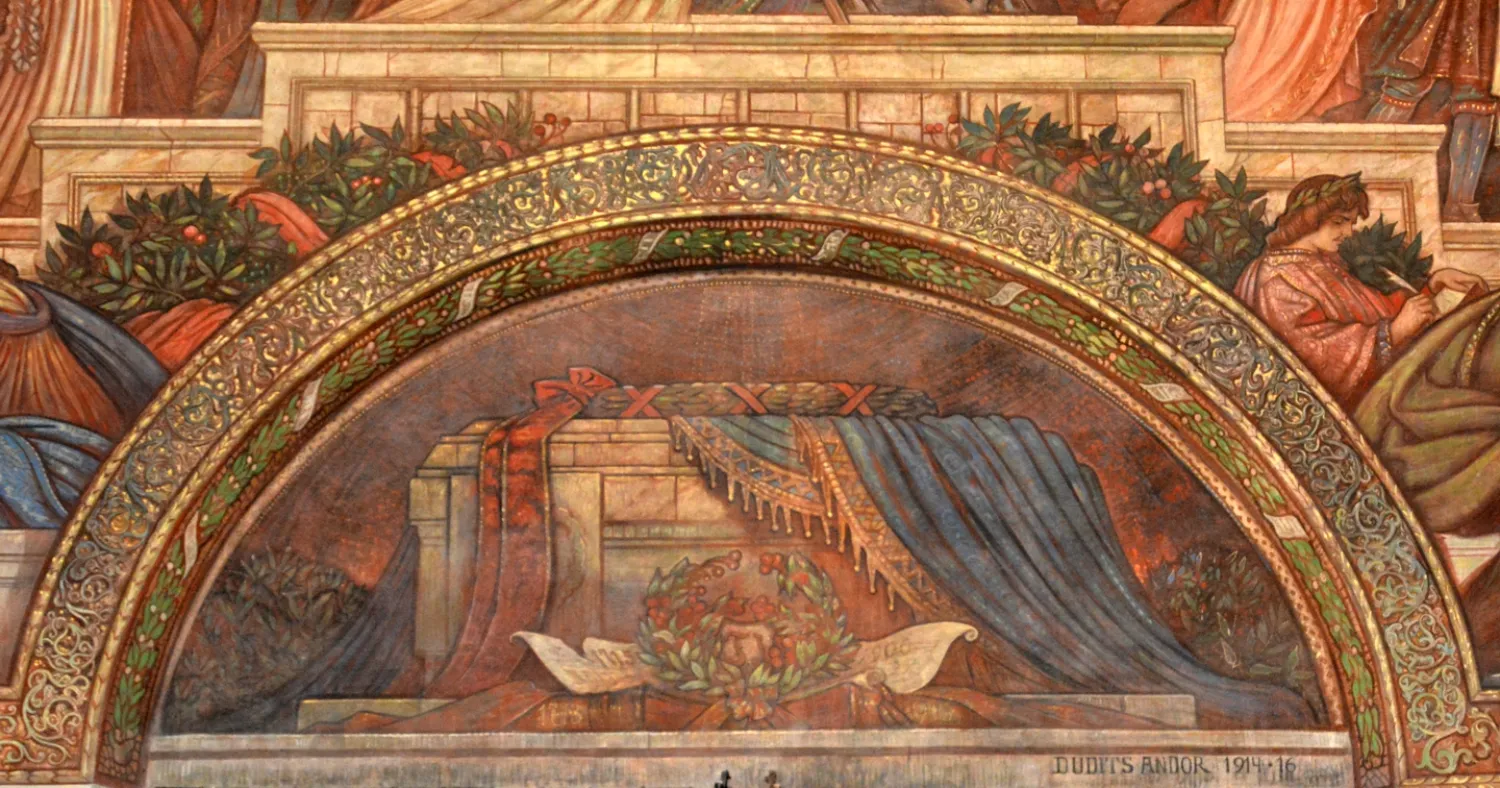
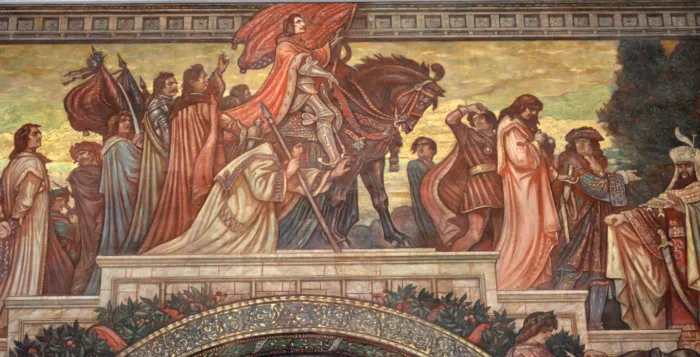
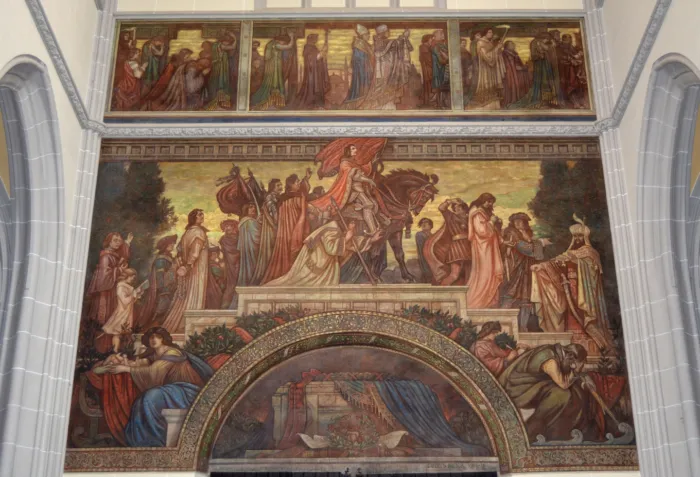
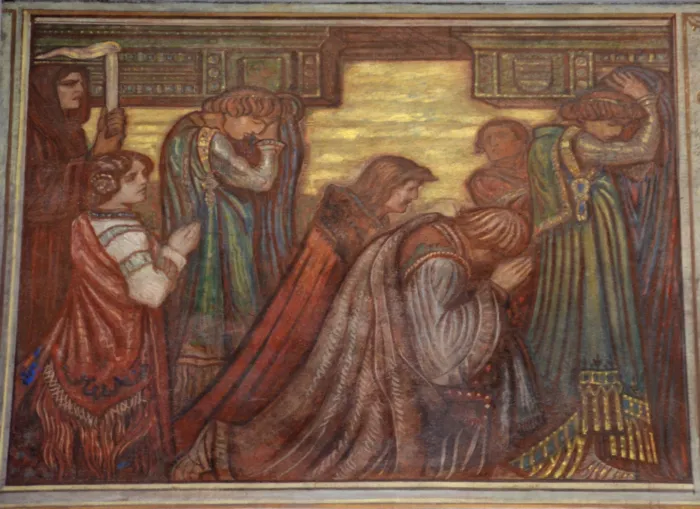
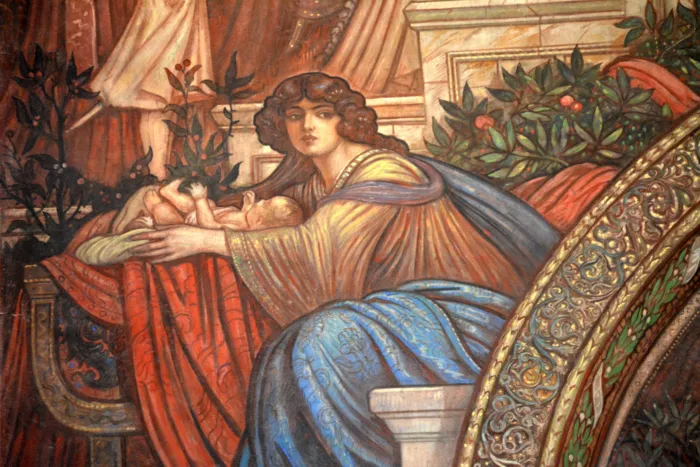
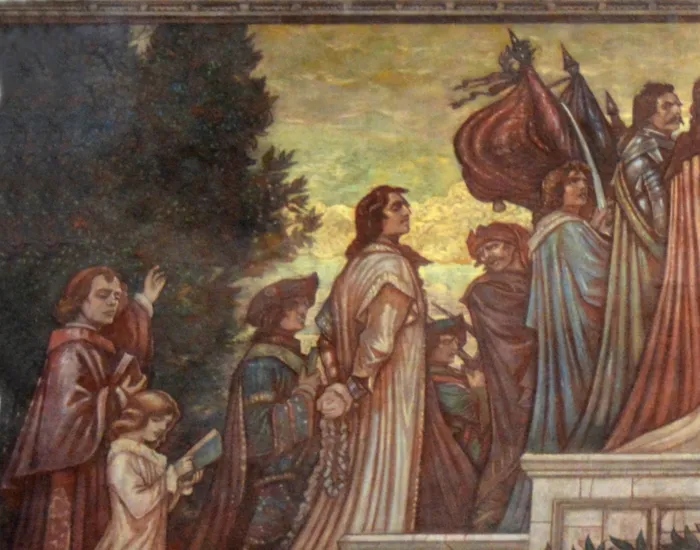
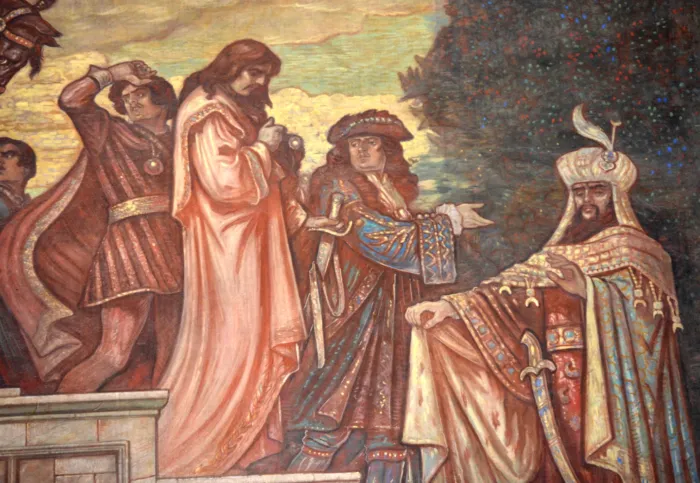
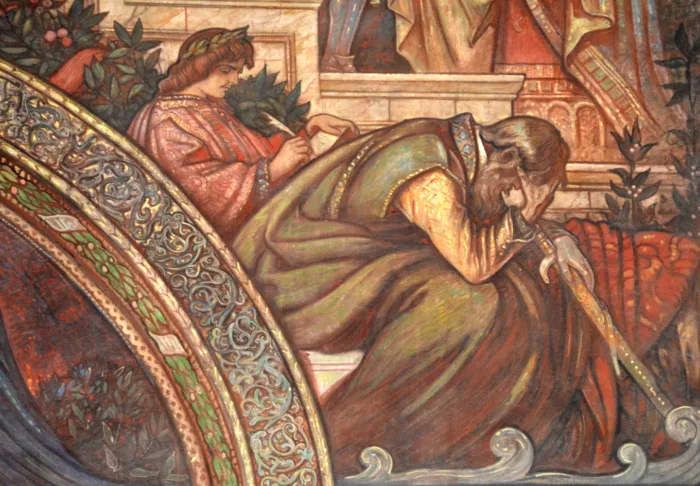
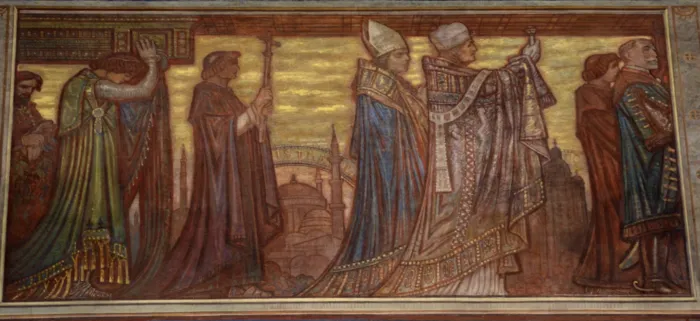
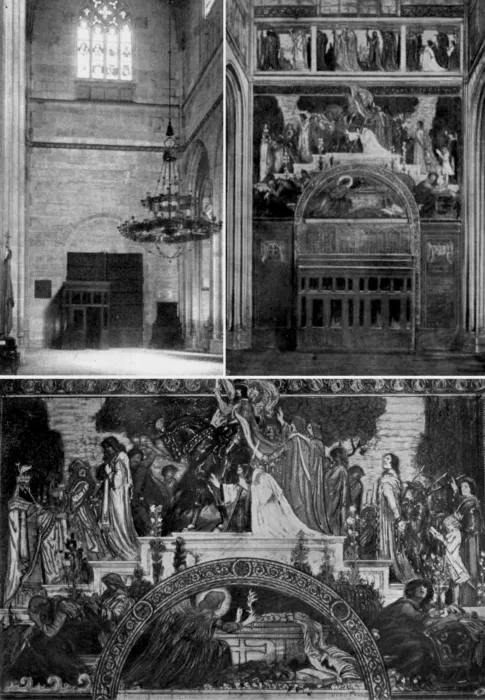
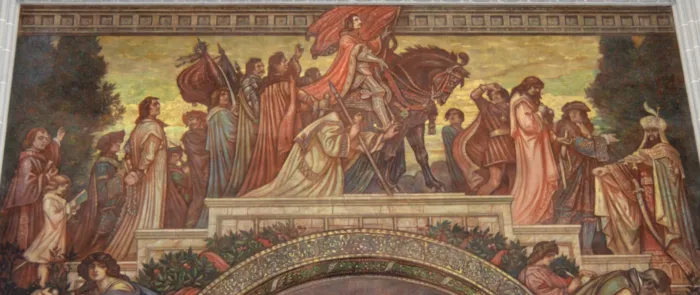
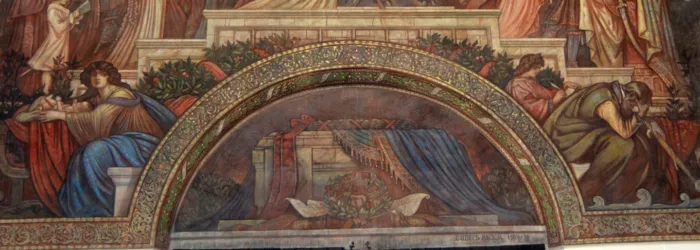
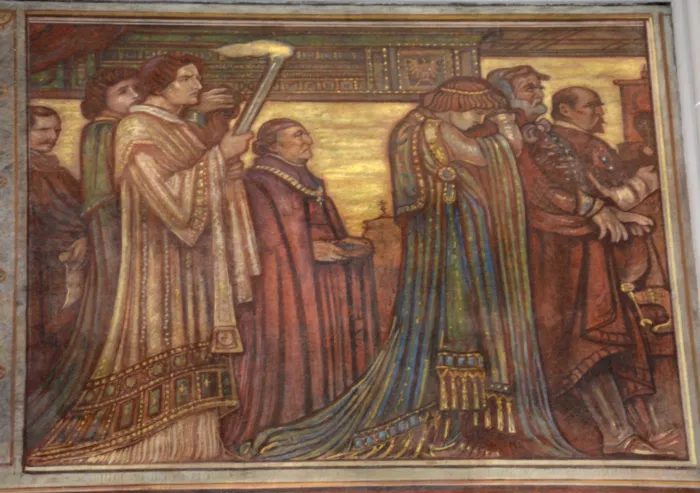
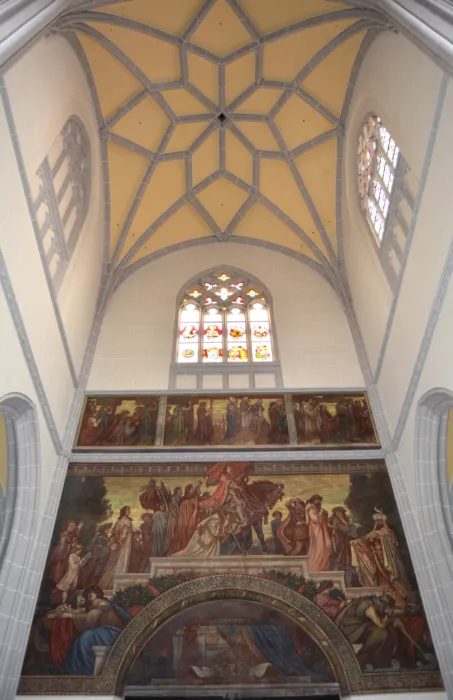
The triptych depicting the life of Ferenc Rákóczi II was painted by Andor Dudics between 1914 and 1916, eight years after the prince and his companions in exile were laid to rest in the cathedral crypt. ; ; Article XX of Act 1906, which provided for the repatriation of the ashes of Ferenc Rákóczi II and his companions in exile, stated that a monument should be erected to perpetuate the memory of the prince and his companions. A competition was announced for the work in 1906. ; László Éber, Károly Lyka's Művészet magazine, 1912/9. writes the following in his issue: "The fate of the narrower competition announced for the design of the fresco has now been decided. Of the ten painters invited, eight took part: Sándor Nagy, Sándor Novák, Andor Dudits, Oktáv Smigelschi, Zsigmond Vajda, Viktor Tardos-Krenrier, Dezső Kölber and Dezső Rakssányi." ; The jury unanimously considered Andor Dudits' work feasible. He was given the opportunity to create the fresco, on which he worked for two years. ; ; Andor Dudits said of his plan: "I attempted to solve the task set by using the entire available wall surface as a monumental memorial plaque. At the bottom, to the right and left of the doorway, each inscribed plaque contains epitaph-like information about Rákóczi and his followers in exile, as well as the repatriation of his ashes. I divided the painting into three main parts, making full use of the designated wall area and taking into account the architectural organization. On the most extensive surface, I tried to summarize Rákóczi's life in a continuous manner, but avoiding realistic episodes, highlighting the main moments of his fate, as if symbolically. At the bottom right, Ilona Zrínyi watches over the cradle of little Ferenc Rákóczi. Higher up, we see the adolescent child, as his priestly tutor instills the fear of God in his heart, and further up, the prisoner, who is being held by the guards. escorted to his prison in Vienna. At the top, at the top of the staircase, which expresses the middle of Rákóczi's life, the height of his activity and glory, the prince, sitting on horseback, raises his sword high and dedicates it to the defense of the homeland. Around him are the great figures of the time, Bercsényi, other Kuruc leaders, generals, and the figure of the peasant kneeling in the foreground already refers to the following events, when Rákóczi, accompanied by the pain of the people, is forced to leave the homeland with his companions in exile. Two princely figures symbolize the course of Rákóczi's further life: Louis XIV, who took him in but later sent the stateless man on his way, and the Turkish emperor, who offered him final refuge. Below I have depicted Rákóczi at the end of his life, in Rodosto, at the side of his writing student, Kelemen Mikes. For the sake of a unified effect, I have not separated the individual scenes from each other and have settled for the fact that the I mark the individual beats with flowers protruding from the tomb-like part. The image of the semicircular tympanum is organically connected to this main part. While the staircase, on which the course of Rákóczi's life passes before us, is like the external decoration of his tomb, the image in the tympanum presents the tomb of the prince buried in exile, as the ruler, as a sign of his sympathy with the nation, sends an olive branch of peace to the glorious ashes, next to the wreath of the nation. The torn page of the book lying on its side symbolizes the cancellation of the law that stigmatized Rákóczi. The uppermost part, enclosed in an architectural frame, depicts the last chapter of Rákóczi's story: the bringing of the ashes home from Turkey to the Košice Cathedral." ; In front of the coffin, members of the five-member committee responsible for repatriating the relics, led by Gyula Forster, the chairman of the National Committee for Monuments, are walking, led by the high priest who is performing the funeral. ; The extraordinary simplicity and transparency of the concept characterizes Dudits' work. Strictly adhering to the given conditions, to the original division of the wall, he distributes his images there - seemingly without any effort. That is why the effect of his work is so impressively simple. The monumental impression requires the largest possible size of the figures. The artist therefore refrains from breaking up the wall planes and uses them completely. ; The main image is not exactly pathetic in nature. The figures move in a definite direction, at a slow pace, between the two final points, the beginning and the end. There is a strong prominence in the middle, both in the composition and in the fate of the hero. We notice the strong inner unity of the work. ; Is this a historical scene or a narrative? Indeed, none of these: a great human destiny reduced to the simplest, almost typical form. More than that: the destiny of the entire nation, which is linked to Rákóczi's. We do not find it strange that the figure of our hero is repeated over and over again between the cradle in Bors and the beach at Rodostó. This is a naivety that we often encounter in medieval art. In the guise of realism, this would be an intolerable fiction, thus highlighting a convincing reality from the conditions of ordinary existence. The depth of the picture plane is small, the background is shining golden yellow. And how one appearance dissolves into the other: it is wonderful. Large figures that stand out strongly from the background, all protagonists, strongly stylized. ; In terms of monumental effect, Dudits' work rises high above the designs of the other applicants. He is the only one who has hit the right note. Moreover, his work fits perfectly into the intended place. Not through external means, not through archaism. He refrained from competing with the rich architecture of the cathedral and freely used certain medieval motifs on the decorative band framing the doorway and above the main picture. The language of his art is completely individual, modern. It is not the external agreement of forms that ensures the harmonious effect of a monumental work in an old architectural environment, but rather the artist's feeling and understanding of the special artistic requirements of the place, fully embracing them, so that they do not bind but rather fertilize his creative power. ; The design is intended for the decoration of a church. That is why some of the applicants tried religious aspects. With some of them, he even overshot the mark. Rákóczi's deep religiosity was one of his characteristic traits. But he was not a saint. It is perhaps least permissible to perceive him as such from an ecclesiastical point of view. In this respect too, Dudits managed to find the right tone. The subjects of the main picture stand out from the constraints of space and time. It presents the course of its hero's life in an almost transcendental way. Its effect is therefore uplifting and awe-inspiring, while a realistic depiction of any scene from Rákóczi's life would be foreign and profane in this place. ; The effect of the main picture is also complemented in this respect by the images in the tympanum of the gate and the upper frieze. Here, the bringing home of Rákóczi's ashes, structured in a triptych-like manner with a correct architectural sense, is strongly stylized, almost symbolic, ecclesiastical in its conception, the idea of death and the grave on the tympanum image and its witty allegorical expression are a touching homage to the memory of the great prince, but also to the exalted soul of our ruler. ; Since May 2012, after demanding restoration work, the Rákóczi fresco has been visible in its original beauty again. The renovation of the Rákóczi fresco took a year. Experts previously unanimously stated that the lower and upper parts of the mural were unsalvageable. The bulk of the work involved removing the surfaces that had adhered to the surface of the painting. Thanks to the restorers, the third part of the work is finally visible again. "In the part above the door, the prince's sarcophagus can be seen, covered with a flag and two numbers: 1715 and 1906. In essence, these two dates cover the prince's exile, because the decree was issued in 1715 that stated that he could not return home either in life or death. He did return home on October 29, 1906.