
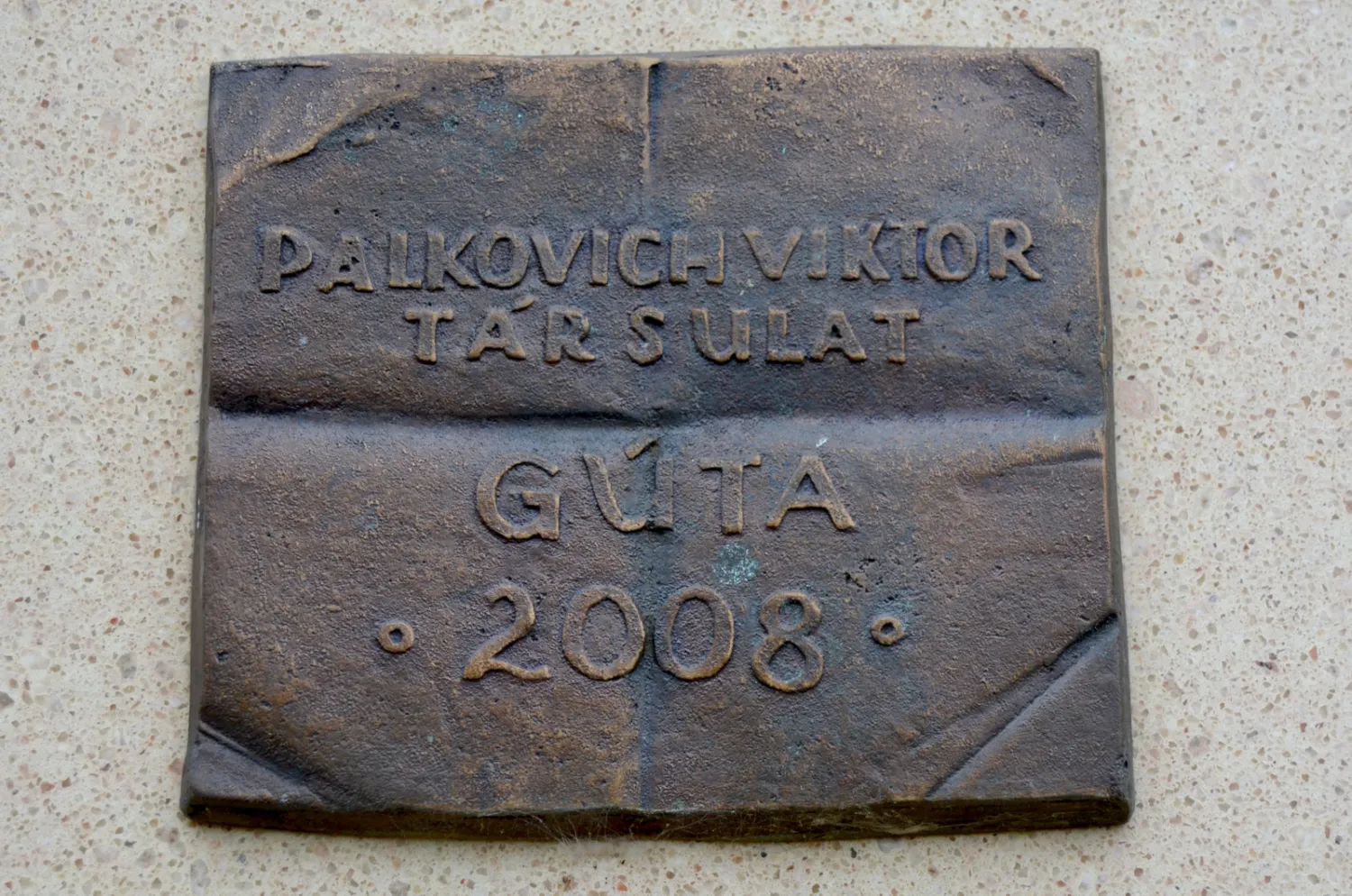
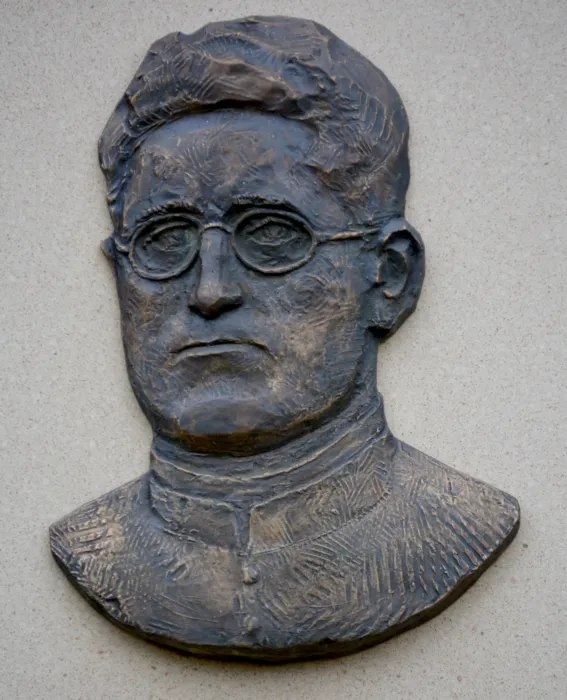
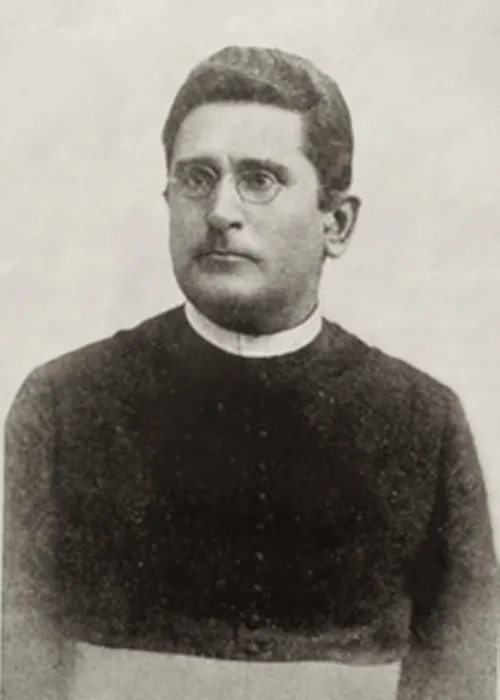
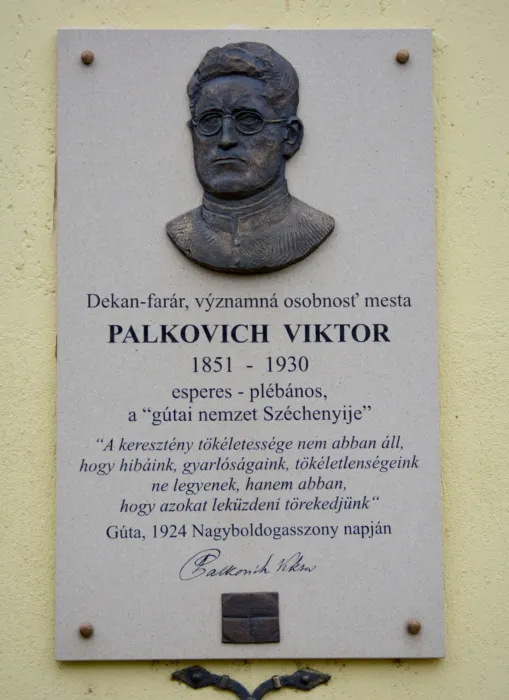
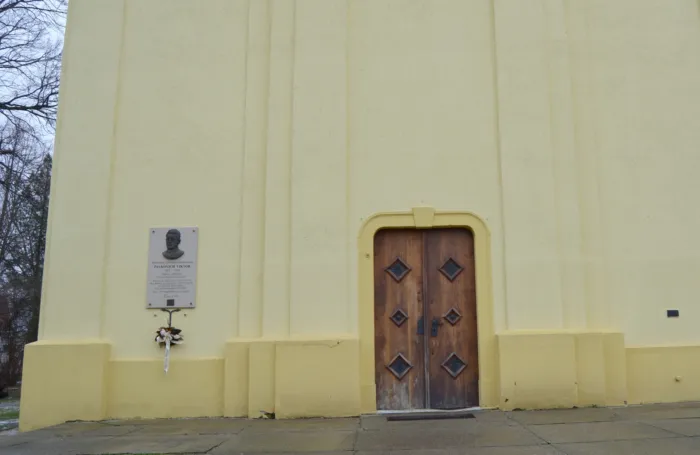
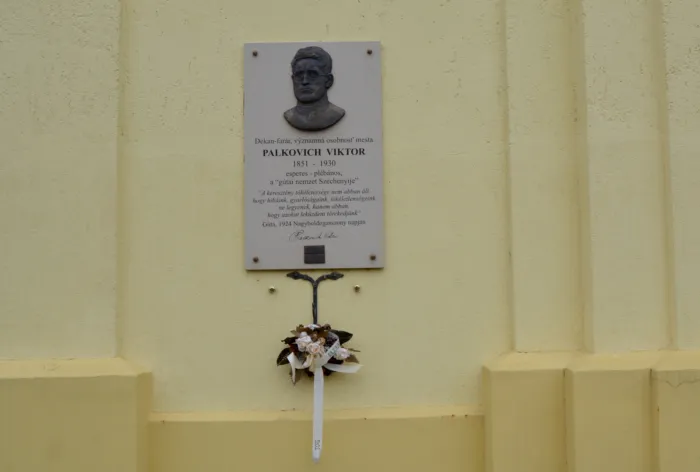
Viktor Palkovich's memorial plaque
Statue, monument, memorial plaque
Viktor Palkovich was born in Esztergom in 1850 and died in Győr in 1930. He completed his theological studies in his hometown. He was ordained a priest in 1873 and became the parish priest of Gúta in 1886. For decades, he was an active organizer of the economy and public life of the village and Komárom County. He was a member of the village council from the beginning, and during his more than 40 years of service in Gúta, he did a lot for Gúta. The founding and successful operation of almost all associations, organizations, and unions can be associated with his name. ; Even in the year of his arrival, he managed to convince the village government of the importance of establishing a firefighting association, and the Gúta steam mill, which began operating in 1904, was also started under his leadership, among others. He established the mill industry joint-stock company and managed its activities as president for several decades. He supported education from the income from his own shares. ; In 1906, with the help of the members of the caucus, he managed to establish the dairy cooperative, and in the same year the Roman Catholic Industrial Circle was formed with more than 300 members. He soon started the operation of the credit cooperative to help the smallholders. ; He was not only tireless in organizing and managing the associations, but he also led the delegations that acted in the interests of the village at higher state institutions. After long efforts and several negotiations, he managed to arrange for 100 thousand crowns to be granted from the national road fund budget for the construction of a single-track railway connecting Komárom and Gúta, but due to the wartime circumstances, the promised amount was no longer provided. After the case stalled, a 40-member delegation led by Viktor Palkovich, the popular dean of the village of Gúta, paid homage to the chief István Kürthy, so that the cause of the people of Gúta would be directed back to the desired course. The railway was finally built and opened to traffic on November 7, 1914. ; Viktor Palkovich performed his pastoral duties with great care and dedication, and also actively participated in the development of the village's school affairs and popular culture. During his time, education began to develop rapidly, and the number of students increased. Unfortunately, during the great fire of 1899, the wooden-shingled boys' school burned down in addition to more than 400 residential buildings. Deacon-parish priest Palkovich launched a national collection, and the school was rebuilt from the donations, and was even expanded with new classrooms, new furniture and auxiliary equipment. In 1900, a school museum was founded, to which Viktor Palkovich donated, among other things, his collection of shells and snails brought from his trip to the Adriatic. ; After the coup d'état, he participated in the organization of Hungarian political life. He became one of the leaders of the Hungarian Catholic priests' resistance to the new state. Between 1922 and 1925, he was a representative of the National Christian Democratic Party in the National Assembly. During the party split in 1925, he was one of the leaders of the anti-Lelley group. ; In 1924, doubts arose about Palkovich's Czechoslovak citizenship, and his name was removed from the voters' register. He was no longer allowed to run for office in the 1925 parliamentary elections. Before Christmas of that year, the Komárom district office notified him that if he did not obtain a foreign passport within 30 days, he would have to leave the territory of the republic. The incident caused great outrage. Several Hungarian representatives interpellated against the expulsion in the Prague parliament. The expulsion was prevented, but the problems surrounding his citizenship were not resolved. ; As solemn as his arrival was (he was welcomed by a decorated Gúta flag at the Érsekújvár railway station, and greeted by the village judge on the banks of the Váh), his farewell at the Gúta station was equally touching. Géza Molitorisz writes the following about the departed: On May 12, 1927, the dean-parish priest Viktor Palkovich, president of the school board, left his followers here. He left Gúta, the scene of his unparalleled work of over 40 years. He went to Hungary with a heavy heart to rest, leaving behind the institutions he had established, which he had raised to greatness with as much love as a good father does with his children. Everything was aimed at the spiritual and material prosperity of his followers. For this reason, he deserves the eternal gratitude of the people of Gúta to the greatest extent. ; He left his rich library to the Jókai Association in Komárom, of which he was co-chairman for many years. ; He spent the last years of his life in Győr, in the solitude of a monastery, where he died on April 24, 1930. A large crowd attended his funeral, including the leaders of the Slovak Hungarian Catholic clergy and representatives of political parties. He was laid to rest in the Esztergom-Szentgyörgymező cemetery, next to his parents, on April 29. ; He served the Hungarians in Slovakia and the school system even after his death. According to his will, he established a foundation, a significant part of the interest of which was to be spent on maintaining the student canteen in Komárom. Out of gratitude, the student canteen took the name Palkovich Student Canteen in the summer of 1930. ; Works: ; 1893 Detailed curricula and lesson plans for the processing of religious education material in Catholic elementary schools. Esztergom. ; 1893 Detailed curricula for the processing of subjects in elementary schools, with regard to the different schools. Esztergom.