
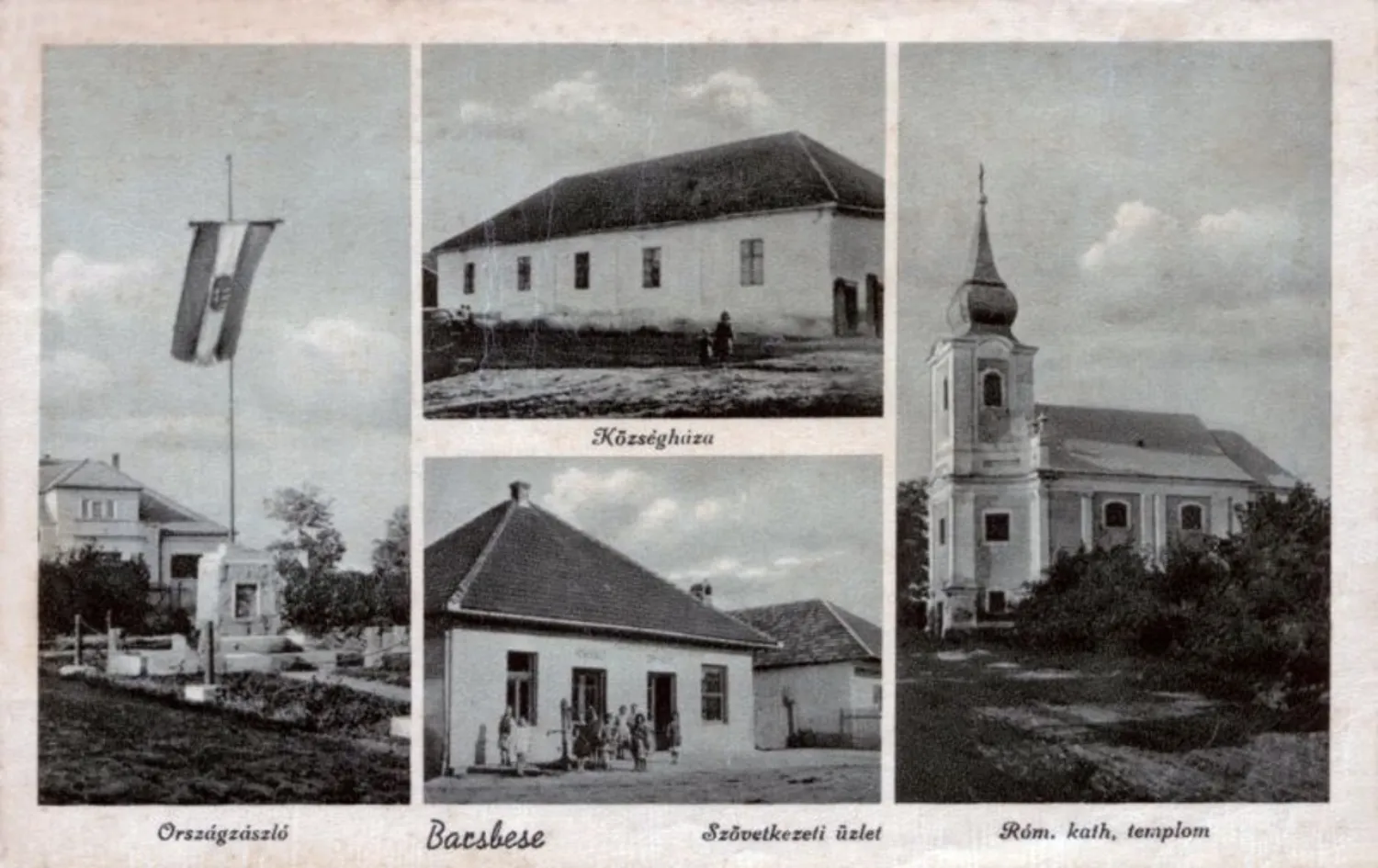
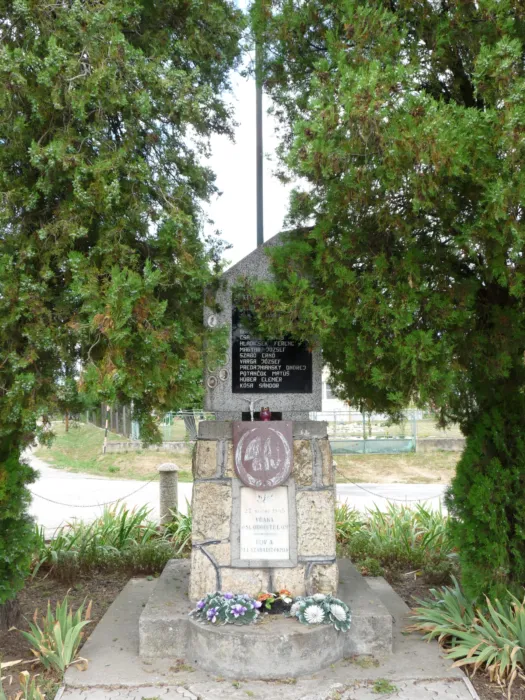
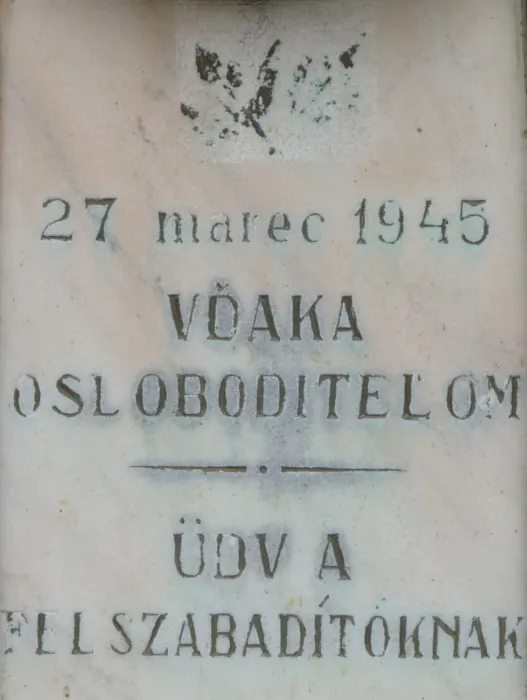
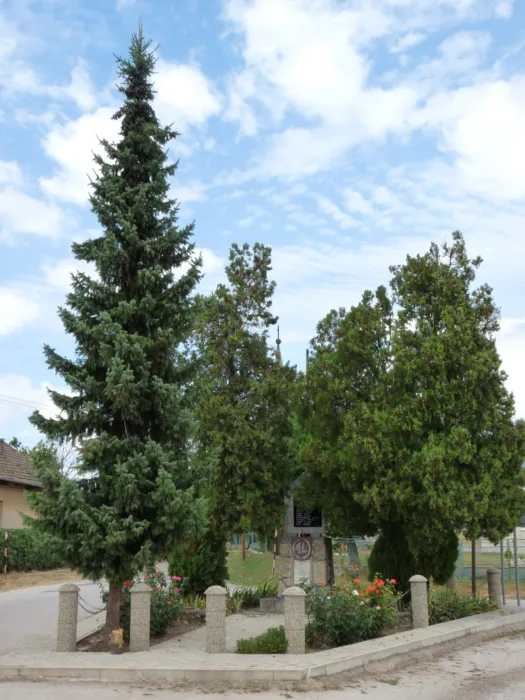
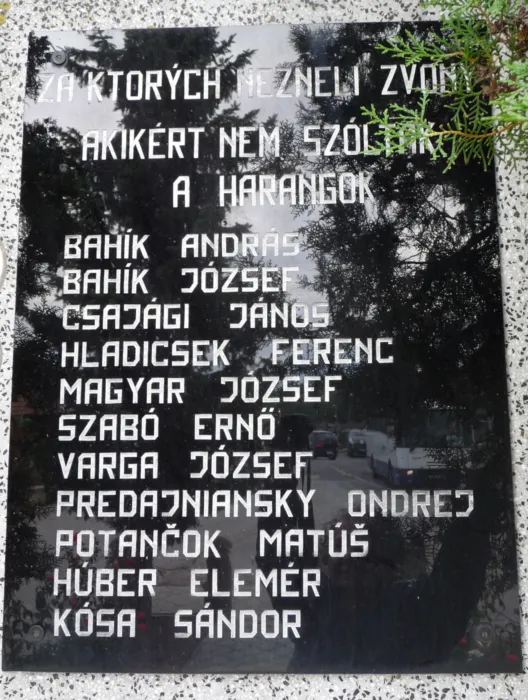
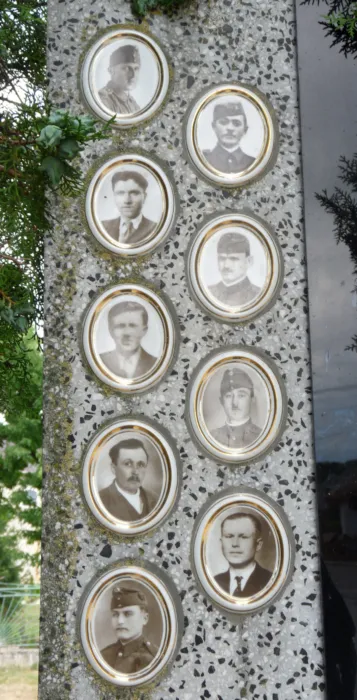
National flag and World War II memorial in Barsbese
Statue, monument, memorial plaque
The national flag movement was announced in 1925 by Nándor Urmánczy (1868–1940), a politician of Transylvanian origin and the leader of the irredentist movement in Hungary. The first so-called national flag with a relic was inaugurated on 20 August 1928 in Budapest on Szabadság tér,243 and he delivered a speech at the ceremony. The relic container placed on the pedestal of the national flag contained soil brought from the 72 historical counties (including the counties in Croatia), from the truncated Hungarian settlements, from the battlefields of Muh, Mohács and the 1948–1849 War of Independence, from the World War I heroic cemeteries in Doberdó and Galicia, and from the birthplaces of Petőfi and Kossuth (Zeidler 2009, 204). At the base of the twenty-meter flagpole was a turul bird with outstretched wings, and on top of the pole was a symbolic hand raised to take an oath, modeled on the hand of Miklós Horthy. The front of the pedestal, made of limestone, pointed north, and its facade was decorated with the Hungarian coat of arms. On both sides of it were quotes from people who supported the revision. After the inauguration of the monument, the flag was lowered to half-mast in accordance with the resolution of the Hungarian National Assembly of November 13, 1920. According to the resolution, “as a sign of the nation’s mourning, the Hungarian flag on the parliament building will be lowered to half-mast until the realm of the Hungarian Holy Crown is restored in its full integrity. The National Assembly also expects that all bodies and individuals who are entitled to use the Hungarian national flag will follow suit” (Zeidler 2009, 203). On January 7, 1921, Minister of Culture Kúnó Klebelsberg issued a similar decree for educational institutions, which, among other things, obliged students to “stop wherever they meet the military marching under the national flag, as a sign of respect, turn towards the national flag and the male students to take off their hats”. Nándor Urmánczy also encouraged the spread of the national flag movement in the countryside. The organization was carried out by the Ereklyés National Flag Great Committee he founded, and one of the committee members usually participated in the inauguration of the new national flag. The first national flag in the countryside was raised in Nagykanizsa in 1932, and the last in Transylvania in 1944. ; After the reunification in 1938, special attention was paid to settlements inhabited mainly by Slovaks for the purpose of political propaganda, and they urged the erection of both national flags and war memorials. High-ranking political leaders usually participated in the ceremonies related to these, and of course they also gave speeches. At events in several settlements, primarily located near the Slovak-Hungarian border, Royal Archduke Joseph himself often addressed the attendees. After the reunification, the first national flag - and at the same time a war memorial - was inaugurated in a Slovak settlement, Gercsely, with a large high-ranking political and military representation. ; After the Second World War, these combined monuments remained, with a few exceptions, and in many places the flagpole is still there to this day. The pedestals of several objects erected exclusively as national flag monuments, together with the flagpole, and even the screw mechanism used to hoist the flag, also remained. In several settlements, the World War II memorial was erected in place of the national flag, and in some cases its pedestal was incorporated into the new monument. This also happened in Barsbese, where the original pedestal was supplemented with new elements, thus becoming a World War II memorial.