
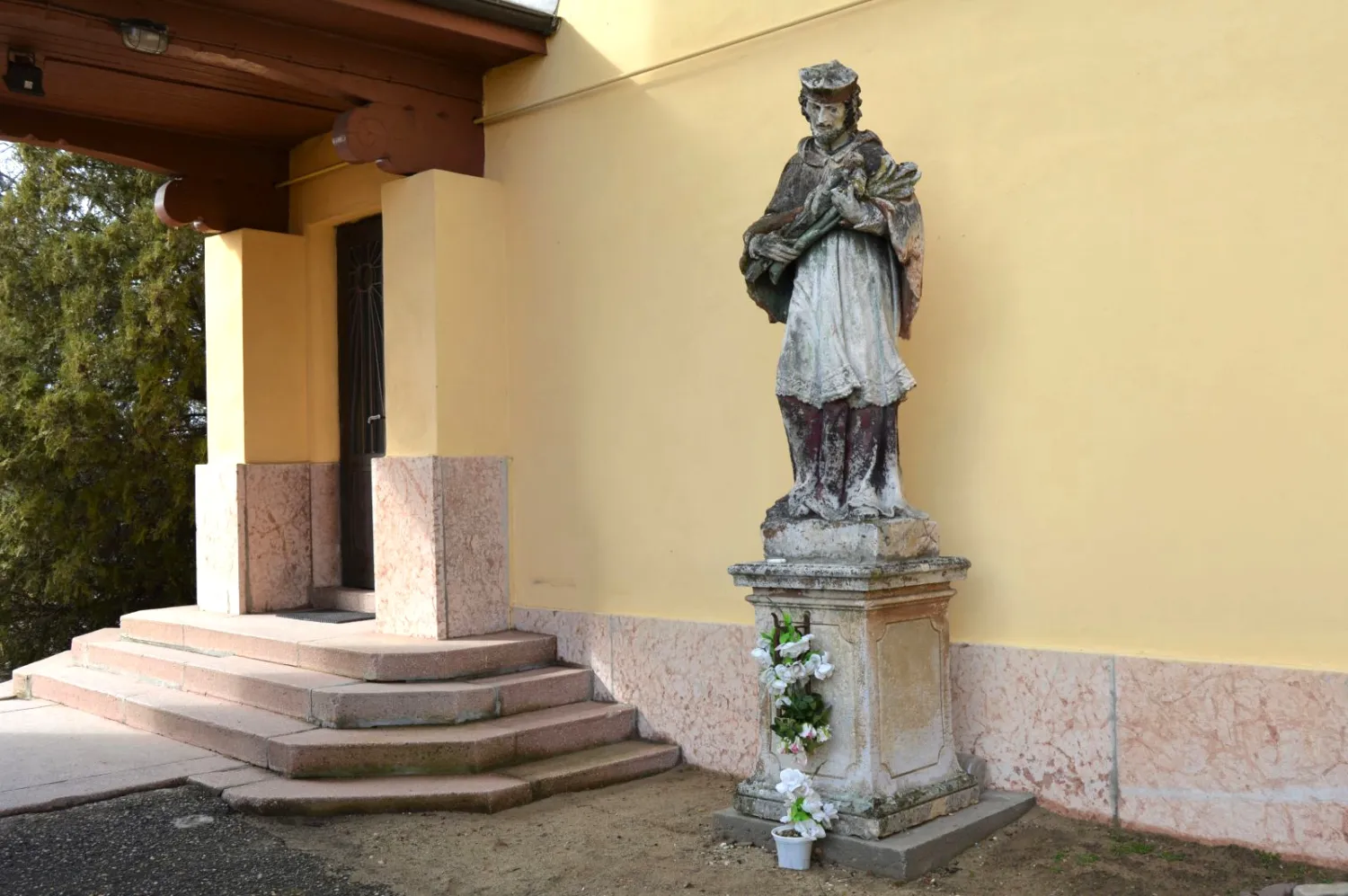
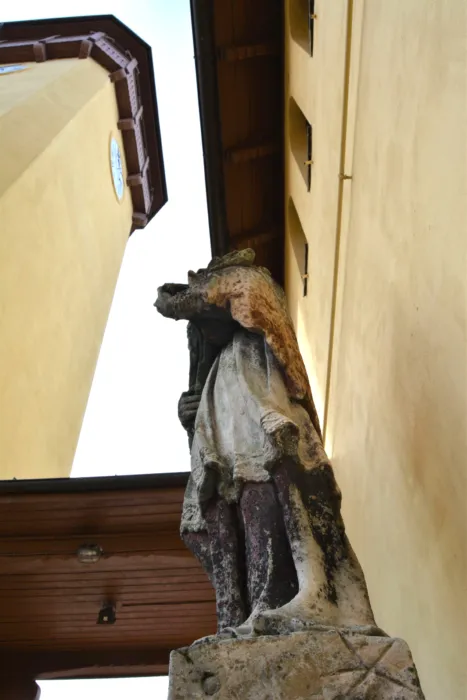
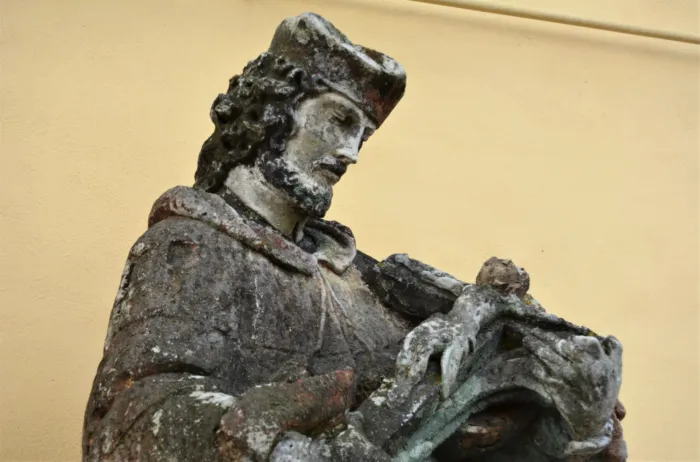
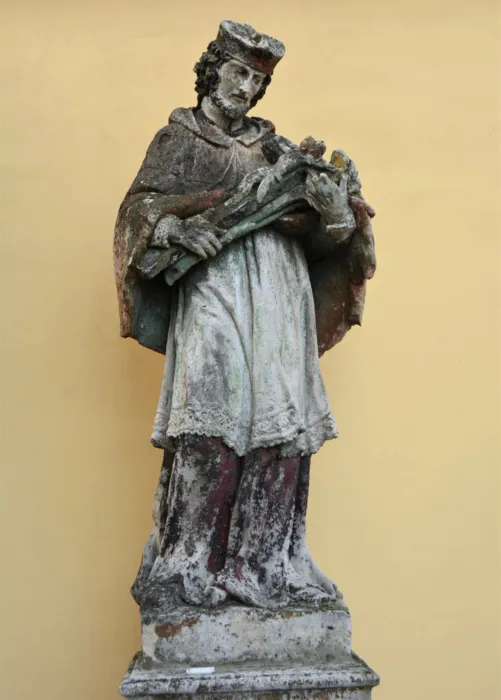
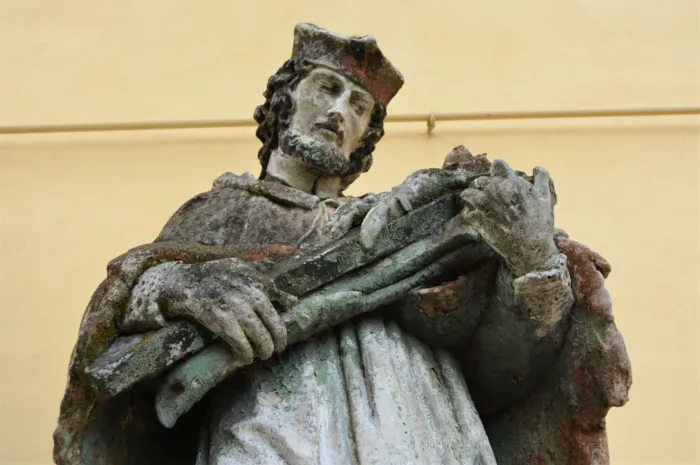
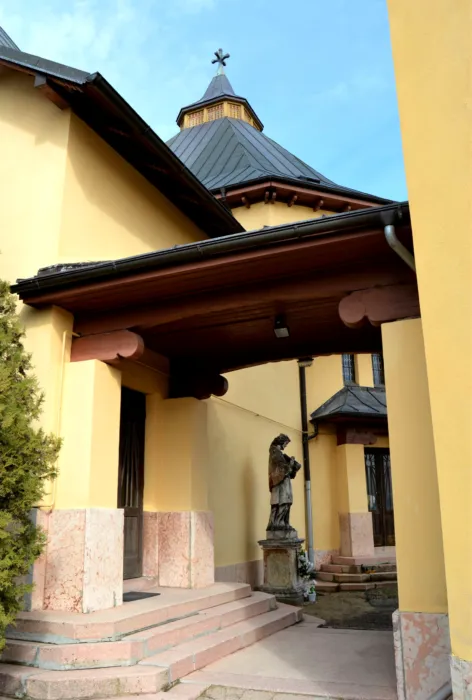
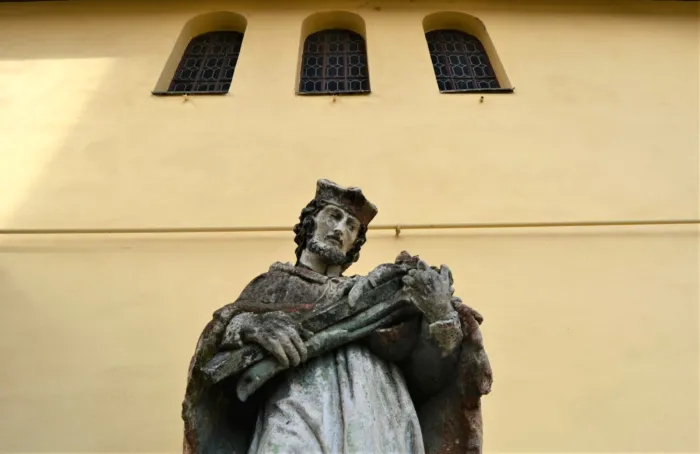
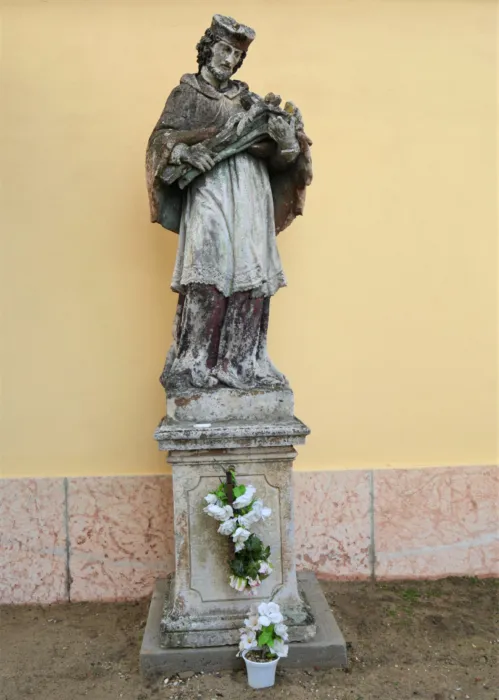
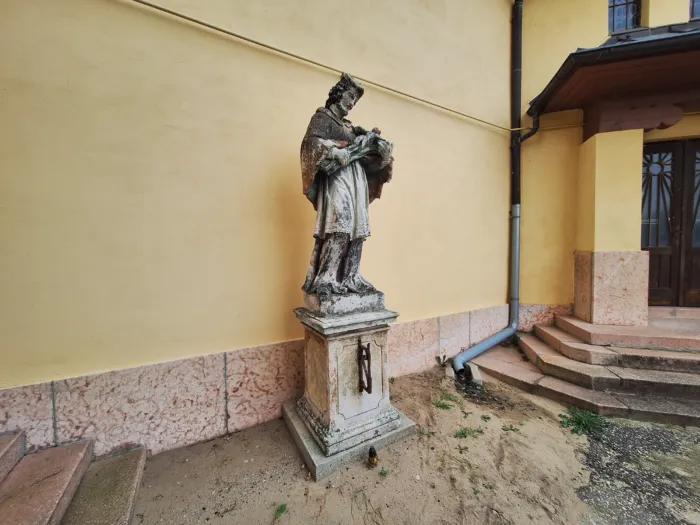
Statue of Saint John of Nepomuk in Ógyalla
Sacral small monument
We can read this about the statue, which is probably temporarily standing next to the wall of the St. László Church, in Árpád Bagin's article entitled Sacral Monuments of the Ógyalla and Bagota Cadastre: ; “A polychrome sandstone statue located south of the church, along the main road. According to József Chalupeczky's note, the statue is mentioned in the first third of the 19th century, in connection with its pedestal. The object can be dated to the 18th century. Its pedestal was repaired in 2001 (?), repainted with gray paint. “It has not been restored (...) its clothing absolutely did not follow the original, so it should be restored again, but by a competent person.” The informant recently placed flowers on the pedestal (this has stopped now, as many Roma people stayed behind the statue for a while because of the restaurant), but his godfather still brings flowers (Szilvia Vrábel, born 1973). The writer of these lines has been living near the object for five or six years, and observed that once, on All Saints' Day, Roma people probably placed several, 10-15 burning candles on the pedestal. The area around the statue is looked after, the grass and bushes are kept in order by city employees (it is not typical, but there was an example of me picking up trash or straightening a mason jar full of flowers that had been knocked over by the wind). At the time of the data collection, there were remnants of tallow candles on the pedestal, with a plastic wreath on a protruding rusty iron stump (probably the remains of an older lamp holder). Behind the object (which is now part of the inner area), there were the lands of Count Révay, who lived in the settlement from the 1700s (this data may be a starting point for further investigation of the origin of the statue). The millennium trees around the object were planted in 1896 for the millennium by the church representative of the three denominations (Catholic, Reformed, Jewish) (Istvánné Feszty Piroska Scheffer, born 1915). Two more acacia trees (?) stand in the examined area today, but it is obvious that a presumably identical tree has already been cut down. The informants mention tree cutting in the early 1990s. The latter two terms are unique phenomena and can be classified as under-information. “The biggest procession was always the resurrection procession”, which marched through the village and turned back at the statue of St. John of Nepomuk. The firefighters stood guard here, and the lanterns were always carried by the “first girls next to the canopy”, and the houses were decorated (Chalupeczky Józsefné Hulkó Anna, born 1923). A local young man claims that - sometime in the late nineties - the statue of the saint bowed its head to him in the evening. He told this to his sister, who was cycling with him, and then to his parents, which led to an argument, as they did not believe the narrator.