
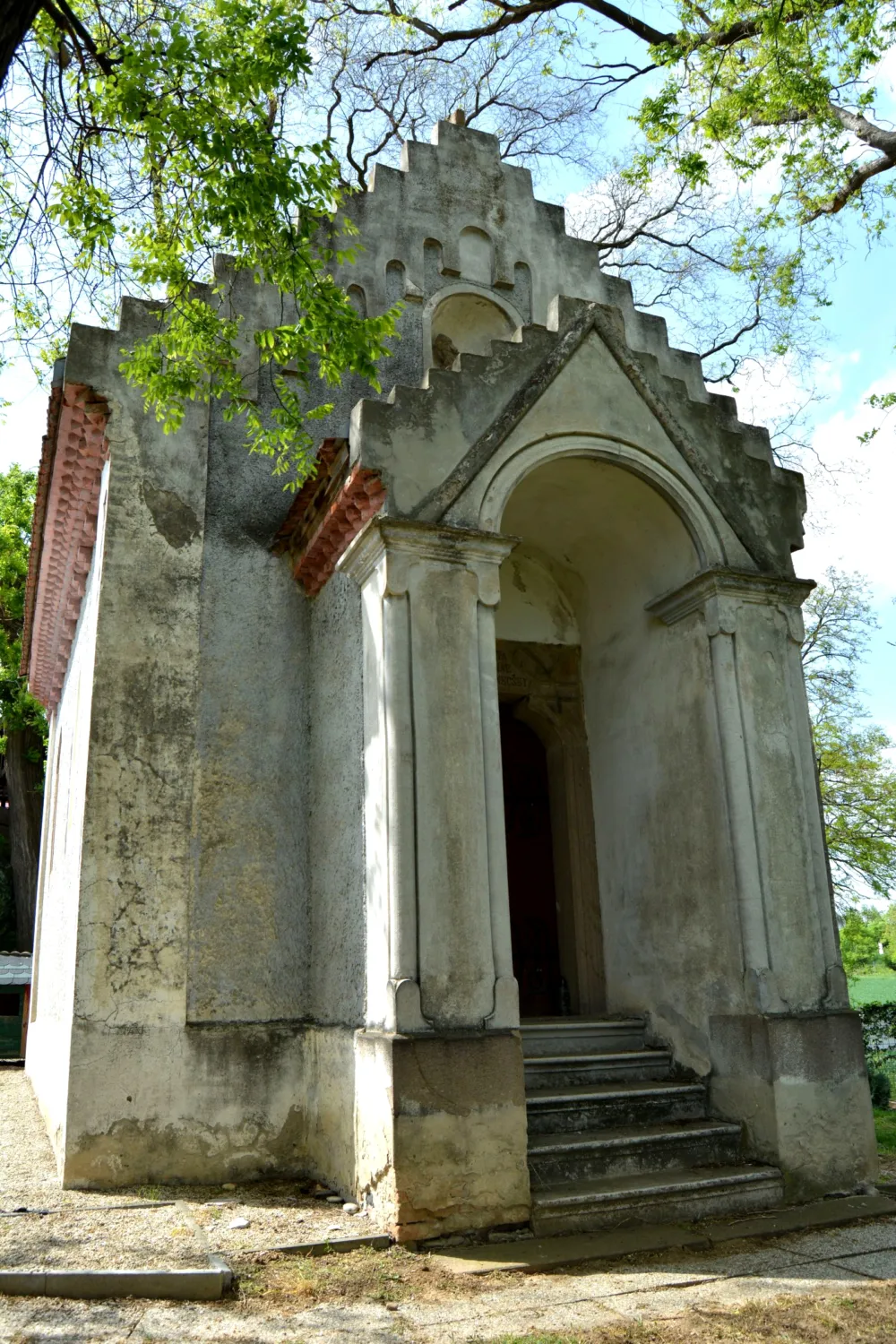
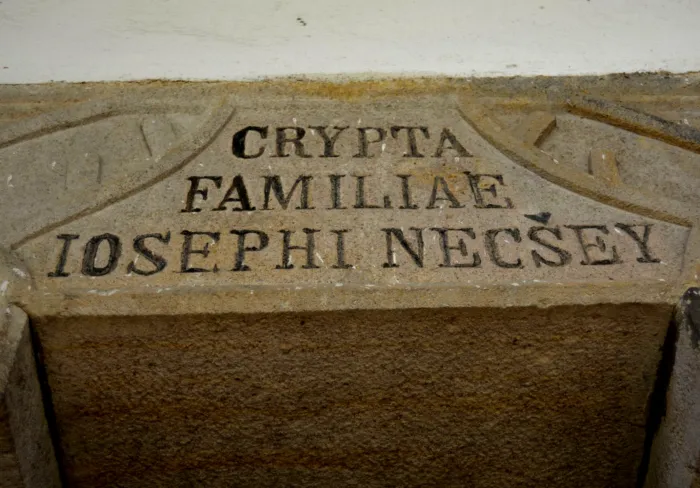
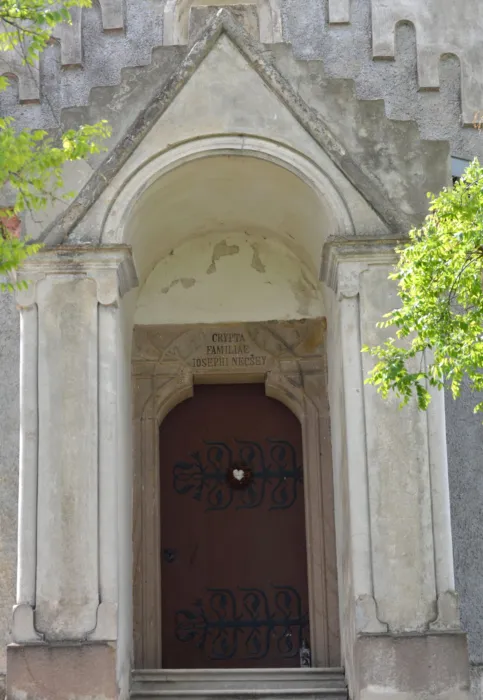
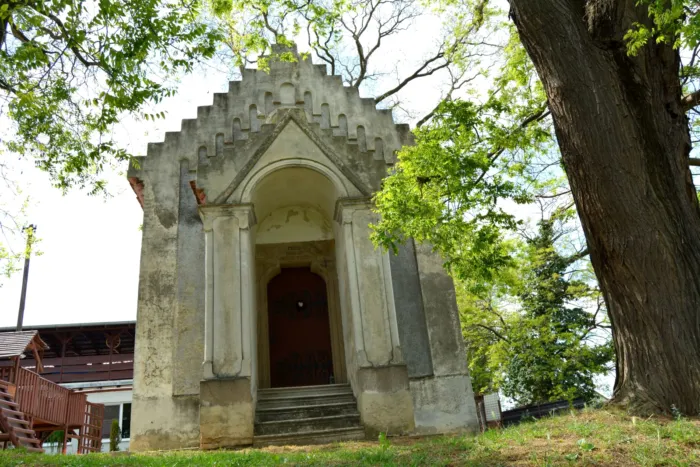
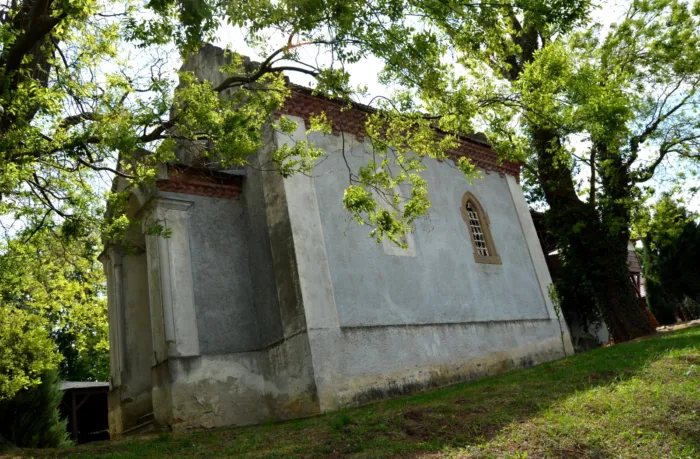
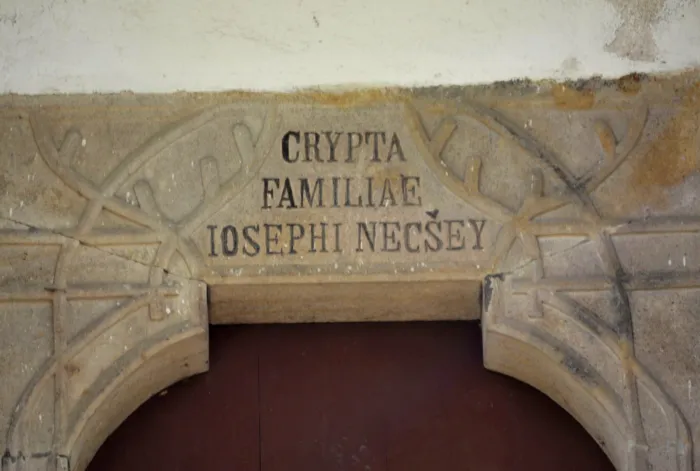
The resting place of József Nécsey, postmaster, antique collector and museum founder
Cemeteries, tombstones, grave sites
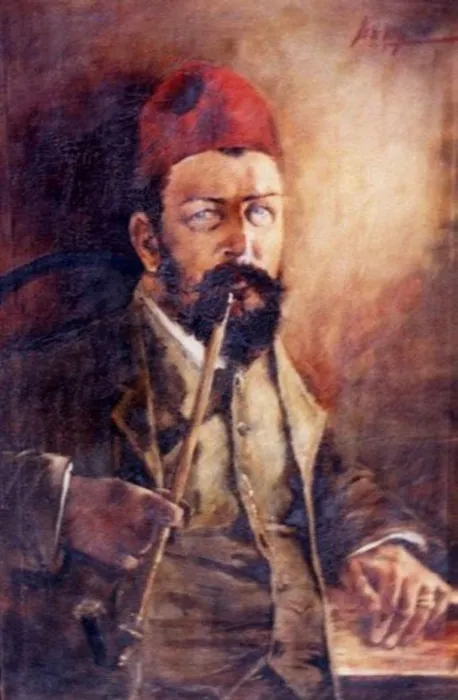
Bars County was one of the counties where the research and collection of relics from various eras began as early as the 1870s. Among the many amateurs interested in the relics of the past, the most notable were the lawyer from Verebély, then from Tildi, Sándor Dillesz, and József Nécsey. While we are only limited to scattered information about the biographies of many amateur archaeologists, József Nécsey (August 27, 1842–January 17, 1929) was fortunately remembered by his friend Jenő Kriek in a special issue of Bars in the year of his death. In addition to personal impressions, Kriek presented Nécsey’s life and wide-ranging activities in Bars County with the help of documents that had been transferred to the Léva Museum. ; József Nécsey was a scion of an old noble family from Oszlány, whose father – János Nécsey – also passionately collected antiques, including incense burners and old altar decorations. His father participated in the War of Independence, and after returning home, he tried to smooth the path of his children's lives. József was the second-born of his five children. Although the family's native language was German, József later learned Slovak and then Hungarian. He completed his primary schooling in Oszlány and Németpróna, and then he was a student of the Piarist gymnasium in Privigyé and Nitra. His father sent him to Selmecbánya, to the mining school, for higher education, but he never used the qualifications he had acquired there. ; During the geological field survey, however, the young man noticed archaeological finds (tools, implements) and then became a diligent archaeologist collector of relics of ancient times. However, these early years were still spent searching for a professional path, so in 1859 he became a pharmacist's trainee in Trenčín, where he studied botany and floristry from Dr. Keő. ; However, an accident put an end to his career as a pharmacist, during which he fell into icy water and caught a cold and developed leg atrophy. After a long treatment in Péstő, he got back on his feet, but his father had already turned him towards a career as a postman. On September 16, 1862, Nécsey successfully passed the exam in Bratislava, and then worked at several post offices. In 1863, he was assigned to the scientific meeting in Turócszentmárton organized by Matica as a postman due to his knowledge of the Slovak language. Here he met the county administrator, Count Albert Nemes, and made important political and scientific connections. From there, he was transferred to Izsák in Pest County, where he met his future wife, Ilona Agárdy, whom he married in 1866. Here he deepened his knowledge of the Hungarian language, and then, after a short detour to Komárom, he rented the Verebély post office in 1869, where he worked as a postmaster for nearly 44 years. ; In addition to the postmastership, however, he continued to increase the family trust and earned a significant income by renting land and using postal revenues, part of which he spent on expanding his collection. However, Nécsey's collection did not consist exclusively of archaeological finds, but also included a good number of ethnographic objects and works of fine art. For example, he also contacted Archbishop Simor about the purchase of a picture. However, while a good part of the collection of his contemporary Sándor Dillesz, about 1,000 finds, formed the basis of the Aranyosmarót museum as early as 1894, Nécsey's collection only arrived in Léva in 1927 after a long struggle as the core material of the newly founded museum. Nécsey's collection survived thanks to this, but Dillesz's has disappeared over the past hundred years, perhaps lurking in some larger museum. Nécsey's collecting activity was known primarily in the county, until it became known nationwide thanks to Sándor Dilesz and then Kornél Divald. ; The idea of establishing a museum and placing his own collection there had already matured in Nécsey in the 1890s, but he tried in vain to gain support from the National Inspectorate of Museums and Libraries, whose low budget did not allow for the establishment of the museum and support for its maintenance. ; The early death of his two sons, István and László, played a role in the offering of his collection to the public. After the deaths of his sons, Nécsey made increasingly serious attempts to transfer his collection to the state, but this only took place in 1927. József Nécsey's collection, as we have already mentioned, consisted not only of archaeological finds, but also of fine arts, applied arts and ethnographic objects. He started collecting when he was young, during his studies, and continued it until the end of his life. He donated the mineralogical collection belonging to his collection to the Piarist Gymnasium in Léva, where his sons were students. Thus, according to the gymnasium's bulletin, in 1882 the school's collection was enriched with a collection of nearly 400 minerals and rocks, and then the following year with meteorites and Roman coins. He conducted his archaeological research primarily in the Zsitva–Garam region. Moreover, he himself conducted excavations, for example in 1893–1894 at the Verebély sites along the railway construction route, and in the area of Földvár in Verebély in 1896. In 1894, István Szombathy and Pál Ruffy approached Nécsey so that his collection, in addition to Dillesz's, would also be sent to Aranyosmarót. Nécsey ultimately sent only the bronze finds excavated in the Köröspuszta in Verebély to Marót, while he intended the rest of his collection to Léva. Divald mentioned József Nécsey's medal collection, and the collection included a 1,500-volume library, which included a good number of natural science works in addition to historical, philosophical, and political science volumes. In 1927, according to Kriek's report, three truckloads of museum material were transported to Léva. ; In addition to local institutions, Nécsey and his sons also enriched the national institutions with their gifts. The father sent various postal history memorabilia and objects to the Hungarian Postal History Museum. His name first appears in the inventory book of the Hungarian National Museum in 1880, when he donated a stone axe and a clay spindle knob found in Csiffár to the archaeological collection. In addition to sending the finds, József Nécsey turned to the National Museum in November 1880, intervening in the matter of the attachments of a grave dug on the outskirts of the village of Saari, and at the same time reporting on an 18th century painting. His name appears again in 1897, when he informed the National Museum about the finds in the Verebély area in several letters. Verebély's archaeological research received new impetus in 1893/1894 thanks to the construction of the Zsitva-Völgy railway. At that time, supervising the earthworks, Nécsey conducted smaller excavations along the railway line, such as in the Földivár-dülő, Sütteő-birtok and Paphegy-dülő areas, which were reported on in the weekly newspaper Barsi Ellenőr and, subsequently, in the Archaeological Bulletin. At that time, as archivist and teacher Ignác Szombathy – a member of the Barsi archaeological and historical committee – reported in the Barsi Ellenőr, Nécsey observed traces of prehistoric settlements and collected animal bones, stone tools and fragments of pottery during his excavations. In mid-July 1896, Nécsey turned to the Hungarian National Museum again, informing József Hampel of his observations: ; ; "Dearest Sir! ; ; I have long been preparing to write to Your Majesty and ask for your kind attention to our ancient sites in Verebély, but my official duties are so pressing that I am hardly able to respond to them alone. But with your kind permission, I will briefly turn to the subject on which I wish to make a statement to Your Majesty. - I have been researching the sites around Verebély for a long time and I know where and to what extent they exist, all of them intact except for a few that were opened by the railway workers in the Zsitva Valley. During this work, several sites were opened, and the county entrusted the collection of the objects found there to the Bars County Museum. The collection was carried out in such a way that I had to search for all the objects myself and buy them from the workers for a small tip. - I made an inventory and handed them over. to the county museum, the objects are all from the Stone Age and are very interesting. ; The other sites are as I said intact and since they can now be easily opened after the harvest and examined in each area, I entrust my request to Your Majesty's wise discretion, would it not be deigned to order their search at the beginning of August, it would not be connected with great expense, Your Majesty or your envoy is my welcome guest, the workers would do a lot of 50–100 ft, there are hearths in 5 places, all different from each other judging by the potsherds, but our so-called earthen castle where I judge from the pits dug by the treasurers that each layer is of a different and different era is extremely interesting and promising! – Yes, I would be happy if we would search the finds first, because, from the county side, the sites are searched in piles and if it is not excavated professionally and with attention, it will be wasted. – Nemecsi lands I found % attached object in regular places, its decoration is primitive, I consider it a currency if it is worth keeping it as a museum. – Finally, I apologize that as an old respectful acquaintance of Your Majesty, my son, who works in Pest thanks to Mr. Ottó Ngos Hermann, I have not announced it until now, and I have not recommended it to your kind patronage, but knowing Ngod's goodwill I hope that you do not take this in a bad light, if I can only get free to see our exhibition I will order myself to go down and with your permission I will be brave to pay my respects to Ngod and introduce my son. ; I am further in your kind inclinations; ; Your Majesty's humble servant; ; Verebély 1896 July 16; ; Postmaster József Nécsey” ; ; Just a few months later, at the end of December 1896, he was the first to carry out archaeological excavations at the Földvár in Verebély, about which, however, the county newspapers are silent. Thus, neither Bars nor the Barsi Inspector reported on the research and its results. ; Fortunately, Nécsey's report, which he sent to the National Museum, as well as the inventory book data on the finds donated to the museum, and later photographs of two objects have survived. Unfortunately, of the nearly thirty bone and ceramic finds, only a single clay disc can now be found in the museum's storage. ; The Földvár/Fidvár settlement south of the Verebély settlement has become internationally known thanks to the work and results of the Bronze Age research conducted since 2007 in cooperation between the Nitra Archaeological Institute and the Frankfurt Römisch-Germanische Kommission. During the geomagnetometer examinations and the excavations related to them, houses of an Early Bronze Age settlement, the structure of an earthen fort, and the graves of a nearby cemetery were discovered. To the east and southeast of this, the remains and phenomena of a settlement belonging to the Line-Decorated culture were observed, which settlement was surrounded by a ditch. ; However, the research of the prehistoric monuments of Verebély and the Földvár itself began much earlier, in the last third of the 19th century. Sándor Dilesz was the first to draw attention to the Verebély earthen fort and the finds found in various parts of the settlement. In connection with the 8th Congress of Pre-Archaeology and Anthropology held in Budapest at the beginning of September 1876, Flóris Rómer carried out lively organizational work from 1875 onwards, so that archaeological maps would be made of certain parts of the Kingdom of Hungary, and excavations and material collection would take place. The county finds, including those from Verebély, were presented at the exhibition held on the occasion of the congress and in the guide prepared for this occasion. The most beautiful and interesting pieces of Sándor Dillesz's collection were placed in the first display case of the exhibition. Among these were numerous bones and ceramics from Verebély, most of which came from Földvár. At the end of December 1896, Nécsey excavated for two days in the Földvár area, and wrote the following to Hampel about his observations: ; ; "Your Excellency! ; ; On December 30 and 31, 2011, I excavated an area of about 12 square meters at the Verebély earthen fort with two men by the owner of the land, in order to obtain a small number of days in a short time. The results of the excavation are interesting. I have sent all the objects to my son, who will present them to your Majesty and hand them over. Please consider it as a Bars vm Verebély earthen fort find and study it for the sake of orientation for possible excavations. - The area of the earthen fort may be approximately 8-10 acres, the degrees of a star shape can be maintained, the interior is a circular rampart, there may be a burial place close to it, but its location is completely unknown, the interior may be empty, as evidenced by its sound and the claim that the earth is dented in one place, years ago they did not reach the bottom with a rusty wooden ram, they filled it in. - The pottery vessels are found there in increasing order, from the most primitive, bone needles, bone necks and with a cut around and a hole through. I gave the small stone, frog, turtle, similar to the antler hat but drilled through first, which almost came from an earthen castle, dates back to the Stone Age, the silver button was found later to the east, but of interesting iron only a single very rusty carriage nail was found. Nothing from bronze. – ; ; With the hope that with this find, I am pleased to present myself to the archaeological department of the museum ; ; Deeply respectfully, sir ; ; Humble servant ; ; Nécsey ; ; Verebély 1897 Jan 17 ; ; József Hampel remembered Nécsey's gifts in the quarterly report of the growth of the Hungarian National Museum's Coin and Antiquities Collection: "As a gift from Mr. József Nécsey, 30 clay and stone antiquities from the prehistoric rampart of Verebély were added to the collection of the n. museum." Of the approximately 30 finds found in the area of the Verebély Földvár and donated by Nécsey to the National Museum, only one clay disk can be found in the prehistoric collection today. Fortunately, photographs of two other vessels have survived in the museum's photo gallery. ; Although the reply and the letter of thanks are missing from the file, the reason for this can be found in the fact that Imre Szalay, the director of the National Museum, thanked for the gifts. The draft of this letter was destroyed together with the museum's director's archives in 1945. In his biography of Nécsey, Kriek mentions Imre Szalay's letters of thanks, which were from 1897 and in which he thanked for the finds and ethnographic memories from the Földvár. Fortunately, one of these, dated January 20, 1897, was published and in it Szalay thanked for the finds that were first sent. The information described in the inventory book and Based on the surviving photographs, it can be established that the finds saved by Nécsey are from the Early Bronze Age. ; ; József Nécsey died on January 17, 1929 and is buried in the family crypt built from the inheritance of his brother, Dr. Mihály Nécsey, which is located on the vineyard hill in Verebély, today in the courtyard of a restaurant. His son, István Bálint Nécsey, a painter, bird and butterfly illustrator, who died young, and László, an art historian, are also buried here. His other children: Antónia, Béla, Ernő and Sarolta. Sarolta was mentally retarded and had no children, while Antonia left for Australia. The others died young and without descendants.