
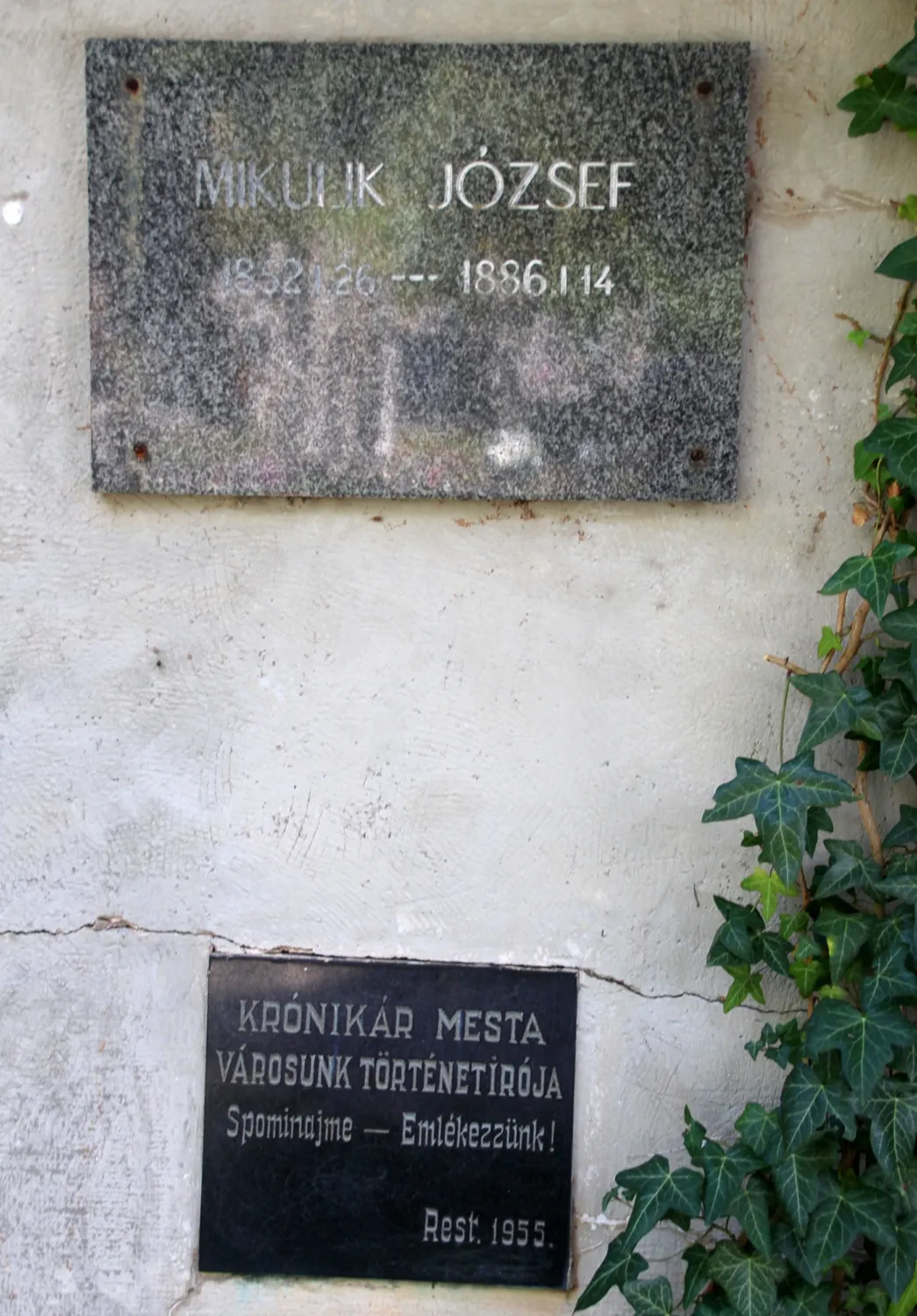
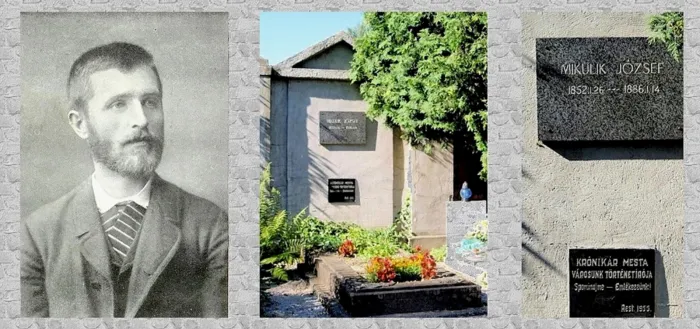
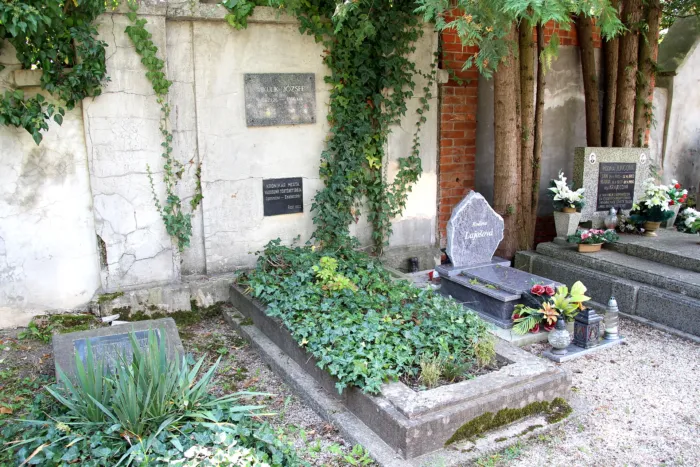
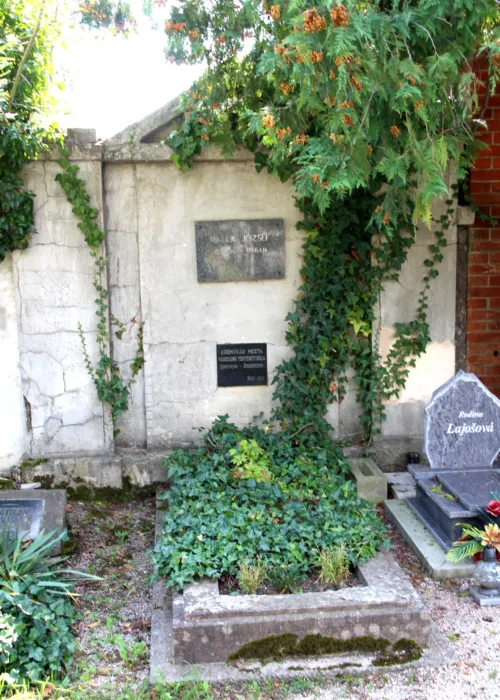
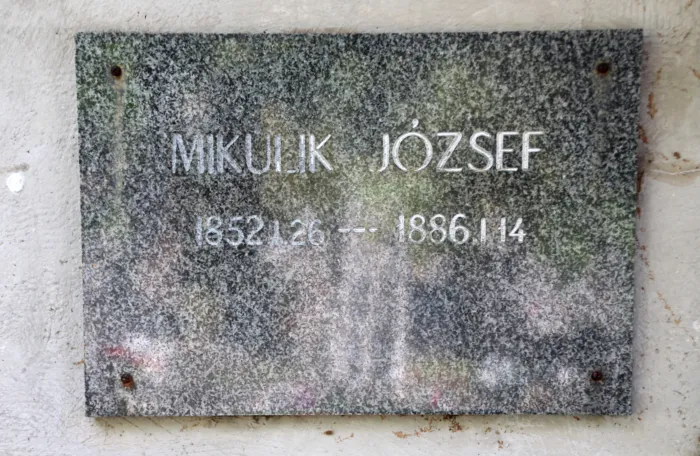
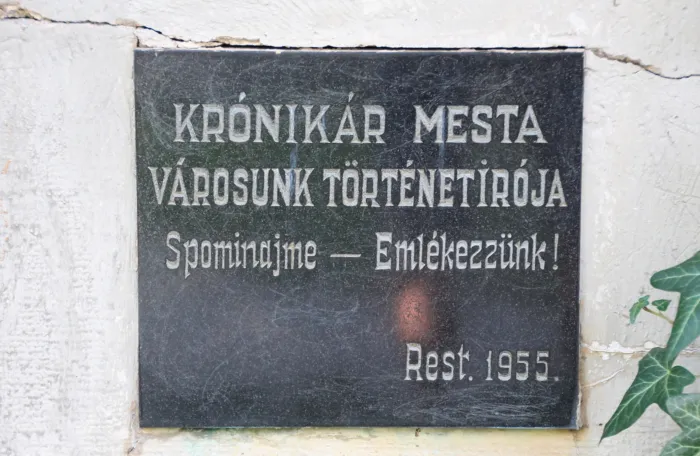
Grave of József Mikulik, lawyer and historian
Cemeteries, tombstones, grave sites
József Mikulik (Dobsina, January 26, 1852 – Rozsnyó, January 14, 1886) was a public and promissory lawyer, deputy notary, archivist, and historian. ; József Mikulik was born in Dobsina in 1852 to a poor mining family. His father was Mikulik Simon and his mother was Rachel Mária. He completed his elementary school education in Dobsina and attended high school in Rozsnyó. The greatest influence on him was Károly Kramarcsik, who was the most famous teacher in the city at that time. It was only thanks to his extraordinary effort and willpower that he overcame the disadvantage stemming from his family's financial background. His excellent progress allowed him to move from Rozsnyó to Prešov, where he studied law and then took the bar exam. This is where his promising career as a historian began. ; He began his legal practice in his hometown, and spent all his free time studying the history of Dobsina and its region. His first published work was a German-language description of Dobsina and the Dobsina Ice Cave (Dobschau, eine monographische skizze… Košice, 1878), and then he wrote his work The History of Mining and Iron Industry in Dobsina, which remains a valuable source for mining history research to this day. In the introduction to the book published in 1880 (the material of which was first published in the journal Történelmi Tár), we can read the following: “This monograph is based on documents, pleadings, wage books, city council and mining court minutes, local civil registers and other authentic sources kept in the Dobsina archives, and is therefore based on indisputable facts, in the description of which all speculative conclusions have been omitted. After outlining the past and present state of mining and metallurgy, I turn to the legal history of the question, recalling the customs, regulations and institutions that once prevailed, not failing to list in its proper place what had a beneficial or detrimental influence on this branch of primitive production. My study is supplemented by an appendix containing examples from the sources.” Since it has long been considered a rare book that is difficult to obtain or access, the Rudabánya Ore and Mineral Mining Museum saw fit to republish it in reprint form (2003), in the hope that in this way they could also contribute to the awakening of the author's memory. Mikulik was in a fortunate position as a researcher: he spoke several languages and had adequate historical knowledge, thanks to which he was entrusted with the care of the rich Dobsina archives. He was also elected as a city councilor, and even ran for mayor, but was left in the minority, missing a single vote. This failure affected him so much that he soon moved to Rožsná, where he took a position as a deputy notary for Dr. Sándor Markó. He did not spend his free time in this city with useless things either. Studying the inexhaustible source material of the city archives, he began collecting data on the past of Rožsná. The result of the almost four years of work was the historical study entitled Hungarian Small Town Life, which deals with the history of Rozsnyó from 1526 to 1715. The book was published in 1885 by the printing house of Mihály Kovács in Rozsnyó. After that, he immediately began his planned work entitled Hungarian Noble Life in the 16th and 17th Centuries. Fate intervenes He spent the beginning of 1886 at his father-in-law's house in Jólesz (today Jovice, near Rozsnyó), when he learned that Count Manó Andrássy was staying at his castle in Betlér. Early in the morning, in the bitter cold, he set off on a sleigh to talk to the count: he wanted to ask permission to collect material for his upcoming work in the Andrássy Archives. However, in Betlér, he had to wait for the count for a longer time, and their conversation also took place under the open sky. He caught a cold and felt unwell on the way back. He contracted pneumonia and died unexpectedly ten days later, on January 14. He was accompanied to his final journey from the house of Sándor Markó on the 16th, and the eulogy was delivered by the Lutheran bishop of Rozsnyó, István Czékus. ; Mikulik processed the history of the Augustinian Lutheran parish of Gömör. (This work was only published 31 years after his death, in 1917.) We can gain an idea of the famous daily customs of medieval Gömör county from his work written on the basis of contemporary church records. The prohibitions he published regarding festive customs are very noteworthy from the point of view of research on folk life. Although most of his data concerns villages with Slovak populations, this is the only work that presents historical material from the area under study. Previously, the Lutheran church of Rozsnyó had also asked him to process their history, but this could no longer be done. He published numerous articles in various newspapers and journals (Journal of Law, Centuries, Forestry Papers, Protestant Review Illustrated Family Papers, Pesti Napló). He was also a contributor to local newspapers (Rozsnyói Híradó, Rozsnyó és Vidéke). In addition to his published works, he also left a huge legacy that he could no longer publish, such as A szabadágyság és a községek, A megyei élet a 16th and 17th centuries, or the mining law encyclopedia he collected and planned about the noble families of Gömör. His life's work awaits the discovery and utilization of modern research.