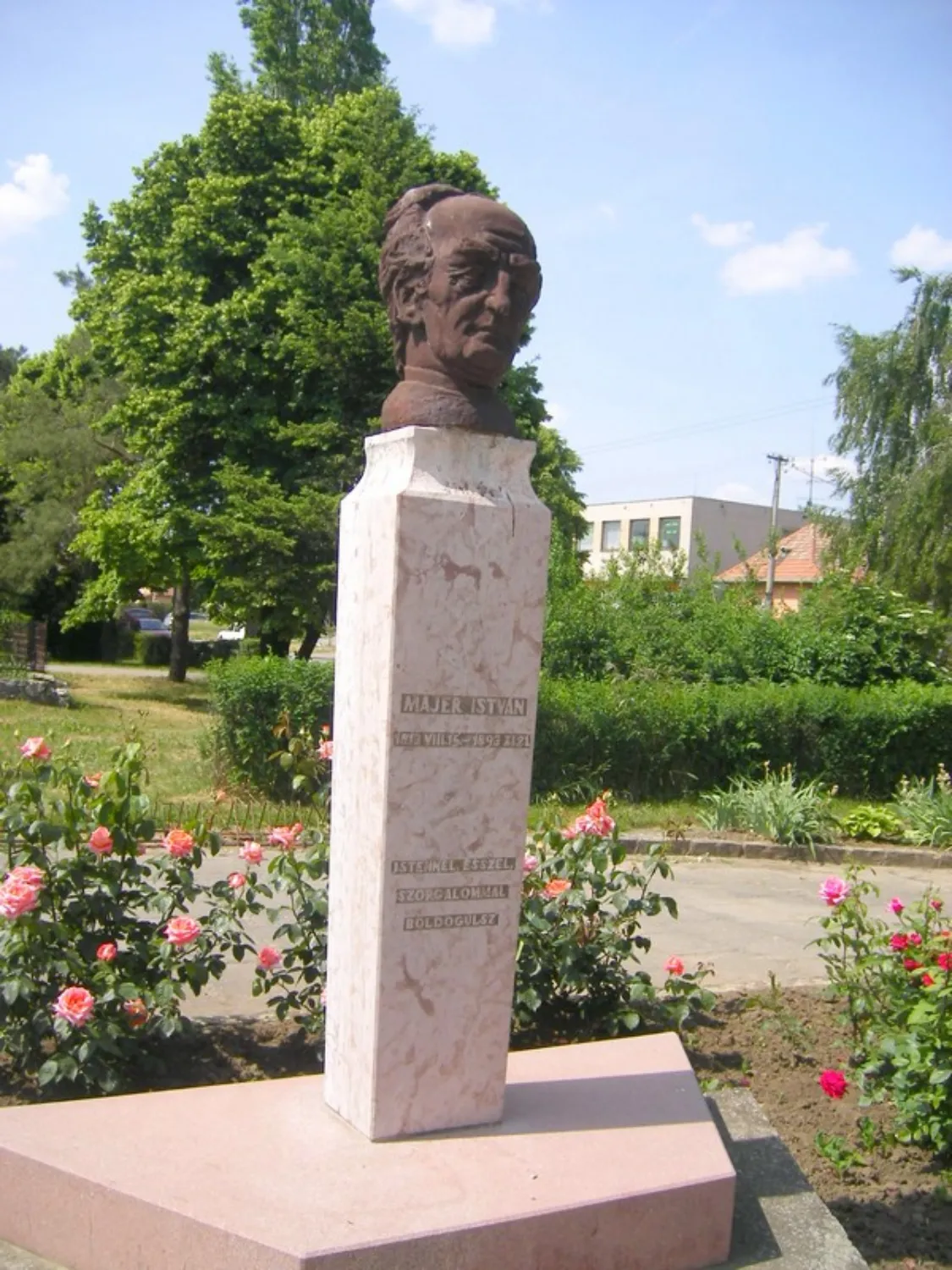
Bust of István Majer in Kürtö
Statue, monument, memorial plaque
"He who lived like Bishop István Majer, who did so much good, who created so much, did not live his days as if time were passing quickly, did not pass unnoticed through life, but wrote his name everywhere on the road he traveled and built a memory for himself in the field of his work." Written by Lajos Novák
;István Majer was born on August 15, 1813, in the large village of Mocsonok in the Nitra district. He completed his elementary school years in Érsekújvár, the public school in Esztergom, and then studied theology in Nagyszombat. Here too, he showed the sacrificial zeal of his later folk culture: he founded a Hungarian language practice association and then went to Pest to study law. His mother, Antónia Majer Tillman, died young, at the age of 38, and his father 9 years later.
;He began his assistant pastor training in Muzsla in 1936. He was the pastor of this settlement for nearly two years. In 1842, he took up a teaching position at the “teachers’ academy” in Esztergom. From then on, he devoted more and more time to solving educational problems. In recognition of his pedagogical writings and ecclesiastical activities, he was entrusted with increasingly honorable tasks: in 1849, he was a teacher at the Faculty of Humanities of the University of Budapest.
;From 1851, he was the director-supervisor of all elementary and private schools in the capital.
;As a result of the wave of Germanization of schools, he resigned from his position as director, and then on February 26, 1857, he took up the ecclesiastical office in Kürt. During his stay here, he created his most outstanding works, he cultivated almost all branches of literature, and his pedagogical works and folk writings made him one of the most popular and beloved people in the country. As a result of his works, he was generally known as “Uncle István” receives a well-respected name.
;From 1856 to 1870, he edited the "Uncle István Calendar", in which he informed the peasant about the modern achievements of the time.
;He classified his works into seven thematic units:
;1. religious, church literature and artistic works - 14 pieces; 2. educational, methodological, school books and youth documents - 34 pieces; 3. folk books and folk literature; 4. historical essays, travelogues, topographies; 5. grammar, linguistics; 6. articles of fiction and mixed content; 7. works in manuscript.
;During his stay in Kürti, he described the Udvard Calvary, built based on his plans and drawings, and the history of the village. As a parish priest, Kürti wrote numerous articles for about the village, in all his writings he speaks of the population with love - the people also try to repay his sacrificial work.
;Even as a parish priest, he does not renounce his pedagogical principles: he was one of the initiators and implementers of the practical reform of school education. In order to popularize home industry, he orders that all schoolchildren must make some kind of handicraft. The boys carved small things, ladders, hangers, benches, the girls knitted nets, wreaths, yarn, and string. During the exams of the circle, there was a whole industrial exhibition in the village school. He rewarded the most diligent ones at such times.
;During his stay in Kürti, he had twenty-two books and numerous articles published.
;From a pedagogical point of view, the "teachers' conference" held on September 19, 1859, in Perbete, as parish priest of Kürti, is significant. His work entitled "Szemléleti tanmód az első ökötságsnál" was read out at the "Teachers' Council" organized in our village on September 3, 1861. His work entitled "On the Teaching of Folklore Grammar, Spelling, Spelling and Composition for Life" was presented, which offers a wealth of practical examples to practicing teachers. In the same year, his dissertation entitled "How is Homeland Knowledge Taught in Kürtön" (Homeland Knowledge) was published in print. He processed the past of the village from the 1700s based on the civil registry entries and oral tradition until 1860. He also dealt with the organization of students' extracurricular activities - he created children's books. He wrote the plays "The Eight Kürti Wreath - a play for the village youth" and "Bethlehem - a shepherd's play for the good Kürti children".
;Years later, he still remembers Kürti with love, and whenever he gets the chance, he refers to the village in his books. In 1870, he established a foundation for the Kürti Saint Wendel statue.
;He died on November 21, 1893.
;A man who rose from the countryside to prominent positions and held high positions - he worked all his life to raise the level of knowledge of the rural peasant and the urban industrialist. Having passed away from Kürt, in 1866 he became a canon of Esztergom, in 1880 a titular bishop, and he can claim many high honors - the Order of the Iron Crown, a knight of the Order of Leopold, an honorary doctor... - but he does not forget his origin.
;However, the descendants of his former followers do not forget him either, and in recent times his memory has been alive again in the public consciousness: in 1990 the scout troop took his name, in 1994 his bust was unveiled in front of the church, and the main square of the village has been named after him since the summer of 1998. Since 1999, the Majer István Professional and Cultural Day has been organized in our village, praising the pedagogical work of the eponymous figure and his activities in the field of school affairs.
;A young cyclist from Kürt dedicated a MEMORIAL TOUR to his honor.