
Bird harvest
Cultural heritage
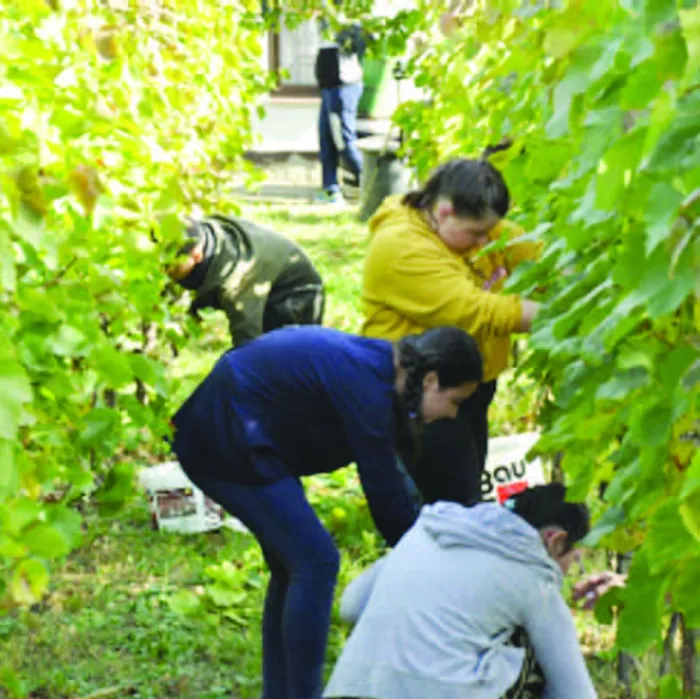
The grape harvest, or as everyone in Madaron calls it, the harvest, was a big event in the village. Since almost every family had a small vineyard that they hoeed, tied, and tended all year round, so that at the end of September or the beginning of October, the whole family, young and old, would gather and harvest the crop. ; it was not an easy job, it required a lot of preparation. The men washed the wooden barrels days in advance so that they would dry out sufficiently before the harvest time came. Then the tub in which the grapes were crushed had to be washed, the sutyú (this is what the grape press is called in Madaron) and the puttonys had to be cleaned, the can, knives, and pruning shears had to be prepared so that on the morning of the harvest, all that was left was to get to work. ; Early in the morning, the housewife baked the flaky scones, added some thinly sliced ham, pinched red pepper, pickled horseradish, and flaky white bread, packed them in a basket lined with a checkered tablecloth, and put half a liter of homemade plum brandy next to them, so that when the company gathered, they would have something to offer them. ; On this day, the closest family expanded with more distant relatives, good friends, and even neighbors, so that the work could be completed as soon as possible. Every adult then started the day with a cup of brandy, so that the autumn cold would not catch up with them, but would keep their souls warm from the inside. Some even managed to drink two. This put the harvesting company in a good mood, and by the time the sun's rays had somewhat dried up the morning mist, the work was already in full swing. ; ; Harvest ; ; In the middle of the Madari grapevine ; The crisp cherry is ripe, ; As red as the blood that has been spilled, ; I will die for my old lover. ; Girls, girls, learn about me, ; Don't keep a soldier lover ; A soldier will be taken far away, ; He doesn't even think that I was his lover. ; A young man wanted to come to me, ; Who couldn't close the door, ; He will learn, there will still be time, ; After the harvest, I will be his lover, ; Then his lovely wife. ; ; Two of them took a row of grapes, one from one side, the other from the other, to make it easier to pick. A more skillful and a less skillful person were always paired up, and if there were children among the workers, they worked with an adult so that no one was left behind. They picked the grape clusters from the vines into the cans, and serious competition developed between the pairs. If someone rushed their work and left a cluster on the vine, they would definitely order it back. They kept track of who had picked with how many cans, and how many baskets of grapes came out of which row. Because there was a man with a basket who collected the grapes from the cans and carried them to the end of the row. There they then loaded the full baskets onto the cart. Singing, loud laughter, and teasing each other were not uncommon. If there were a lot of grapes, they would rest at half-time, the home-made grape brandy would come out from the checkered tablecloth, there was even some plum brandy, and by the time all the grapes were loaded onto the cart, the company was already in a very good mood. ; Then at the cellar, the picked grapes were ground into the large vat. Assembling the grinder and grinding the grapes was men's work. It required serious physical strength. By the time the vat was full and it was evening, the women had cooked dinner. To quench their thirst, they would pour fresh must, which could be poured from the strainer in the large vat. ; A few days later, when the grapes had released enough juice, they would strain it into barrels, and the grape skins would be collected in the sutyú so that every last drop could be squeezed out of it. The sutyú is a cylindrical press made of wooden slats and metal rims, which was pulled tighter and tighter by hand, and a small trough at the bottom collected the valuable juice. The grape skins and seeds, i.e. the terkő, which were stripped of their moisture, were not wasted either, because later they were used to make terkőpálinka. Incidentally, the geese also liked it, and when it started to ferment a little, they got a nice kick out of it. ; In the barrels, the must first turned into mash, and then – as the spring continued to flow – into wine. Every child knew that it was forbidden to enter the cellar when the wine was boiling, because the gases produced were deadly poisons, and adults were only allowed to go down with a burning candle in their hand, if for some reason they really had to. ; The science of winemaking was passed down in the family from father to son.