
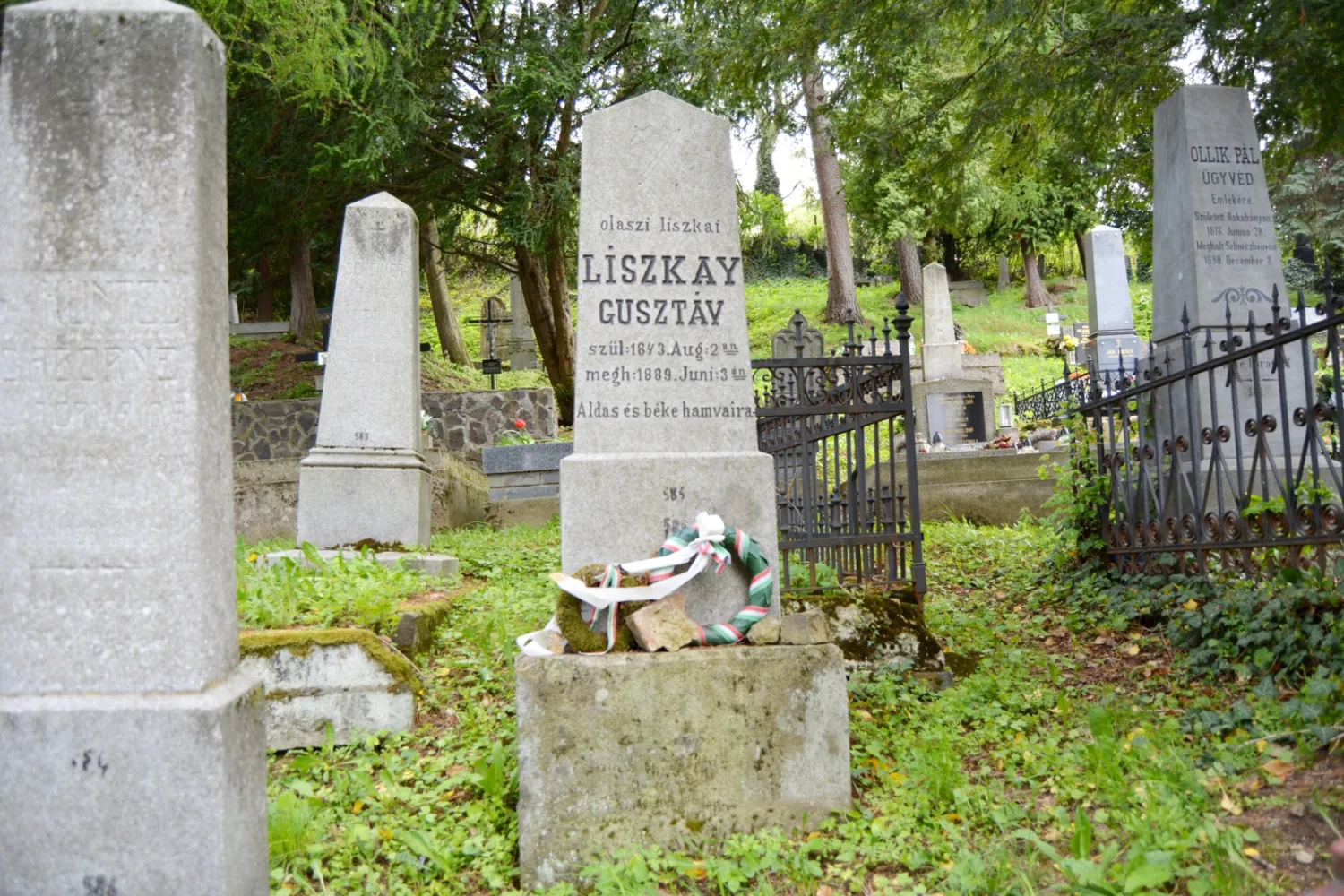
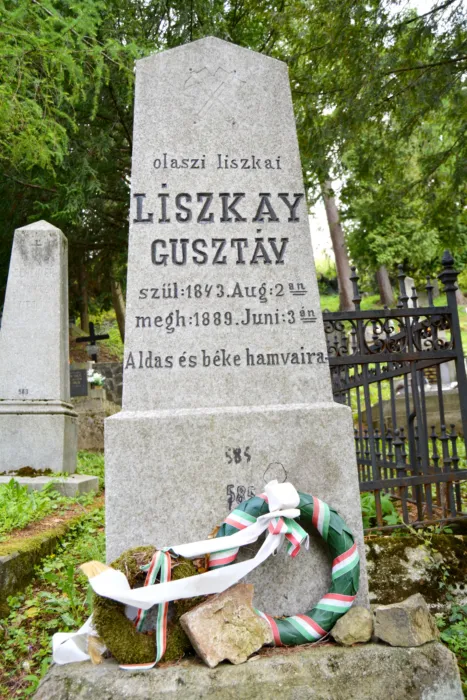
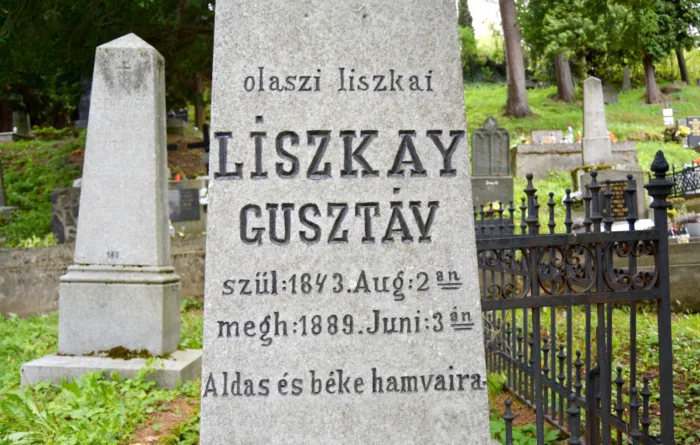
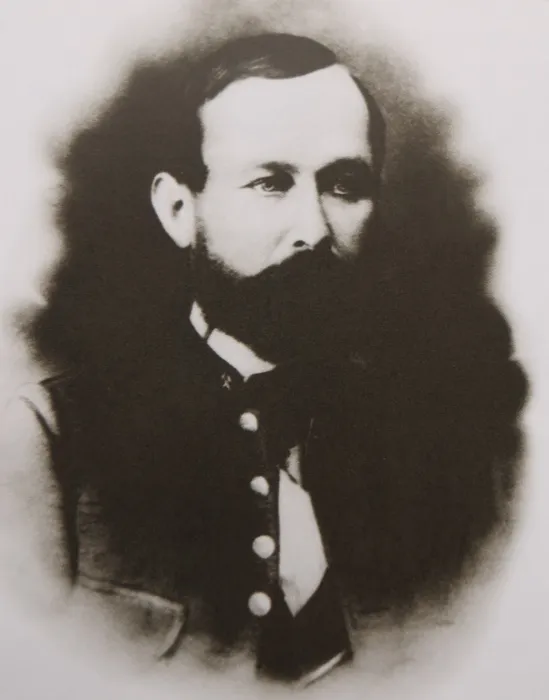
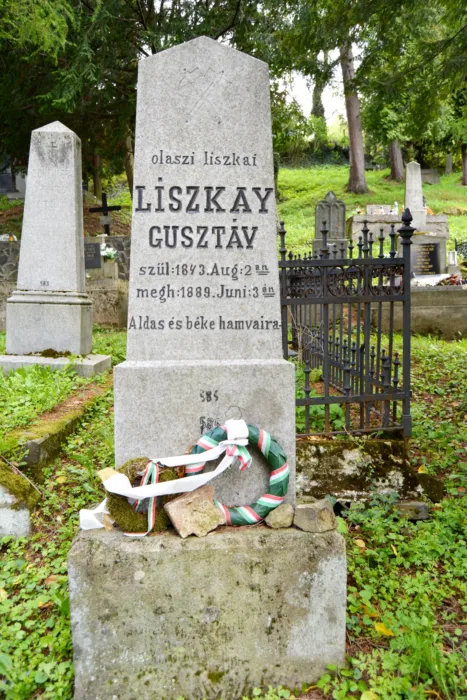
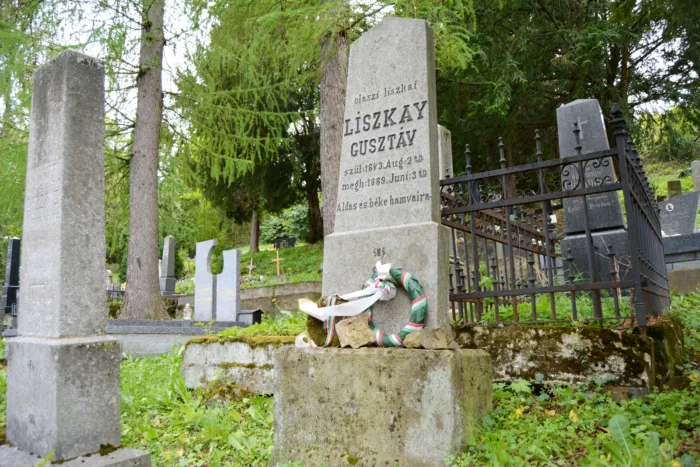
The grave of Gusztáv Liszkay
Cemeteries, tombstones, graves
The mining engineer and teacher Gusztáv Liszkay is considered by the profession primarily as one of the creators of the Hungarian technical and official language. Dr. Jenő Faller wrote about him in his series Our Forgotten Greats that although “there are no outstanding great works in his short oeuvre”, the fact is undeniable that “he had a great contribution, along with Antal Péch, to the creation and development of our Hungarian mining language”. This is proven by his studies published in various professional journals, “written in enjoyable Hungarian, and his books, which stand out far from our professional literature of the time with the purity of their language”. (Dr. Faller J., 1958. p. 730); Liszkay was born on August 2, 1843 in Derencsény, Gömör County. He began his studies in Rimaszombat, graduated in Késmárk, and in 1866 earned a diploma in mining and metallurgy at the Selmec Academy. He served in the ironworks of the banác for half a decade. In 1871, he returned to Selmecbánya, where he worked until his death. First, he was a draftsman at the mining directorate, and then in 1873 he was entrusted with the organization and administration of the Selmec mining school. Between 1872 and 1880, he also lectured at the academy as an invited assistant teacher on geodesy and the then standardized subjects of office organization and standardization. (L. Zsámboki, 1983. p. 236) Jenő Faller mentions that Liszkay was brought to Selmec “primarily because of his perfect knowledge of the Hungarian language, where at that time the mining administration and academic teaching, which had been in German, had to be converted to Hungarian”. (J. Faller, 1958. p. 730) Liszkay published his famous Mining Theory in Selmecbánya as early as 1878. He wrote his book for the royal mining schools and for private use “after several wells”. In fact, this is our first complete mining theory. And although the work has many shortcomings according to experts, its method of discussion is descriptive and follows the old systematization, despite these shortcomings it is a significant work. This important work was preceded by the Manual published in Selmec in 1877, which he wrote for state officials and treasury officials, and which is also a pioneering work, “the first summary of the official administration of our mining industry in Hungarian”. (Faller J., 1958. p. 731). In 1885, Liszkay published the Hungarian version of E. F. Scholl’s German-language Machinist’s Guide in the Joerges printing house in Selmec. By applying it to Hungarian conditions, he did a great service to his country at a time when “the use of the steam engine was spreading rapidly”, but no relevant Hungarian specialist book existed yet. Liszkay’s professional activities and merits are recorded in all our lexicons. His name can also be found in Slovak-language summaries. The Slovak Biographical Dictionary also highlights Liszkay’s activities in the field of Hungarian technical language. He also mentions the descriptive and systematic work he did on the minerals of Selmecbánya, Bakabánya, Hodrusbánya, Újbánya, Zsarnóca and the Szepesség area. (Mináè, V. main editor, 1989. p. 415.) Several major studies by Liszkay were published on the above topic. Such are, for example, the work on the occurrence of minerals in the Selmecz region (Geological Journal, 1876), the work on the geological and mining relations of the Zsarnóca region (Data on the geological and mining relations of the Tiszolczi region) (1877) or the work on the marble types of Tiszolczi. These writings are also characterized by “deep professional knowledge, perfect knowledge of domestic and foreign literature, sharp observational skills and wise objectivity, not to mention the polishedness of their language, which was important and of great significance in the early 1870s, when our language was still difficult to pronounce”. (Faller J., 1958. p. 731); Liszkay was also very active in the “new-spirited reorganization” of Selmec after the Compromise. He was a member of the Selmec Doctors and Naturalists Society and the Selmecbánya branch of the Hungarian Geological Society. He died relatively young on June 3, 1889, in the mining town of northern Hungary. His grave is in the Lutheran cemetery next to Kopogtató.