
:
:
Komárom carters' clothing, lifestyle and carters' banderie
Cultural heritage
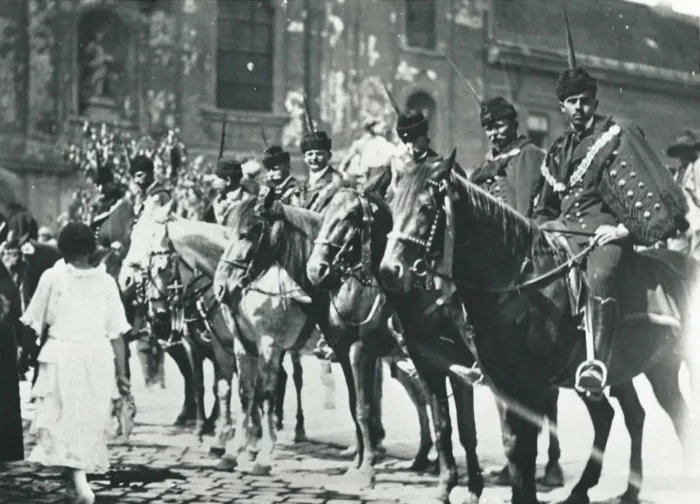
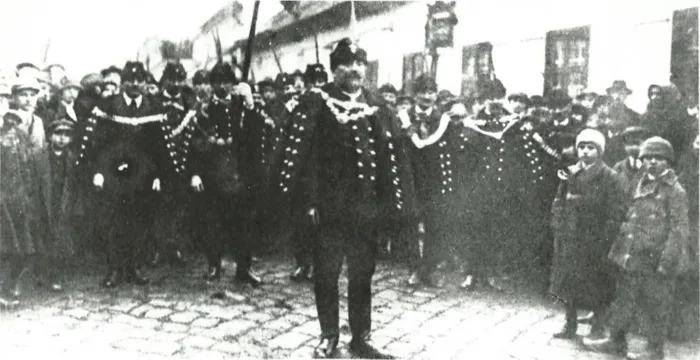
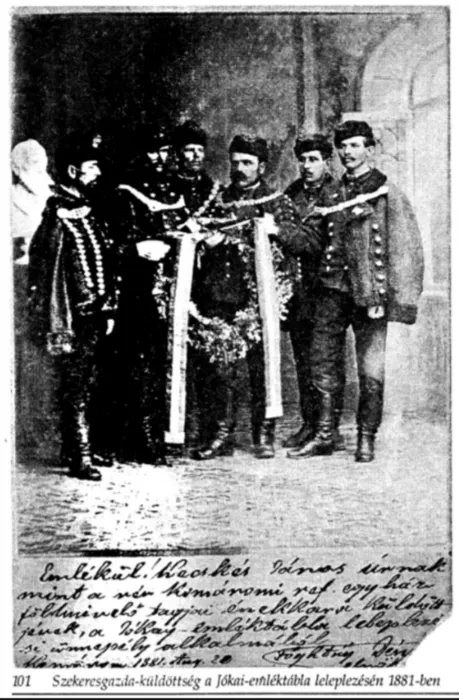
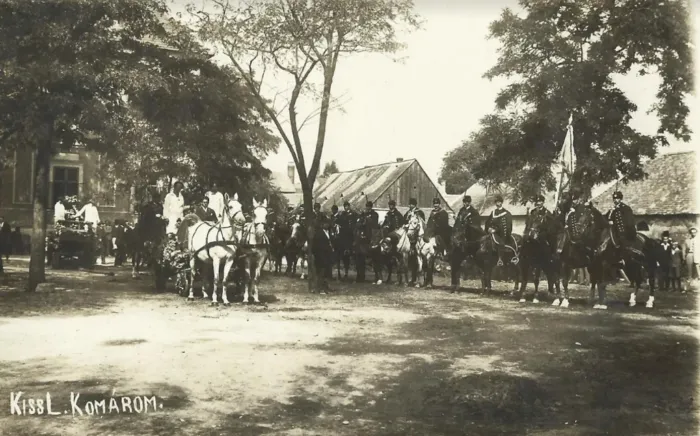
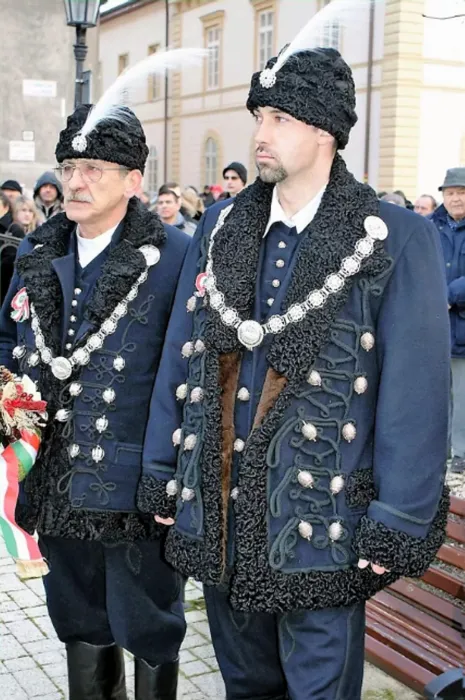
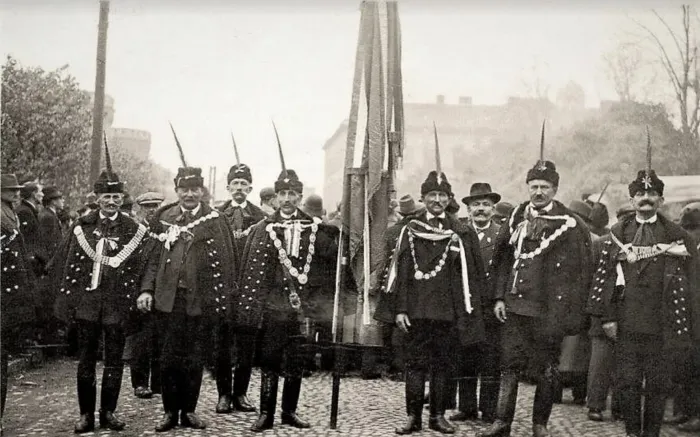
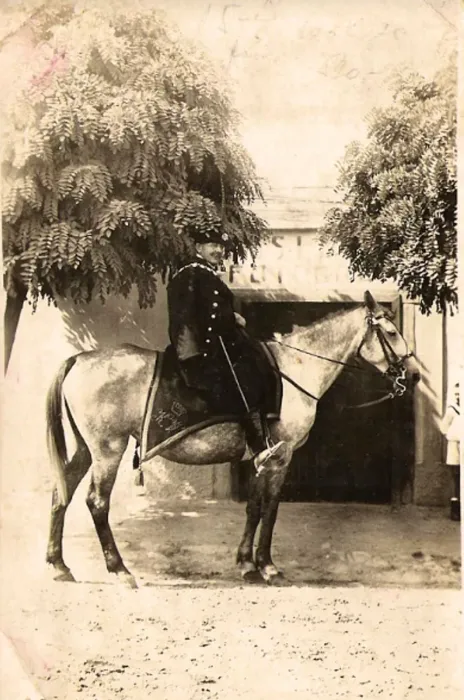
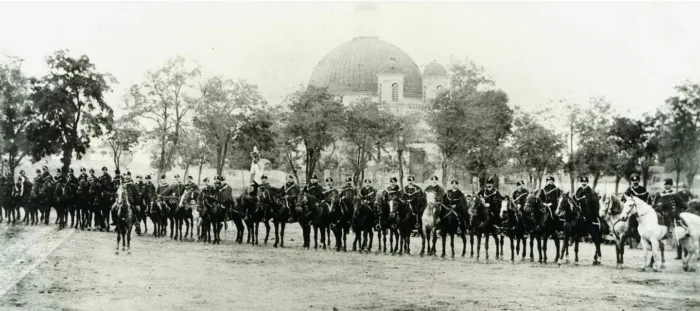
Lifestyle ; Due to its advantageous geographical features, the city of Komárom has been of great commercial and military importance since ancient times. A special, ancient stratum of the city's population until the middle of the 20th century was the carters, who considered themselves descendants of the conquering Hungarians. Their lives were closely connected with the history and fate of the city. During the Turkish times, they excelled in the defense of the castle and the city as naszádos and hussars, and most of them then earned landless so-called armál nobility for their combat merits. This is evidenced by the noble letters, which mostly date from the 1600s. Since they received very little and infrequent payment for their service, they had to provide for their families themselves in other ways. They earned their bread by raising livestock, farming, and later by towing ships and transporting goods. ; Boat towing was a special, now forgotten, complex job of the carters, requiring great experience and organization. The boats were usually towed in pairs, tied side by side. A towpath ran along the shore, on which the drivers and the animals in pairs drove. Where the shore was high and steep, a stepped, multi-level path was created so that the horses could travel on the right path at any water level. The towpath ran either on one bank or the other. The changeover was a complicated, difficult operation, in which people and animals had to work precisely. Towing boats on the Danube required 200-300 m of rope. This hemp rope, woven from eight branches and the thickness of an arm, was made by ropemakers from Komárom. Towing two medium-sized, connected ships required: 5-9 sailors, 2 tugs, 1 kurtulyás (who looked after the ropes), 18-20 drivers, 30-38 horses. Towing was a dangerous occupation that required excellent local knowledge, great expertise and extraordinary presence of mind. The ships were usually towed to Győr or Vienna, but sometimes to Regensburg and even Ulm. The carters undertook raft towing, passenger and freight transport. According to the records, they reached Prague, Warsaw, Munich, Graz, Belgrade and even Paris with their carts. The wood for the construction of the Reformed church, which began in 1785, was brought from Serbia by the carters in a caravan of about 200 carts. ; In the 18th century and the first half of the 19th century, cart owners were mainly engaged in ship towing and transportation. With the spread of steamships and railways, their main occupation became farming. This can also be read from the entries in the civil registers of the time. ; Older entries mention the occupations of tractor, horse owner, and farmer, but at the end of the 19th century, farmer and landowner appear in the occupation column next to the names of cart owners. ; The cart owners lived in one block, did their work in one community, and did not form a guild, but despite this, the cooperation between them was very orderly and exemplary. ; Most of them were Calvinists, and they strongly adhered to their religion and traditions. ; In addition to working together, they also had common entertainment. While the guilds had their own starters, the cart owners had a famous verbunk-like song, the famous “Megyercsi utcai”, which is an original Komárom melody. This is also documented in the appendices. ; The farmers’ choir, founded in 1881, performed at several events and church events, and even serenaded the city’s dignitaries. The farmers’ choir organized several very successful balls and parties. ; After 1945, the political and economic circumstances made the life and livelihood of the cart owners completely impossible, and today only the descendants are trying to cherish the memory and traditions of their ancestors. ; ; Clothing ; ; "The dress of the carters was picturesque. It consisted of trousers made of dark blue cloth, a waistcoat, a dolman and a kilt. Today, many of the dresses are still carefully guarded in the closets of older people. Where the dress is no longer there, the kilt chain and the buttons are family property and are passed down from father to son," wrote László Kecskés about the dress in his book introducing the crafts of Komárom. The trousers were close-fitting Hungarian trousers, with a beautifully woven black knight's binding on the upper front of the thigh, and black trimming on the seams. The waistcoat had beautiful, finely crafted silver buttons the size and shape of half a hazelnut. The dolman was tailored to the waist, with black knight's binding in the front, and silver buttons the size and shape of half a walnut. Its hem was small, just leaving the neck open. The white collar and the black Hungarian tie with gold fringes were visible from under the lapel. The mente was the most beautiful piece of clothing. The front was decorated with richly worked knightly bindings and two or four rows of walnut-shaped and large silver buttons sewn on. All seams on the sides and back were covered with black trimming. The mente was edged all around with astrakhan fur, which was also used to make the collar. In warmer weather, it was worn thrown over a panyóka. The two halves of the front were held together by a mente chain reaching from shoulder to shoulder. Their kucsma was made of astrakhan fur, and in the past, egret, later eagle, or pheasant feathers were pinned to it. The outfit was completed by black, side-sewn Hungarian boots with wrinkled throats or with a strop. On special occasions, for example, when they marched in a corps, they wore a sword (fringia) on their side. A separate study could be written about the finely crafted silver buttons and wonderfully beautiful chainmail chains of the charioteers' clothes. ; The uniqueness of the charioteers' ceremonial clothing is manifested in the fact that it is uniform in shape and color, almost uniform-like, the difference being only in the decoration. ; ; Bandérium ; ; The charioteers once formed the city's bandérium due to their organization, noble rank, picturesque, richly decorated with silver, dark blue cloth, trousers, waistcoat, dolman and mente, as well as an astrakhan fur kuchma with egret feathers, and their proficiency in horse riding. The bandérium was formed occasionally, for special festive occasions. Its leader was the captain elected by themselves, and their officials were the standard-bearer, the halberd bearer and the two maces. When the banderium marched, the charioteers dressed in their ceremonial robes, tied swords to their sides, and put on the horses a decorative saddle blanket made of red cloth, edged with gold trimming. The monogram KV (City of Komárom) was embroidered in gold in the corner of the saddle blanket, above which was the five-pointed crown of the common nobility. When the banderium marched, the halberd man walked in front, followed by the standard bearer with the banderium's flag, and on either side of him a mace-bearer. After them was the captain of the banderium, then the horsemen in double rows. The charioteer banderium welcomed distinguished guests arriving in the city, such as the emperor, the archduke, or the prince-primate. They also served as a permanent escort at the inauguration of the archduke. The most active period for the banderium clearly fell on the 1890s. A series of celebrations and parades followed one another, such as the inaugurations of lords, the jubilee of Kálmán Tisza as chief guardian, and millennium commemorations. The charioteer's horse banderium represented Komárom in Budapest at the millennium parade in 1896. ; After the coup d'état, the horse banderium marched in the Hungarian Farewell in Komárom in September 1921, at the consecration of the new bells of the St. Andrew's Church on July 13, 1924, and at the consecration of the flag of the National Hungarian Smallholder, Farmer and Craftsman Party and the flag of the banderium on August 31, 1924. The last official parade of the banderium in Komárom took place on September 15, 1929, at the inauguration of the bell of the Reformed Church. ; ;  , ; ; ; ; Komárom City Television's coverage of the establishment of the Komárom Carriage Owner and Tradition Preservation Association in 2015.