
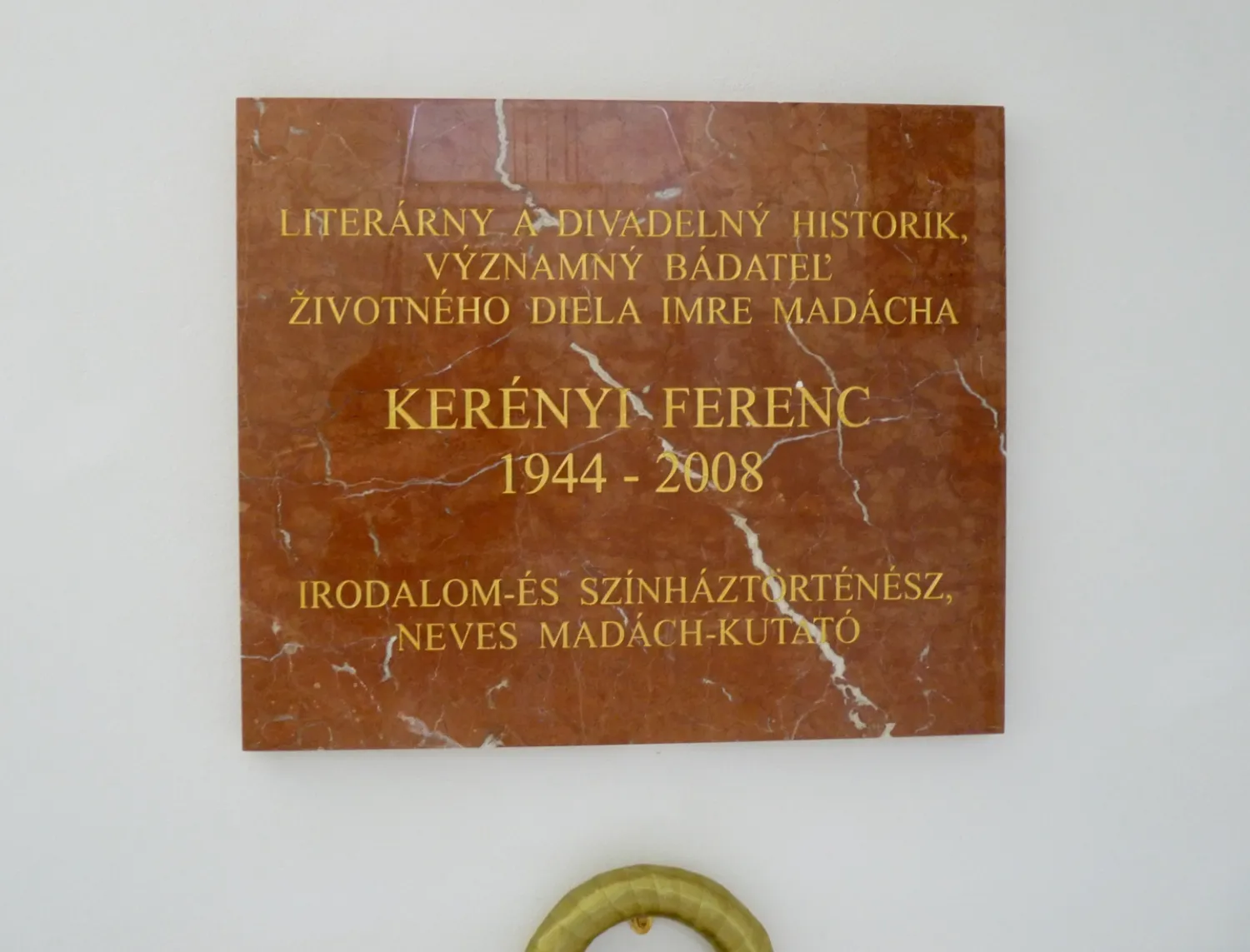
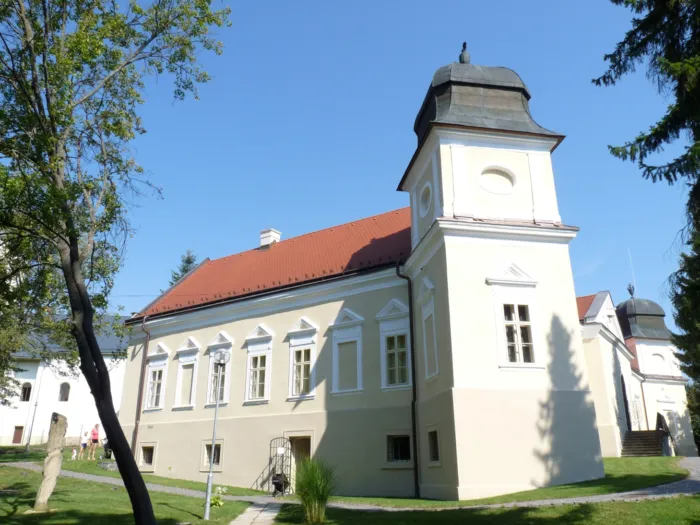
Memorial plaque of Ferenc Kerényi
Statue, monument, plaque
Ferenc Kerényi completed his university studies at the ELTE Faculty of Arts, Department of Hungarian History (1963-1968), worked as a secondary school teacher (1968-1976). then a lecturer at ELTE (1970-1990). After his doctorate (1972), he worked as a staff member of the Petőfi Literary Museum, head of its Art Collection (1976-1982). After that, he was a scientific staff member (1982-1983) and director (1983-1992) of the Hungarian Theatre Institute. Since 1992, he has been a staff member of the Institute of Literary Studies of the Hungarian Academy of Sciences, as well as an associate professor at the Academy of Theatre and Film Arts, and vice-president of the Hungarian Literary History Society. His research area is 19th century literature and the history of 19th-20th century dramatic literature and acting. Within this, Petőfi and Madách were the closest to him. His book “Imre Madách (2006) also had antecedents: the book “...I wrote a poem quoting Madáchot” (1989), the Selected Works of Imre Madách (2005), edited jointly with Károly Horváth, and primarily the critical edition of Az ember tragédiája (The Tragedy of Man) (2005). ; His small monograph on Madách was the first to summarize for the general public the half-century results of scientific research conducted around the author of Az ember tragédiája. Thanks to his many years of research and preparation, he prepared a comprehensive, complete account of Madách’s life and writing career. With scientific thoroughness, but keeping in mind the principle of popularization, he delved into the history of the family, presenting the Pest of the Reformation and the public life of the contemporary Nógrád county, Madách’s presence in the 1843/44. at the 1848/49 Bratislava National Assembly, his local political activity in the 1848/49 War of Independence… He commemorated every important stage of his life, every event and every significant piece of his literary oeuvre. In his Madách book, as in the one about Petőfi, he dealt in detail… with the environment: the landscape, relatives, friends, acquaintances, opponents and the small, seemingly insignificant events of his biography, which nevertheless gain significance in their context. In this way, he brought the heroes of his book to life and brought them closer to the reader: their lives, their world of thought and emotion, their works.” – László Orosz praises his work. ; Kerényi showed that János Arany barely improved the original manuscript. ; His work On the Old Hungarian Stage (1981) reviewed Hungarian theatre between 1790 and 1849 according to programme layers and drama types. In his collection From Wandering Theatre to the National Theatre (1987), he published letters related to theatre and theatre, The Beginnings of Hungarian Theatre Criticism (1790–1837) (2000) is a significant milestone in his three-volume work, containing 1778 pages and 2634 entries. He published two important studies on József Katona. One of them shed new light on the Bánk performances before 1848. ; So he made a significant contribution to both literary history and theatre history.