
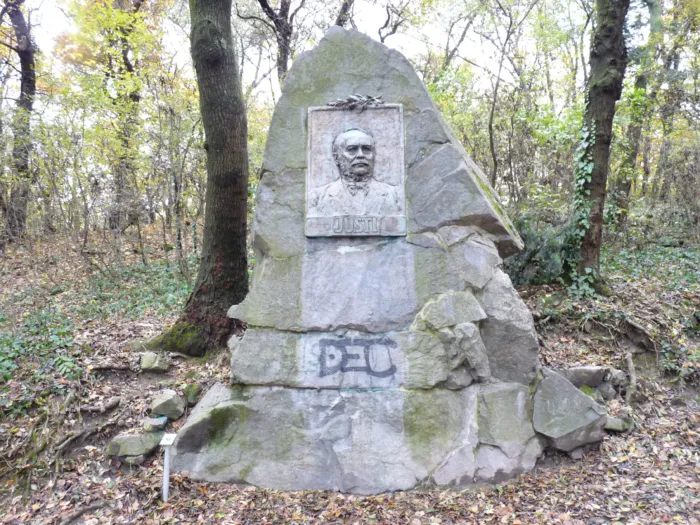
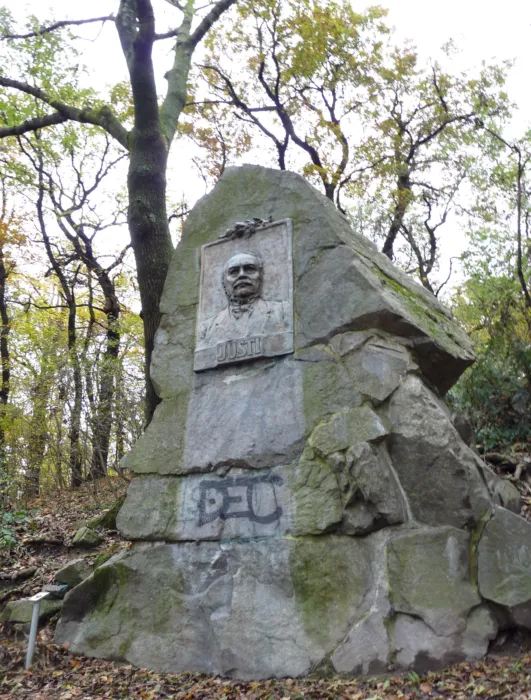
Monument to Henrik Justi
Statue, monument, memorial plaque
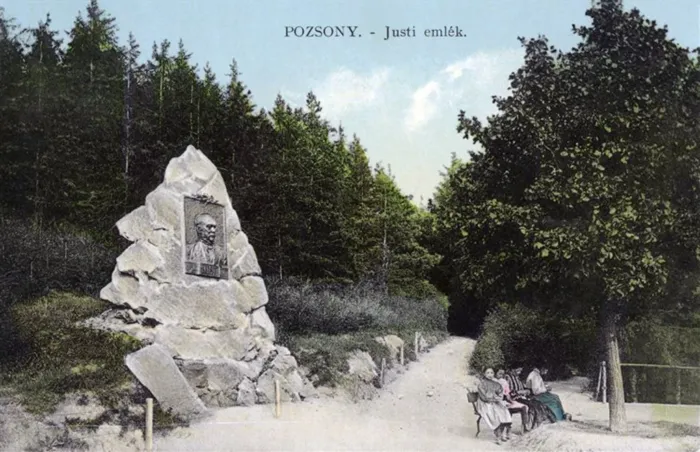
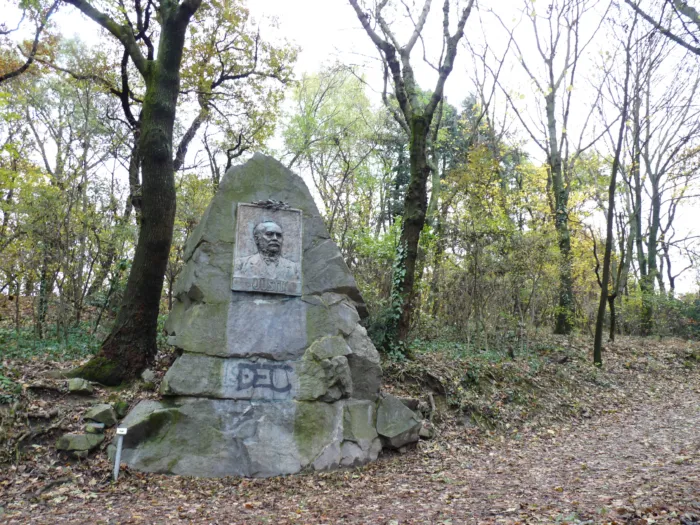
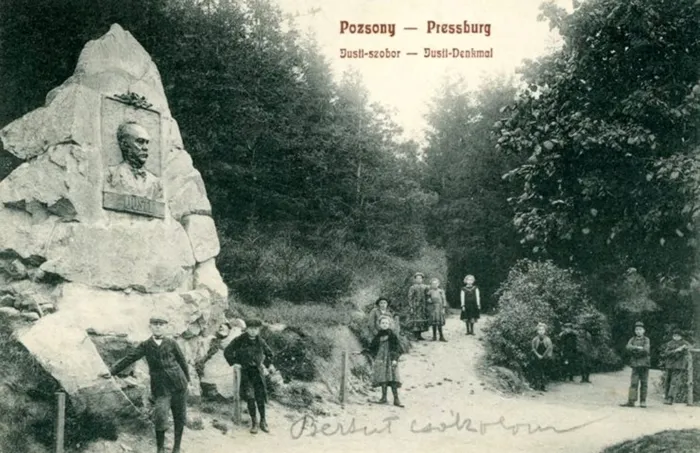
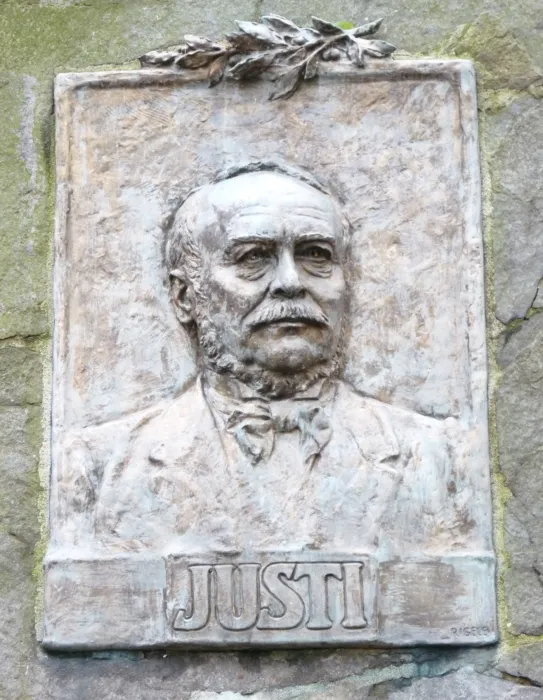
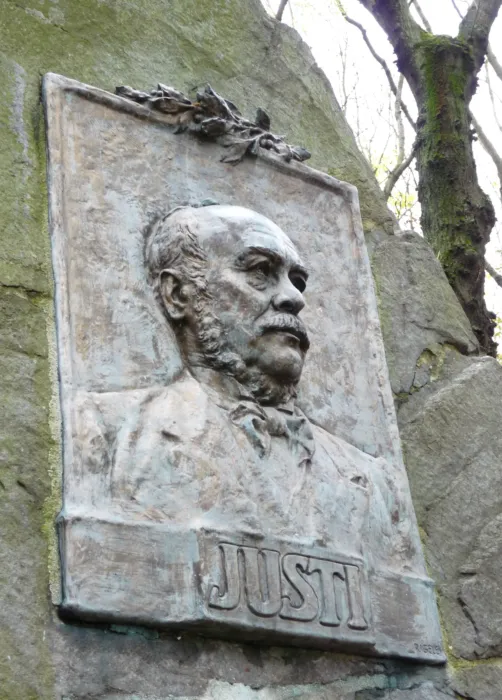
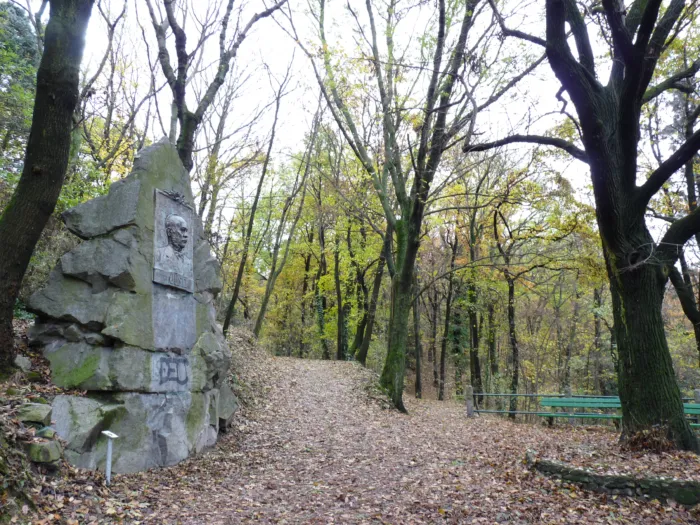
"Justi Henrik was born in 1804 in Transylvania, where his father, Justi Károly, was a state engineer. He completed his secondary education in Cluj-Napoca and Sibiu. In 1815 he joined the military engineering directorate as a draftee. He then served in the 19th Hessen-Homburg Regiment, but since there was no prospect of becoming a captain in the general staff, he left military service in 1829. From then on, he devoted himself to a political and administrative career and came to Bratislava, where he entered the city service and at the same time completed his legal studies. In 1834, he was a city trainee, later an actuary of the city court. At that time, he already developed a proposal for all city services, which was accepted. He became a city councilor for this. In 1848, he led a section of the Bratislava National Guard to Nitra to suppress the Hurban rebellion and At Szenitsa he dispersed the rebel troops to such an extent that he received full recognition from the military. Upon his return, he took over the leadership of the entire local national guard. When the imperial armies entered, he was suspected of being a revolutionary. Count Ferenc Zichy put him to the test and appointed him as a military commissar to the Russian Grabbé corps command. Justi adapted, but his energy was not to the liking of the Russians. Minister Bach offered him a high political position in December 1849, but he did not accept it. In January 1850, he was tried before a military court as a revolutionary, which, however, acquitted him. He then retired to private life and became the director of the English air force set up in Bratislava in 1865, a position he held for almost the rest of his life. In 1867, when the constitution was restored, he was elected mayor by a majority of votes on May 13. In 1875 He was retired on Aug. 2, 1878, but not with his well-deserved full salary, which greatly disappointed the 71-year-old man who had served the city faithfully and energetically. He died on Oct. 17, 1878. His remains rest in the Sz. András Cemetery - forgotten. ; Justi was the greatest and most significant mayor of Bratislava in the second half of the 19th century. His 8-year term was a pioneer in the development of Bratislava. With great and correct expertise, he reorganized the entire administration of the city. With unsurpassed energy and never a mistake with his independent initiative, because he - the last - elected autonomous mayor, "ruled like an autocrat" in the city council with the majority led by his friends, Tivadar Edl and the city vicar Károly Heiller (1849-1889). The most notable moments of city life occurred during his term of office: the raising of the Danube Dam in Oroszvár, the securing of the right to the consumption tax, the piling and regulation of the city's Danube bank, for which it was rightly named Justi-sor (Justilände), as well as the compensation of the state railway for the sources diverted in the tunnel, the separation of the Catholic lordship's property, the creation and implementation of the architectural system that exists today, the purchase of the Apponyiház, the construction of the present city hall, the beautification of the city's diszliget, the establishment of the mountain park from the Petzl Foundation, the creation of the retirement regulations for city officials, the establishment of the city Museum, and the beginning of general sewerage and paving. We mention that he increased the city's income from 2,957,000 forints to 5,176,662 fruts, and also increased the value of the city's land by 262,661 forints. In addition, the city's debts only increased by 80 thousand forints under him. On the other hand, when he stepped down, the city's wealth increased by 483,000 forints. He was an extraordinary administrative talent. In a proposal to Menyhért Lónyay, he requested a loan of 5 ½ million for the city to implement his city program, which included: building a permanent bridge, barracks, slaughterhouse, water pipeline, market hall, schools, regulating the city, increasing tourism, making food cheaper, establishing manufacturing companies to bring capital to the city, and on the other hand, to provide work and bread for the poorer population of Bratislava, setting up warehouses for storing goods. But his far-sighted plans were not understood by all, and the city assembly voted down the loan draft. When the institution of the lord mayor came into effect, political views changed and he came into conflict with Justi's autocratic actions. He was forced to resign from his office and was retired with a smaller pension (1800 forints instead of 2400 frt) by 53 votes to 41 votes. The Freemason lodge he opposed, the Hallgatagság, placed a wreath on his coffin with the following inscription: “To the loyal, strong and purposeful developer of Bratislava”, in appreciation of his immortal deeds for the city. His oil portrait – a successful work by Kornél Spányik – can be viewed in the mayor’s office.” ; However, the further development of the city vindicated him – the water supply was gradually built, the Franz Joseph Bridge was opened, new schools and a market hall were built, and industry began to flourish like never before. The people of Bratislava increasingly realized how much of a treasure they had lost in Justi, and in order to at least pay him homage after his death, they named a part of the Danube embankment Justi Row (today Vajanský Embankment), and a bench was erected in his honor at the entrance to the Hegyi Park (this has since been lost). The Bratislava City Beautification Association finally decided to erect a worthy monument to Justi in the middle of the Hegyi Park. The bust was made by sculptor Alajos Rigele, and the foundation was made by master stonemason Károly Mahr. ; And D-Day arrived, May 13, 1908, when the people of Justi gathered at the monument covered with the city flag After the unveiling, Gyula Simonyi, the president of the association, gave a speech: "Justi became mayor of our city exactly 41 years ago, opening a new era in the history of Bratislava! We can honor him not only as an exceptional mayor, but also as the father of the City Hill Ornamental Garden and the founder of our city beautification association. In addition to his indelible memory and legacy, only one modest photograph of him has survived, based on which Alajos Rigele modeled his iron effigy. Anyone who knew Justi personally will immediately recognize him in Rigele's work!" ; Simonyi handed over the monument to the city on behalf of the Bratislava City Beautification Association, which was represented by Deputy Mayor Tivadar Kumlik. Then Kumlik rose to speak: “I accept the monument on behalf of the city with deep emotion. The God of the Hungarians plants Justi’s energy in us, so that we have the strength to protect the interests of the city!” Then, in a trembling voice, he addressed Justi himself: “You have untied the shackles that hindered the development of the city! You were the pioneer of the current prosperity! Where would we be today if your ideas fell on fertile ground! However, your generation did not understand you, so you withdrew from public life with a bleeding heart! We can also thank your far-sighted gaze for this place, where your monument now stands, and the City Mountain Ornamental Garden, full of the scent of flowers and the soothing song of birds! We thank you for the city beautification association, which offers you this place with noble sentiment!” His words were followed by thunderous cheers. Alajos Rigele, who was present with his family, received numerous congratulations on his work, as well as on the Pázmány Prize and the accompanying Rome scholarship.