
Jesuit College
Building, structure
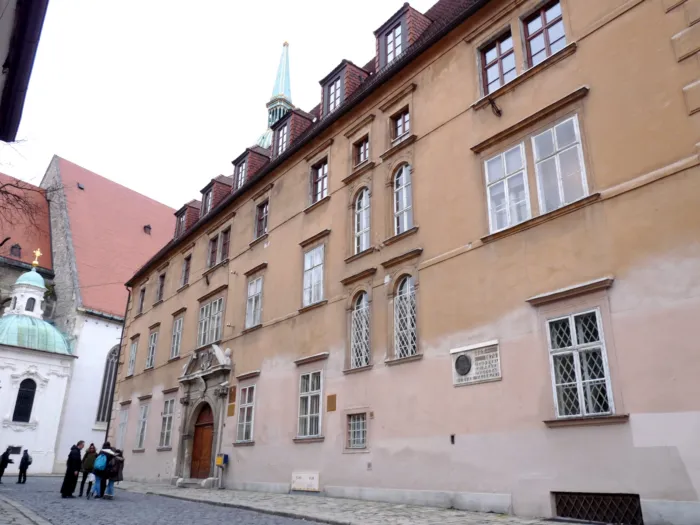
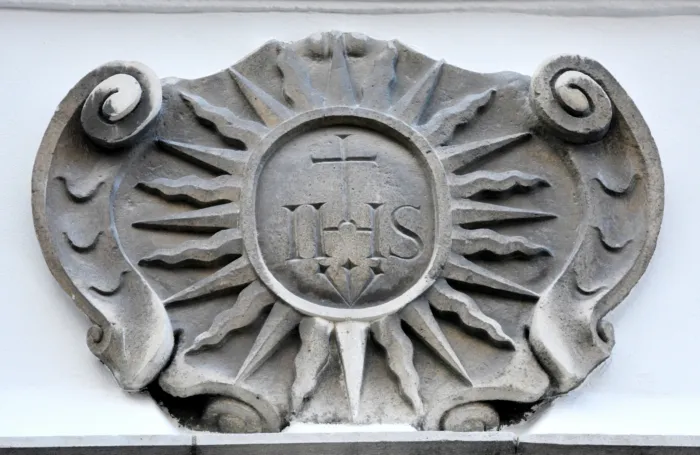
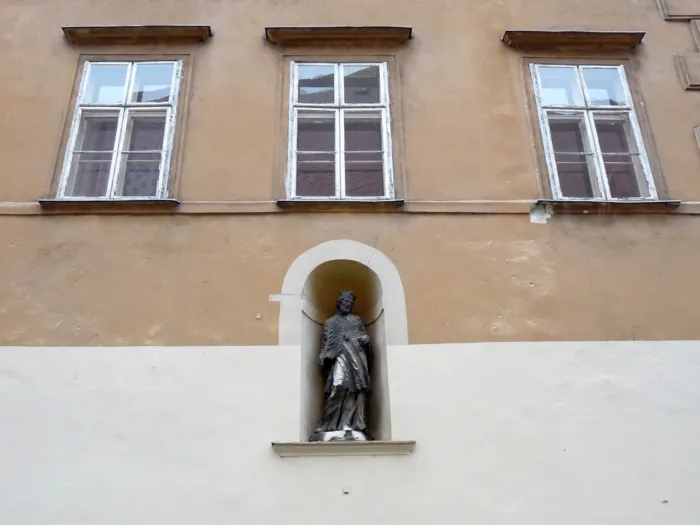
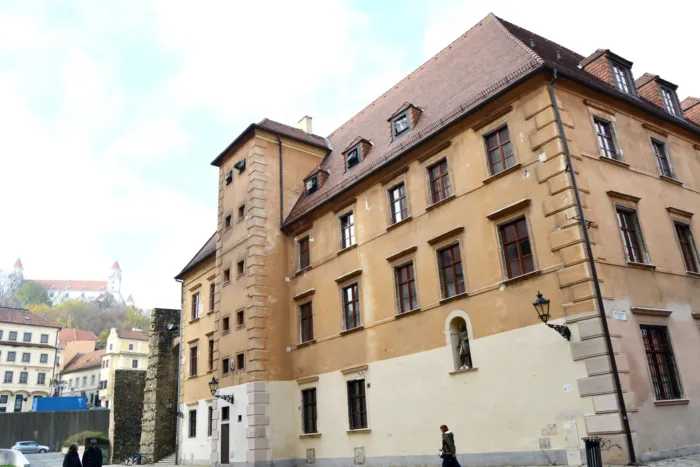
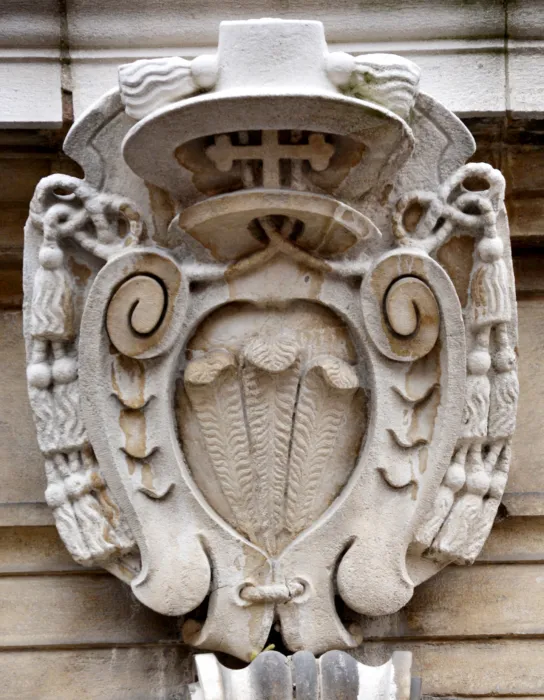
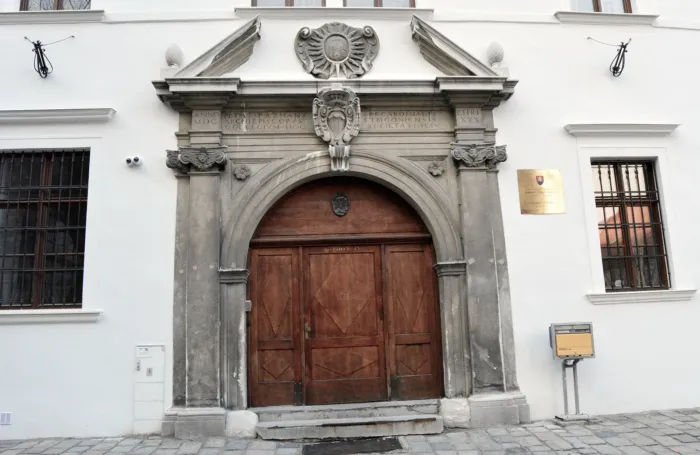
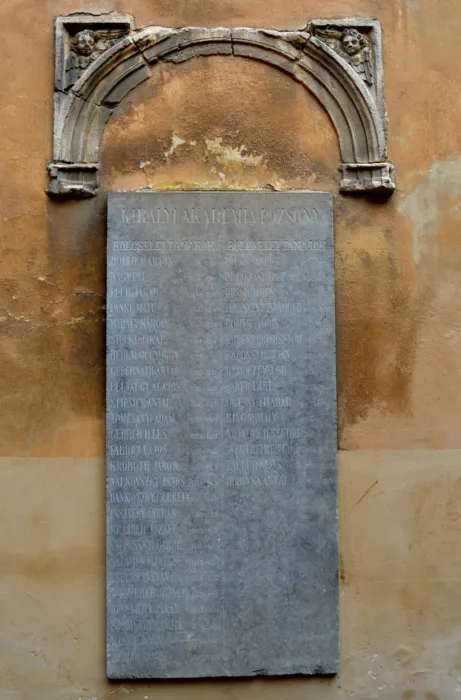
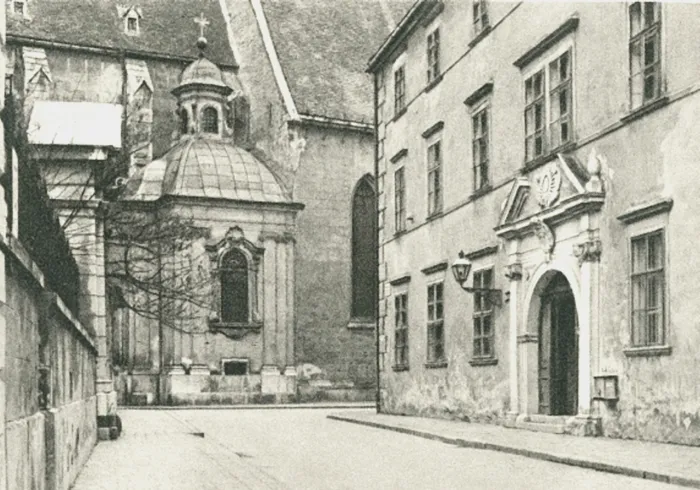
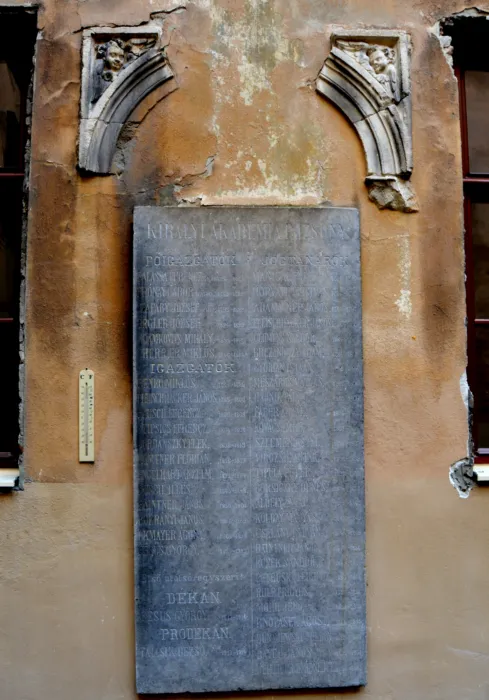
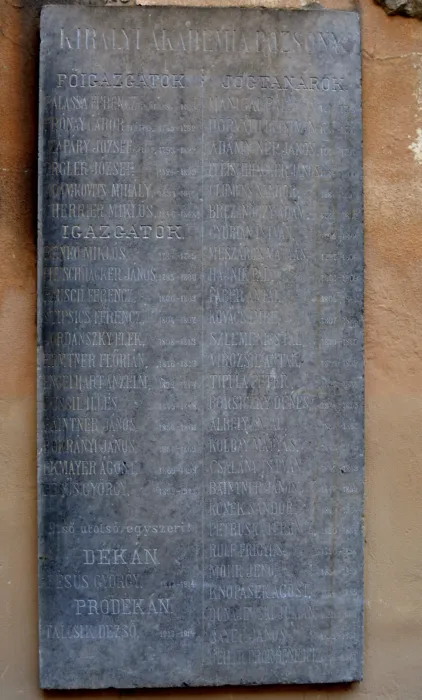
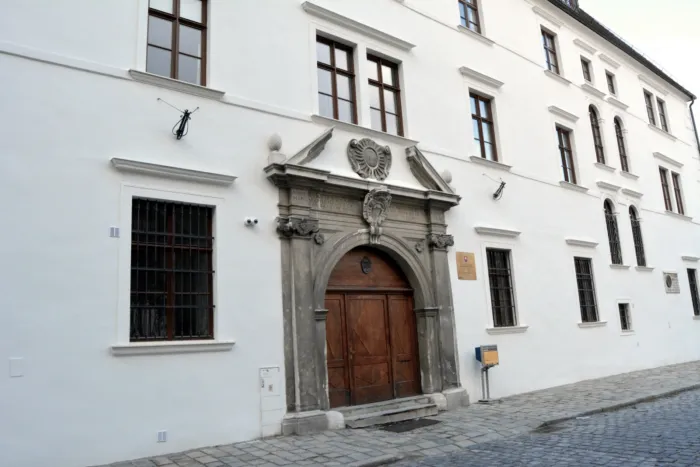
“Opposite the provost's office is the main building of the Royal Law Academy, the southern wing of which extends to the Cathedral Square. Originally, the house of the provost of Bratislava, designated Ave et Salve, stood on the site of this building, half of which served as accommodation for the elementary schoolmaster. Next to it stood the house of the chapter's canons and beyond it the church-owned house named after St. Nicholas. Primate Péter Pázmány acquired these houses from the provost and the chapter for the Jesuit college he was to establish, in such a way that in the event that the college was dissolved, the Ave et Salve house would revert to the provost and the canons' house to the canons. On 11 September 1626, Péter Pázmány founded the Jesuit college of Bratislava with 50 thousand Rhenish forints, and signed it on 13 December of this year. the founding charter, on July 10, 1628, King Ferdinand II confirmed the foundation of Pázmány, and on June 13, 1629, the Jesuit Order General, elevated the Bratislava Jesuit residence to the rank of a collegium. On August 10, 1637, Ferdinand III also confirmed Pázmány's foundation. The foundation stone for the new building was laid by Pázmány on April 17, 1628 (it was built according to the plans of J. Rava). During the year 1629, the eastern wing of the building, or Káptalan Street, was completely completed and the Jesuits moved into it in 1631. In 1633, the southern wing, or the wing facing the cathedral, was completed, and finally in 1635, the wing facing the city wall (a later inscription on the main gate of the building only shows the year in large letters). indicates as follows: Anno Christi MDCXXX Petrus Pazmany S. R. E. Cardinalis Archiepiscopus Strigoniensis Collegium hoc Societati Jesu. The Jesuit gymnasium was also located in this building from 1627 to February 1714. At that time, it moved together with the college to the Behaim-like house on Városház-utca. ; Pázmány sent the scholar and enthusiastic György Káldi, the famous Hungarian translator of the Bible, to Bratislava to supervise the construction. He became the first rector of the house from July 22, 1629 to 1634, when he became the Hungarian preacher of the college and gymnasium. In this house, he published two volumes of his sermons in the printing house of the Jesuit college in 1631 (in the August issue of the Bratislava KiáIlitási Ujság, edited and published by Fabricius Otto, It is said that the Jesuit Káldi "made the first complete Hungarian translation of the entire Bible in Bratislava", which is not true, because the translation found in manuscript in the library of the University of Budapest was made as early as 1606, and with the permission of the church authorities it was printed in Vienna as early as 1626, while Káldi only came to Bratislava in 1629 to supervise the construction of the collegium.). He died there on 30 October 1634 of cholera. ; Where today the office of the R. Catholic Church is located in the building, there was once a pharmacy of the Jesuits and it remained there until November 1833, which is confirmed by the inscription on the door to the left in the doorway from 1834 (VetVs S. I. aesCVLaplon In praelatVraM orDln : S. Ben. ConVertebatVr. (= 1834.). In 1713, during the rectorship of András Madecsányi, the collegium moved from this building to the new collegium on Batthyány Square in the last days of October, and the second half of the 1713/14 school year opened there on February 22. Only a few Jesuits remained in the house on Káptalanútca due to the functions they had to perform in the cathedral. The building itself was given the rank of a residentia, which was incorporated into the collegium. Its residents remained subordinate to the collegium. In 1747, two new members were settled in the residence as auditors (librorum revisores). In 1751, the provincial governor appointed two councilors (consulatores). In 1773, the building became the property of the religious foundation. On October 3 of that year, the movable and immovable assets of the collegium were seized. The assets of the educational foundation increased by ¼ million forints from the Bratislava collegium alone. In 1775, the newly organized city elementary school (schola germanica trivialis ad gradus ecclesiae S. Martini) moved into the upper rooms of the part facing the cathedral with its teacher. The Salvator pharmacy remained in the ground floor rooms facing the cathedral. In 1780, the auditing office moved in. In 1812, the Benedictines took over the building. After their departure, it became the property of the academy in 1850. György Fésüs placed an ornate memorial plaque on the building. ; During the time that the Jesuits lived in this building, a lively and eventful life took place in it. The Jesuit gymnasium there was visited by many young people. It also had a theater room equipped for theatrical performances. The theatrical performances that were usually performed here were attended by notable individuals: Péter Pázmány, Pál Pálffy of the m. chamber president, in 1634 the widow of Gábor Bethlen: Catherine of Brandenburg, in 1635 Palatine Mliklós Esterházy. But on other occasions, the Jesuit house almost always had many distinguished guests. Such were Péter Pázmány, Kollonich, Szelepcsényi, Gáspár Ampringen, the presidents and councilors of the m. chamber, almost everyday guests of the collegium. In 1690, gr. János Pálffy, Kristóf Erdődy, chamber president, etc. ; After the abolition of the collegium, the law academy moved to this building later in 1858, which was moved from Nagyszombat to Bratislava in 1784 and was located in the building of the Poor Clares from May 14, 1784. The academy initially consisted of two faculties: law and humanities. Until 1850, it was based on the study system established by the Ratio Educationis. On September 29, 1850, it received its second study organization based on the Entwurf der Organisation. The academy's philosophical cursus was discontinued and merged with the gymnasium. The academy remained purely legal and received the title "Imperial Royal Academy of Law". An official decision dated September 25, 1855, supplemented the institute on October 2, extending its study period to 3 years and permanently abolishing the freedom of teaching and learning. It became a civil service training institute. On May 19, 1874, it became a faculty of law and political science with a four-year course. By decrees of January 6 and 27, 1875, a separate liberal arts course was established at the Royal Academy in Bratislava and It has been organized in such a way that all those who study the humanities subjects closely connected to the aforementioned course during the required period of time in the capacity of regular students and for the number of hours established by the regulations for university humanities students enjoy the rights granted to university-graduated humanities students and are admitted to the relevant examinations. As for those who also wish to obtain secondary school teacher training, in accordance with the measures of Act XXX of 1883 and the decree of the Royal Hungarian Ministry of Public Education dated August 10, 1883, in the professions for which departments are organized with this course, namely Hungarian, classical and German linguistics and history, the years spent here are fully credited towards the secondary school teacher examination. And if finally in 1883-84. From the academic year 1901-1902, lectures on education and the history of education were also ordered, and teacher candidates could also complete the pedagogical studies required for the secondary school teacher examination in this course. Despite all this, however, this course only had philosophy students until 1882, because its originally planned organization remained unfinished. The total number of teachers working at the academy, apart from the director, is 10, of which 7 are law and 3 are humanities teachers. In addition to these, there are 3 lecturers for forensic psychiatry, forensic medicine and public health administration. The average number of students is 250-300 (in 1901-2, 234 regular and 14 extraordinary students were enrolled, in 1902-3, 258 regular and 9 extraordinary students were enrolled, in 1903-4, 302 regular and 18 extraordinary students were enrolled.). ; In the seven rooms The institute library housed at the end of 1903 contained 22,106 volumes worth 109,555 crowns. It mainly contained theological, legal and historical works. There has also been a Lawyers' Aid Association at the institute for 39 years, which carries out a blessing-bringing work among the poor academic citizens. The number of those who were able to complete their studies only with the support of this association is well over half a thousand. The share capital of the Association in 1903-4 was 50,810 crowns, which is under the official custody of the board of the royal academy. The association also has a library of 282 volumes. ; In 1915 it was attached to the law faculty of the newly established Royal Hungarian St. Elizabeth University. ; Currently, the building is the seat of the Cyril and Methodius Catholic Faculty of Theology.