
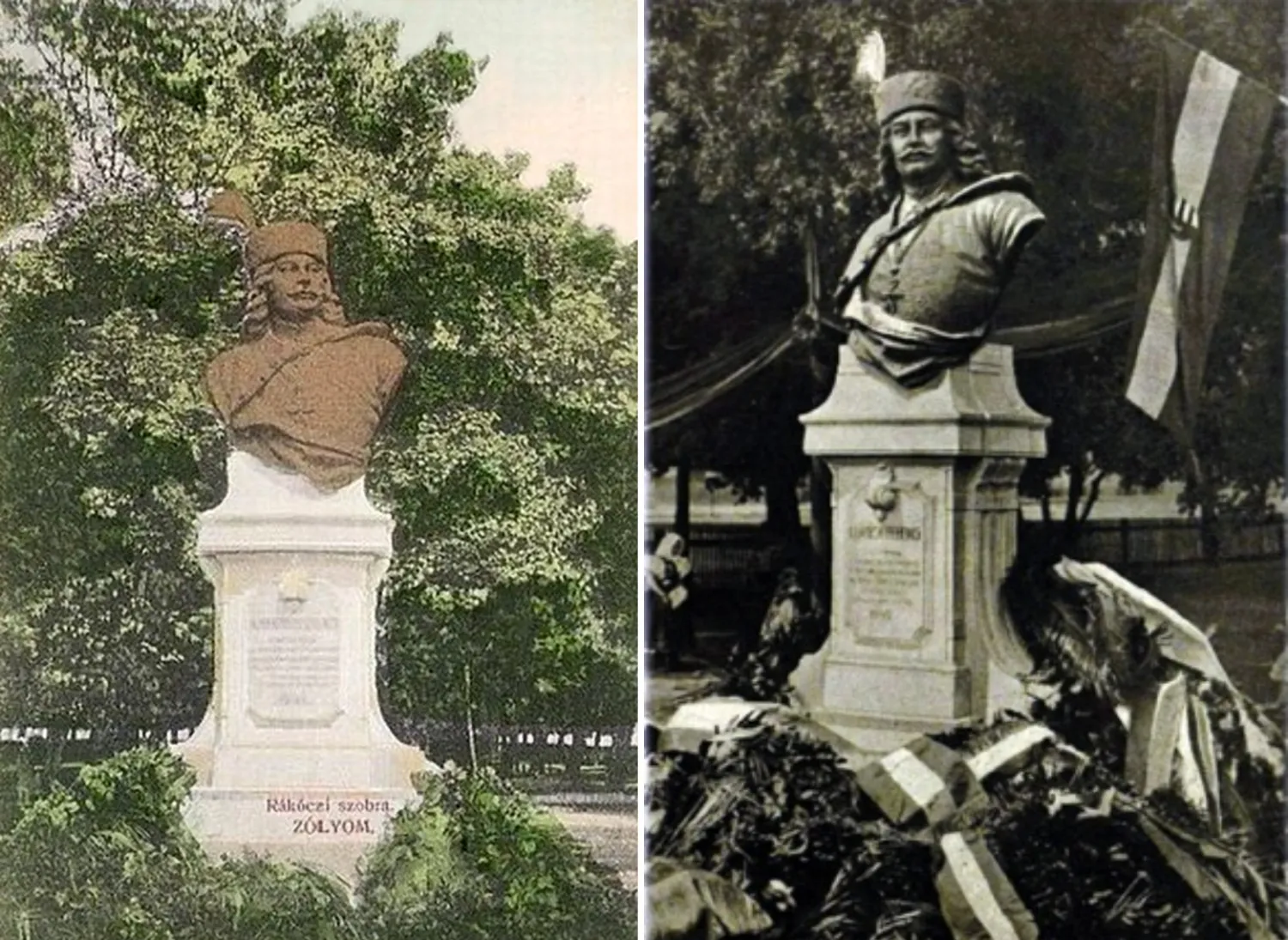
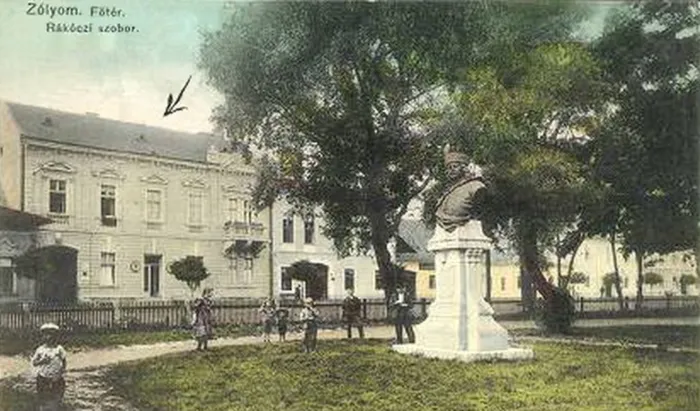
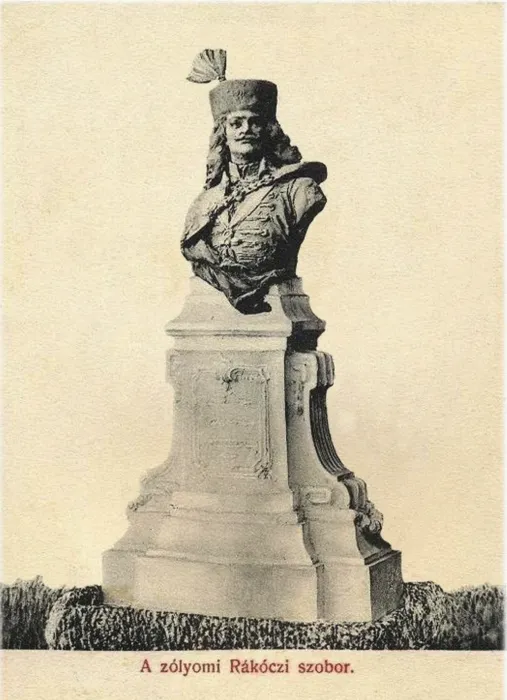
Bust of Ferenc II Rákóczi
Statue, monument, memorial plaque
The Rákóczi statue that can be seen today in Borsi originally adorned the main square of Zólyom. It was placed in a metal case on its base, with the story of the statue's creation written on 4 sheets of parchment. ; The remains of the prince and his fellow exiles were brought to Košice in 1906. The contemporary record reads: "The Hungarian locomotive drivers, who drove the train carrying the glorious ashes and thus participated in the ceremony, were able to directly observe the touching manifestations of true piety. They saw the lighting of the bonfires on the Hungarian pylons, they saw the sparkle of tears of joy in the eyes and they heard the prayers that went up to the God of the Hungarians. The Hungarian heart beats in the hearts of the Hungarian locomotive drivers and when, at the end of the ceremonies, they told their comrades what they had seen and heard, the idea for the statue was born." ; Sándor Mihajlovits, the head of the Rókus boiler house in Szeged, and György Schemmel, the locomotive driver, initiated the erection of the statue, stating that it would be implemented by the Hungarian locomotive drivers' association. Tivadar Petheő, the president of the National Association of Locomotive Drivers under the Hungarian Holy Crown, after consulting a narrower circle, presented the matter to the federal committee meeting in December 1906, which was unanimously accepted. ; The subject of debate was where the statue should stand. Chief engineer Dávid Havas, the boiler house manager, argued that it should stand in a city in the Highlands to which the prince is linked by historical traditions, but where many locomotive drivers are also stationed. Thus, Zólyom was chosen. ; Havas and chief locomotive driver Pál Szenes were entrusted with contacting the city administration of Zólyom. After the city's favorable response, Mayer Ede (1857-1908), an academic sculptor, visited the site and immediately began to model the statue. He undertook this completely free of charge. ; The model was presented on February 12, 1907. The sculptors György Zala and Ede Telcs, members of the jury, declared it to be of high quality and granted permission for the casting. Thus, the Association only bore the casting cost of 3,500 crowns. ; Mayer Ede is the creator of some of the statues and reliefs of the St. Stephen's Basilica in Budapest, and some of the statues of the National Theater building in Košice are also his work. ; The statue was unveiled on June 2, 1907, during a multi-day celebration. The ceremony was attended by the government, parliament, members of the Hungarian railway administrations, and numerous foreign and domestic locomotive drivers. ; The special train departed from Keleti Railway Station at 10:00 on June 1. It arrived in Zvolen at 3:00 in the afternoon. After the ceremonial welcome and accommodation, a get-to-know-you evening was held at 7:00 in the evening. At 10:00 p.m., a musical closing ceremony closed the first day. The next day, at 10:00 a.m., a ceremonial general meeting was held in the grand hall of the city hall, and an hour later, they marched to the statue. The statue of the prince was unveiled at 11:30 a.m. This was followed by lunch, then a trip to Szliács, to the spa. The day ended with a social dinner and dance party, which lasted until three in the morning. Then the train left for Keleti, where it happily arrived at 8:00 in the morning. The foreign guests were given lunch at 1 p.m. and a meeting was held with them at 5 p.m. On the last day, June 4, the foreign comrades were shown the sights of the capital and the series of events ended with dinner - the contemporary records state. ; Géza Balassa (1914-1994), a teacher and art historian, wrote down his notes on the further fate of the statue in June 1975: ; "After 1918, the Czechoslovak Republic was established. So everything that reminded us of the past had to be removed." ; Masaryk trees were planted in the place of the statue, which were cut down by young people from Zvolen. They were convicted of damaging the statue. Lawyer Sándor Bothár, a colleague of Oszkár Petrogalli, argued in vain in court that the trees could not be classified as statues. ; In 1921, Petrogalli wrote his article "Destroyed Monuments". Let us quote from it: ; "The pyramids, pyramids and sphinxes of Egypt have been evidence for thousands of years of the greatness of vanished eras and peoples, and no one has ever proposed their demolition, on the grounds that they were built by the pharaohs and that they were built by a people living in a barbaric, enslaved state. (...) They defended every fact of the great French Revolution. They could find excuses and explanations for the regicide, the mass massacres. For the fratricidal wars that destroyed the flower of the French nation's ornament. But they could not find any excuse to justify the fact that the people, with the benevolent connivance and silent consent of the authorities, destroyed the beautiful equestrian statue of Louis XIV. They could only give an explanation for it. They explained it by saying that by then the people had already stripped themselves of all noble feelings, had lost their calm, sober thinking, and no longer had a sense for the beautiful and useful. And although they were the masters of France whose their spiritual world was the same, or those who raised the people to be like that for their political goals, they could not yet have the moral courage to confront the people when they act in the spirit of their teachings. ; We sadly see that a different view is now beginning to prevail here. The newspapers close to the official power bring news of the toppling of statues with joy and satisfaction, one after another, more and more frequently. ; Irresponsible people, who modestly withdraw from the public, also destroyed the millennium statue in Dévény. Soon after, the Zoborhegy monument was sent to the same fate. The statues of the soldiers in Košice and Levoča were destroyed long ago by unofficial elements. The statues of Bethlen, Rákóczi, and Kossuth were removed with official assistance. The government newspapers say that the state budget is responsible for raising the necessary money for the removal of the Hungarian monuments that are still intact. provides. We do not demand the undamaged preservation of our monuments by referring to our Hungarian glory, our national self-esteem. We know, we are used to the fact that if we refer to this, we will not receive an answer. But we demand this in the name of culture, human self-esteem, we demand it based on the democratic slogan of the republic. If the Protestants can tolerate the statues and altars proclaiming the truths of the Catholic religion remaining in their churches, if the Rome of the popes preserved and protected the works of art of pagan Rome from destruction, if the liberated Spaniards did not destroy the monuments of the expelled Moors, then the Czechoslovak Republic should also have the moral strength to maintain and preserve the monuments, even if they proclaim that this land once belonged to Hungary. The past cannot be erased by removing the monuments proclaiming its glory, much less "The future can be built on the demolished ruins of the memories of the past." ; Géza Balassa was commissioned to establish a museum in Zólyom in 1943, where he worked as a teacher. The museum opened the following year. It was then that he completely unexpectedly found the Rákóczi statue in the farm building in the courtyard of the town hall, wrapped in hay under the stairs. A city farmer had hidden it. He then hid it in the chapel of the Zólyom castle, so that its material would not be used to make a current political statue. ; The statue was safe in the Zólyom castle for a while, because its renovation took place under the leadership of Géza Balassa. He remembers that in 1967 it was transported to Fülek because the high school wanted to take the prince's name. He consulted with teacher Zoltán Molnár about the transfer. ; After the political system was relaxed, it was indeed exhibited in the courtyard of the Fülek museum, but after the Soviet invasion, the statue had to go into hiding again. It was then that Géza Balassa learned that Borsi was looking for a statue. Géza Balassa offered it, then had it delivered to Borsi, and on May 31, 1969, the statue was solemnly inaugurated again.