
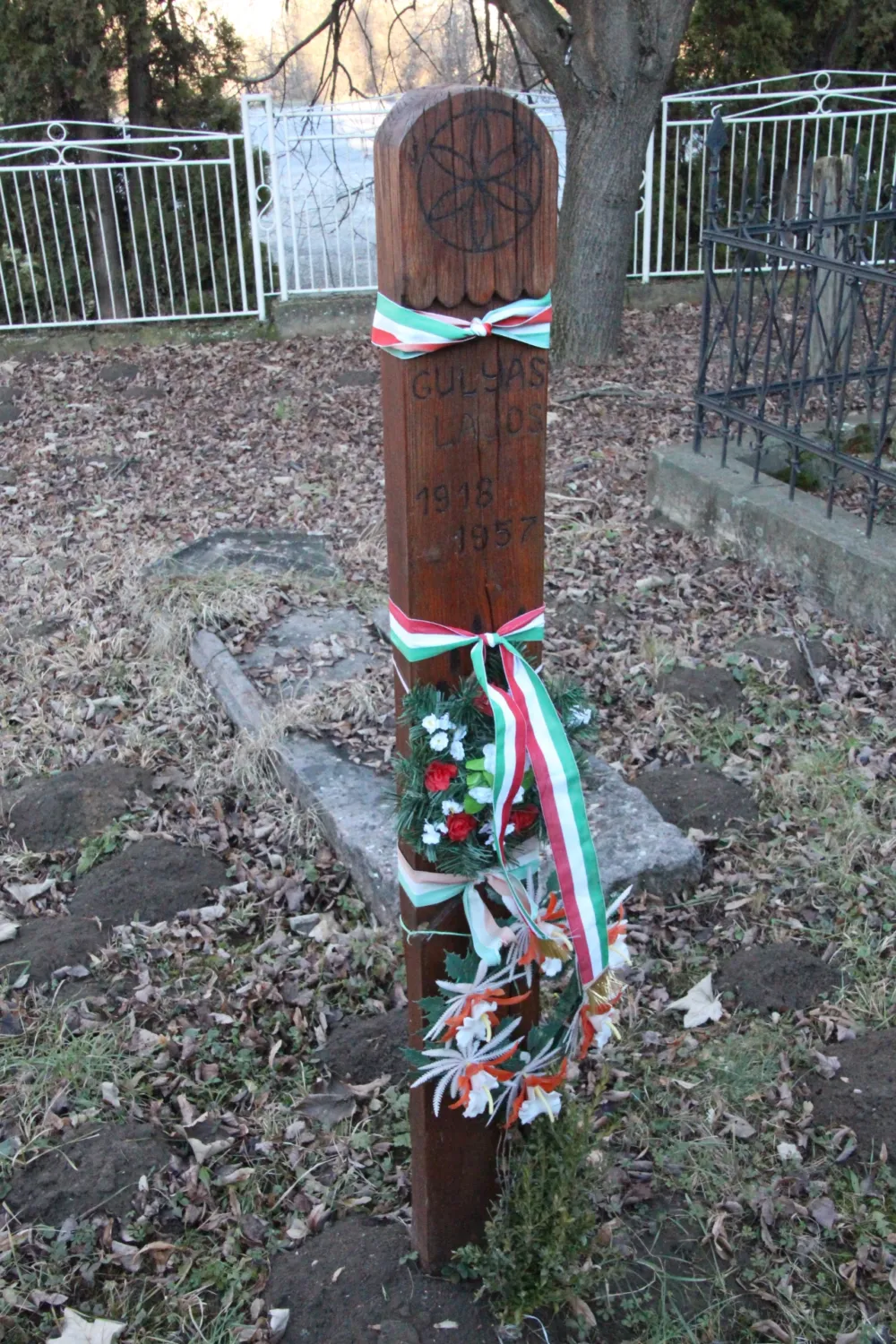
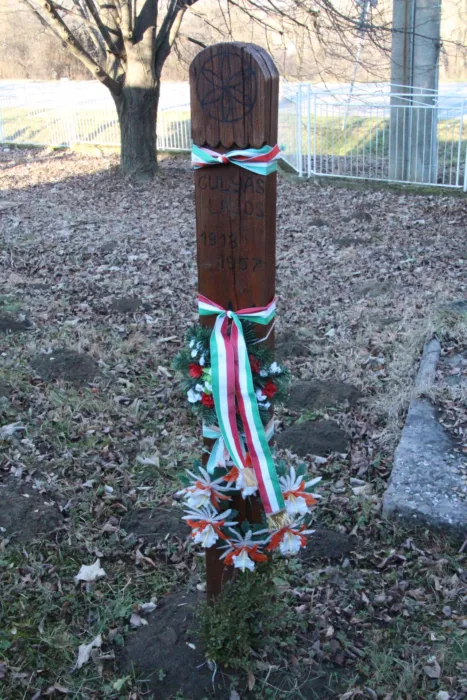
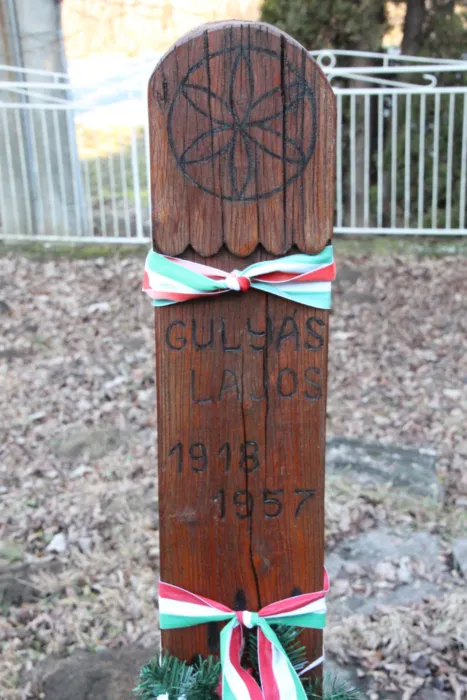
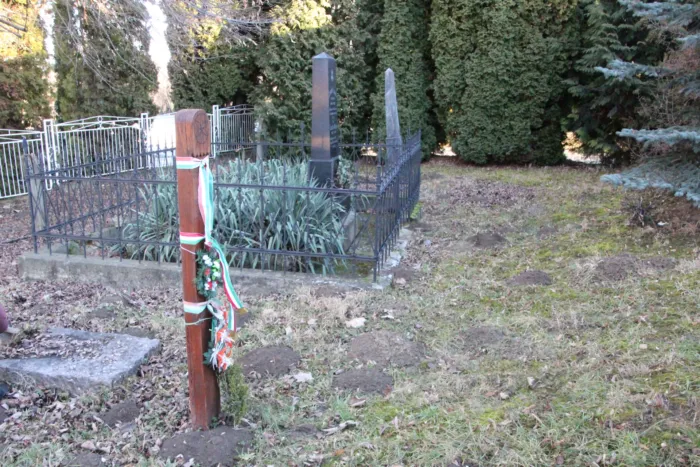
Headstone erected in memory of the Reformed pastor Lajos Gulyás
Statue, monument, memorial plaque
Lajos Gulyás (Kisújfalu, February 14, 1918 – Győr, December 31, 1957) was a Calvinist pastor. He was sentenced to death and executed for his participation in the 1956 revolution, the only pastor of the Hungarian Calvinist clergy executed in connection with 1956. ; He was born on February 4, 1918, the second child of Lajos Gulyás and Erzsébet Kovács. His father owned 25 acres of land, was the judge of the village in Hungarian times, and as a strong Calvinist family they participated in the life of the church and the village. After completing the local elementary schools, he studied at the Érsekújvár Real Gymnasium, where he graduated in 1937. After graduating from the Ársekújvár high school, he began his studies at the Losonc theology school, and after its closure, he continued his theology in Pápán, from where, strengthened in faith, soul, sciences, and patriotic feelings, he embarked on his pastoral career. ; He began his ministry in Felsőgellér, then continued it in Balatonszepezd, and from 1948 he was the pastor of the village of Lévél. His wife, Gabriella Puskás, worked as a teacher at the local school. They had three daughters. ; He also got involved in political life at an early age. Due to his nature and personality – in addition to his pastoral ministry – seeing the challenges of his time – he was full of will to do, and his sense of justice did not allow him to not speak out when necessary. He was a member of parliament for the Small Farmers Party. He also had the courage to speak out during the Arrow Cross rule, for which he suffered imprisonment, but he was also dragged away several times during the Rákosi era. ; On October 22–23, 1956, Lajos Gulyás was in Kisújfalu when he heard about the events in Hungary on the radio – he tells his family: that’s where I belong – he immediately packs up and travels back to Levél. ; On October 26, 1956, in Mosonmagyaróvár, a crowd of students, workers and intellectuals marches in front of the local border guard barracks with national flags demanding the departure of the Russians and an independent Hungary. It is 12 noon. “Be steadfastly loyal to your homeland, oh Hungarian”, they sing, when volleys of gunfire erupt. More than a hundred dead and more than 200 wounded remain on the ground. Lajos Gulyás hears about this at two in the afternoon, gets on his bicycle and goes to Óvár. By the time he gets there, a huge crowd has gathered, wanting to storm the barracks. He warns them against it, fearing a continuation of the bloodbath, and trusting that the police will be able to control the situation. Soon the soldiers and national guards from Győr arrive and occupy his barracks. When they lead the captured officers out, they cannot carry out the arrest because of the enraged crowd, so the officers are lynched by the crowd. In this situation, taking a huge risk, but exercising his calling as a pastor, he tries to stop the people: Don't hit! - he shouts - don't become murderers too! One of the officers from the ÁVÓS is miraculously saved. This provided the basis for the fact that in 1957 three completely innocent intellectuals were accused of incitement and sentenced to death and executed. In a closed hearing on December 21, 1957, the appeals court acquitted him of the charge of inciting murder, but not of the charge of leading a movement aimed at overthrowing the people's democratic state order and of treason, and he was therefore sentenced to death. His request for clemency was also rejected by the President of the Republic. The sentence was carried out in the yard of the Győr prison on the dawn of New Year's Eve 1957. ; In 1989, the village population and the Calvinist parish in Kisújfalu erected a headstone in his memory in the local cemetery. On March 29, 1990, the Győr County Court declared the 1957 sentence null and void. His reburial took place in 2005, when his birthplace became the Kisújfalu Village Hall – the local government set up a memorial room for Lajos Gulyás – “who died for a just cause as a loyal son of our church and nation”.