
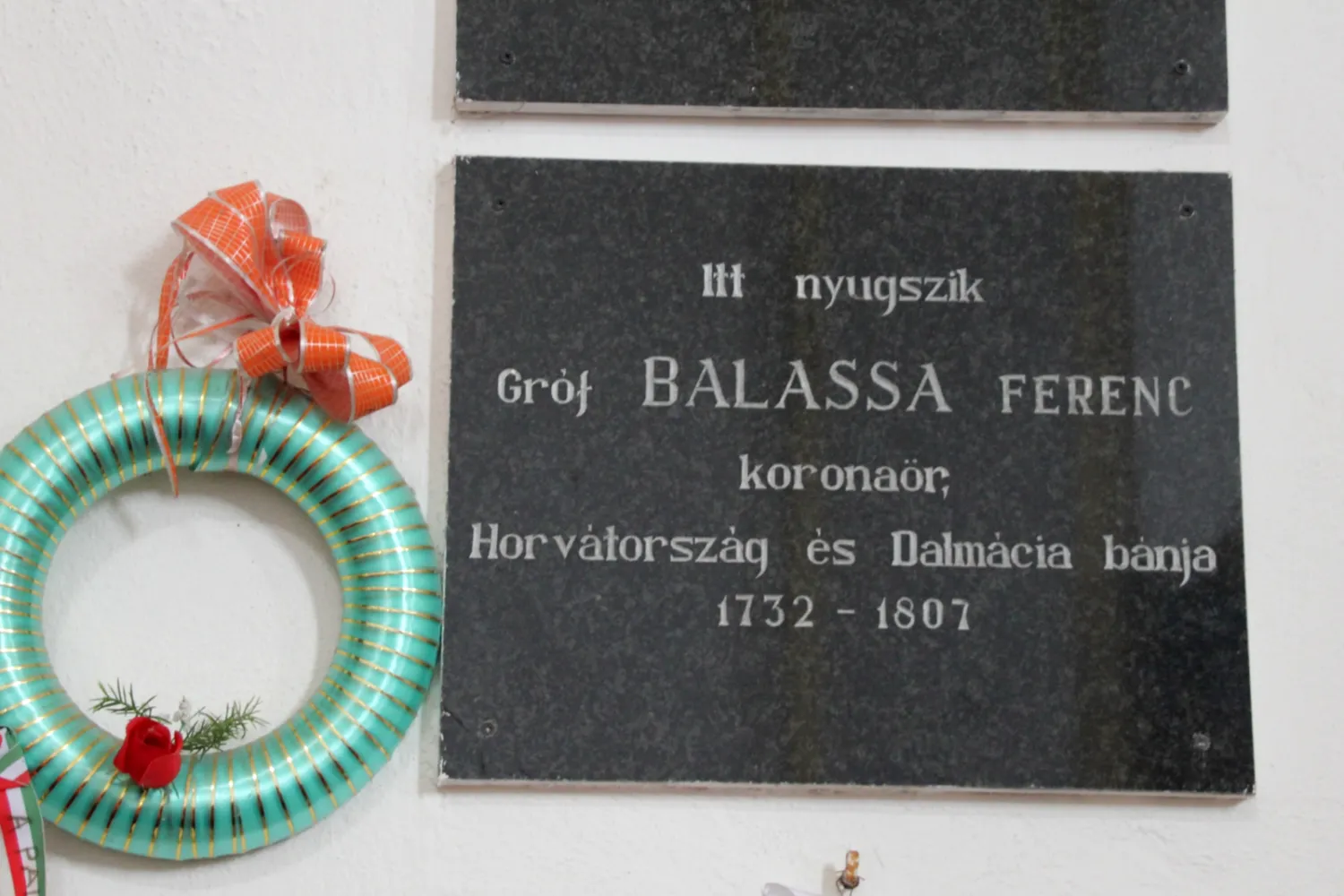
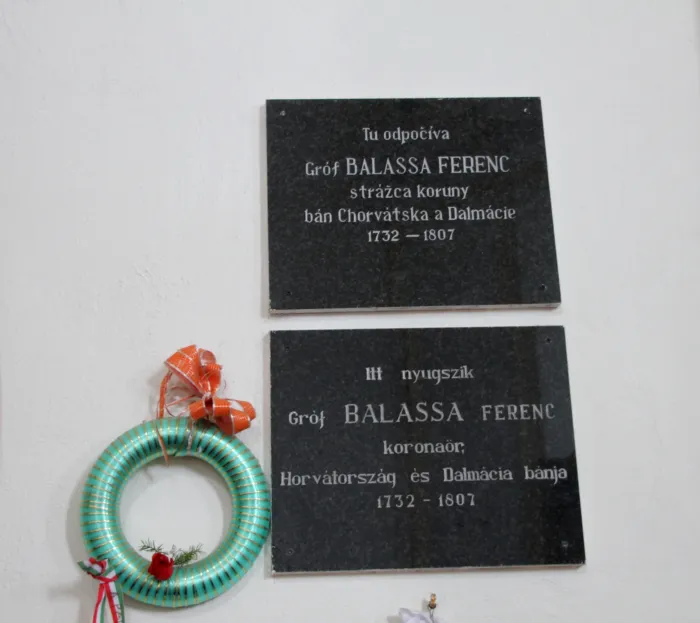
Count Ferenc Balassa memorial plaque
Statue, monument, memorial plaque
Black marble tablet with white inscription, above it a tablet in Slovak. Ferenc Balassa, who was the Croatian-Dalmatian and Slavonic ban, chamber president and crown guard of Emperor Joseph II, was laid to rest in the crypt under the altar. ; ; Count Ferenc Balassa de Paola Gábor Ferdinánd (Kékkő, April 3, 1736 – Kékkő, August 28, 1807) ; A scion of the ancient and prestigious Balassa family of common noble origin. His father was Ferenc Balassa of Kékkő, and his mother was Baron Borbála Tolvay of Köpösd. Among his ancestors is his great-grandmother from the distinguished Tóthi Lengyel family, Sándorné Balassa of Kóthi, Katalin Lengyel of Tóthi, whose parents were János Lengyel of Tóthi and Zsuzsanna Ghyczy of Ghyczi, Assa and Ablonczkürthi. He completed his schooling at the Theresianum in Vienna, then Maria Theresa employed him as an intern at the ministry, in 1756 he became a royal chamberlain and a councilor-in-chief at the governor's council, and from 1762 to 1785 he was the lord governor of Szerem County. ; In 1763 he was the health commissioner of Slavonia, in 1765 a member of the Slavonian lord's salary settlement committee, in 1769 a deputy director of the provincial committee, in 1782 its director-general. ; On October 16, 1772 he was granted the rank of count. In 1777 he became the director-general of the schools of the Bratislava school district, in 1780 he became a Knight of the Middle Cross of the Order of Saint Stephen. ; In 1779 he was the royal commissioner of Rijeka and Charles Town. ; In 1782 he was an inner privy councilor. II. In 1783, Emperor Joseph appointed him as the president of the chamber and crown guard. In 1785–1790, he was the Croatian-Dalmatian and Slavonian ban and captain-general, owner of two regiments, chief commissioner of the Zagreb district, district commissioner of Pozsega county. As a confidant of Joseph II, he tried by all means to implement the centralizing measures, which earned him the dislike of both the Hungarian and Croatian orders. He proposed that the Academy of National Languages be established in Buda. ; With the death of Emperor Joseph, he went to Vienna and became the consiliarius of the Croatian nation, the head of the Illyrian Court Chancellery in Vienna. ; In 1792, he resigned from this position in accordance with the law, and lived as a private citizen in Vienna, later in Bratislava and on his estates. He was unmarried, and with him the count branch of the Balassa family became extinct. He was buried in Nagyzellő (Felsőzellő, today: Vel'ké Zlievce, Slovakia) in the county of Nógrád.