
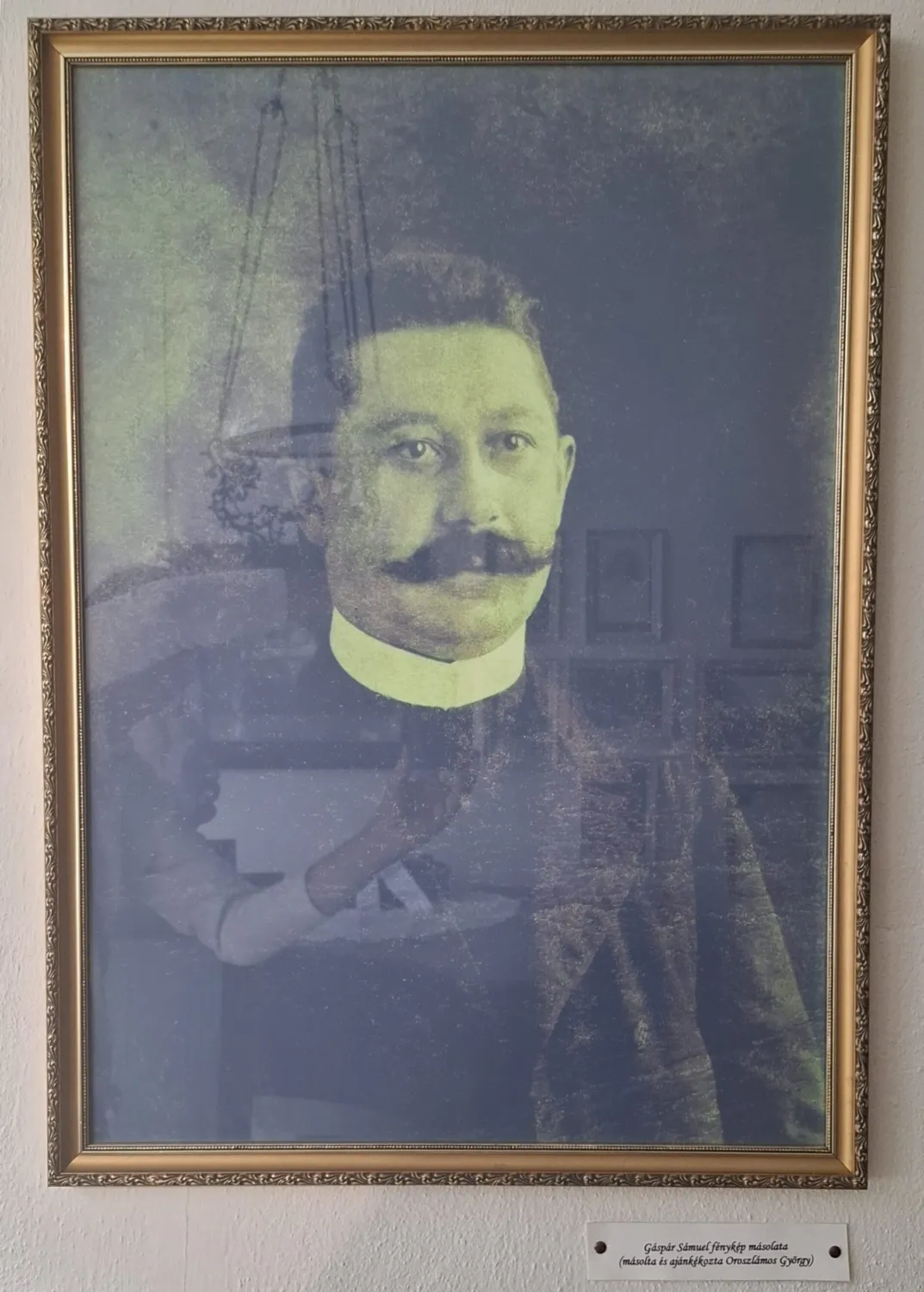
The life and work of Sámuel Gáspár
The life and work of Sámuel Gáspár
Sámuel Gáspár was born on May 10, 1848 in Csicsó. His father, József Gáspár, was the village cantor teacher, and his mother, Zsuzsanna Hegedűs. His family raised him in a patriotic spirit, as his father himself participated in the 1848–49 War of Independence.
He completed elementary school in his native village, then continued his studies at the famous Pápai Reformed College. At that time, the Pápai College was the only institution in the parish where students were prepared for the matriculation examination. Sámuel Gáspár was able to learn from such excellent teachers as historian István Bocsor, naturalist Lajos Tarczy, and philosopher Károly Kerkapoly. During his student years, he became involved in the work of the Educational Society and in youth movements organized against Austrian oppression. The patriotic education he received there influenced his entire life.
After completing his studies, he first worked as an assistant teacher, then as a cantor teacher in his native village. He married Juszti Bödők from Csicsó, with whom he had two children: József and Amália. In his teaching work, he placed great emphasis on education with a Hungarian national spirit. His main goal was to teach the Hungarian language, history and geography with national content.
In addition to his educational and public activities, he also did a lot for the development of the village. He participated in the work of the Industrial Protection Associations supporting domestic industry, and encouraged local farmers to introduce modern agricultural methods and machines. After the Compromise of 1867, he strongly advocated the construction of a flood protection system, and even turned to the Hungarian government for this.
He often spoke out against unconstitutional illegalities at county assemblies and stood up for the protection of the constitution. Due to his open actions, he came into conflict with compromising political circles on several occasions. After his heated exchanges, he was not only threatened, but also sued for treason.
The life and work of Sámuel Gáspár are a good example of how it was possible to serve the cause of the Hungarian nation as a teacher, a public figure and a patriot at the same time in the second half of the 19th century.